{"title":"Zeolite composite prepared by quasi-in situ interzeolite conversion approach","authors":"Ruizhe Zhang, Bo Wang, Jiani Xu, Honghai Liu, Hongjuan Zhao, Jiujiang Wang, Shutao Xu, Shunsuke Asahina, Francesco Dalena, Camille Longue, Benoît Louis, Ludovic Pinard, Simona Moldovan, Zhengxing Qin, Xionghou Gao, Svetlana Mintova","doi":"10.1016/j.checat.2025.101298","DOIUrl":null,"url":null,"abstract":"The design of zeolites with optimized textural properties is a continuous goal. Here, we report a composite comprising mesoporous ultra-stable zeolite Y (USY) and nanosized Zeolite Socony Mobil-5 (ZSM-5) with enhanced acid site accessibility and pore connectivity through quasi-<em>in situ</em> interzeolite conversion in a solvent-free medium. The preparation of the composite begins with a spatial and elemental-biased dissolution of USY with impregnated tetrapropylammonium hydroxide (TPAOH). This results in a hierarchical zeolite with increased mesopore volume and improved pore connectivity. Simultaneously, the solute provides all the necessary nutrients for the growth of ZSM-5 zeolite. Due to the constrained mass transfer during the quasi-solid-state dissolution, the resulting ZSM-5 crystals are as small as 10 nm and intimately connected with the USY zeolite. The advantageous synergy between zeolites Y and ZSM-5 in the composite was demonstrated through the methanol-to-olefin reaction and the cracking of n-hexane.","PeriodicalId":53121,"journal":{"name":"Chem Catalysis","volume":"85 2 1","pages":""},"PeriodicalIF":11.6000,"publicationDate":"2025-03-04","publicationTypes":"Journal Article","fieldsOfStudy":null,"isOpenAccess":false,"openAccessPdf":"","citationCount":"0","resultStr":null,"platform":"Semanticscholar","paperid":null,"PeriodicalName":"Chem Catalysis","FirstCategoryId":"1085","ListUrlMain":"https://doi.org/10.1016/j.checat.2025.101298","RegionNum":0,"RegionCategory":null,"ArticlePicture":[],"TitleCN":null,"AbstractTextCN":null,"PMCID":null,"EPubDate":"","PubModel":"","JCR":"Q1","JCRName":"CHEMISTRY, PHYSICAL","Score":null,"Total":0}
引用次数: 0
Abstract
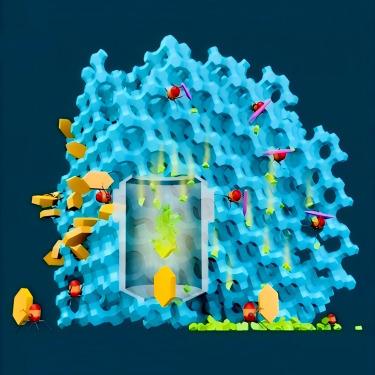
The design of zeolites with optimized textural properties is a continuous goal. Here, we report a composite comprising mesoporous ultra-stable zeolite Y (USY) and nanosized Zeolite Socony Mobil-5 (ZSM-5) with enhanced acid site accessibility and pore connectivity through quasi-in situ interzeolite conversion in a solvent-free medium. The preparation of the composite begins with a spatial and elemental-biased dissolution of USY with impregnated tetrapropylammonium hydroxide (TPAOH). This results in a hierarchical zeolite with increased mesopore volume and improved pore connectivity. Simultaneously, the solute provides all the necessary nutrients for the growth of ZSM-5 zeolite. Due to the constrained mass transfer during the quasi-solid-state dissolution, the resulting ZSM-5 crystals are as small as 10 nm and intimately connected with the USY zeolite. The advantageous synergy between zeolites Y and ZSM-5 in the composite was demonstrated through the methanol-to-olefin reaction and the cracking of n-hexane.
期刊介绍:
Chem Catalysis is a monthly journal that publishes innovative research on fundamental and applied catalysis, providing a platform for researchers across chemistry, chemical engineering, and related fields. It serves as a premier resource for scientists and engineers in academia and industry, covering heterogeneous, homogeneous, and biocatalysis. Emphasizing transformative methods and technologies, the journal aims to advance understanding, introduce novel catalysts, and connect fundamental insights to real-world applications for societal benefit.



 京公网安备 11010802042870号
京ICP备2023020795号-1
京公网安备 11010802042870号
京ICP备2023020795号-1

 分享
分享
 求助内容:
求助内容: 应助结果提醒方式:
 扫码关注我们
