Aksu Gunay, Steven D. Targum, Alex D. Leow, Olusola Ajilore, Mark M. Rasenick
{"title":"A simple platelet biomarker is associated with symptom severity in major depressive disorder","authors":"Aksu Gunay, Steven D. Targum, Alex D. Leow, Olusola Ajilore, Mark M. Rasenick","doi":"10.1038/s41380-025-02941-1","DOIUrl":null,"url":null,"abstract":"Previous studies have shown that the heterotrimeric G protein, Gsalpha (Gsα), is ensconced predominantly in lipid rafts in acutely depressed subjects with major depressive disorder (MDD) in contrast to healthy controls, and that effective antidepressant treatment (ADT) facilitates translocation of Gsα from lipid rafts. The measurement of Gsα via prostaglandin E1 stimulation of adenylyl cyclase (PGE1 stimulation) has been proposed as a peripheral biomarker for assessing clinical status in MDD. We examined the Gsα biomarker in a new study. PGE1 stimulation was used to assess the coupling of Gsα with platelet adenylyl cyclase in depressed subjects in active treatment and healthy controls. The Quick Inventory of Depressive Symptomatology (QIDS-C16) measured thresholds of symptom severity at two study visits spaced 2 weeks apart. QIDS-C16 scores and PGE1 stimulated responses were stable between the two study visits. The QIDS-C16 was inversely correlated with PGE1 stimulated responses at each visit (rs = −0.33, rs = −0.60, respectively). MDD subjects with mild-moderate depressive symptoms (defined by QIDS-C16 ≥ 6) had significantly lower PGE1 stimulated responses than asymptomatic MDD subjects (QIDS-C16 < 6) or healthy controls (p = 0.001 and 0.002 respectively). MDD subjects with moderate depressive symptoms (QIDS-C16 ≥ 10) had the lowest PGE1 responses of all subjects (Fisher’s exact = 0.012). These results support our earlier findings that a simple, high-throughput-capable platelet assay may be a useful biomarker to assess the clinical status of depressed subjects. Larger studies are needed to evaluate the utility of this biomarker for diagnosis and treatment response.","PeriodicalId":19008,"journal":{"name":"Molecular Psychiatry","volume":"30 8","pages":"3551-3559"},"PeriodicalIF":10.1000,"publicationDate":"2025-03-04","publicationTypes":"Journal Article","fieldsOfStudy":null,"isOpenAccess":false,"openAccessPdf":"","citationCount":"0","resultStr":null,"platform":"Semanticscholar","paperid":null,"PeriodicalName":"Molecular Psychiatry","FirstCategoryId":"3","ListUrlMain":"https://www.nature.com/articles/s41380-025-02941-1","RegionNum":1,"RegionCategory":"医学","ArticlePicture":[],"TitleCN":null,"AbstractTextCN":null,"PMCID":null,"EPubDate":"","PubModel":"","JCR":"Q1","JCRName":"BIOCHEMISTRY & MOLECULAR BIOLOGY","Score":null,"Total":0}
引用次数: 0
Abstract
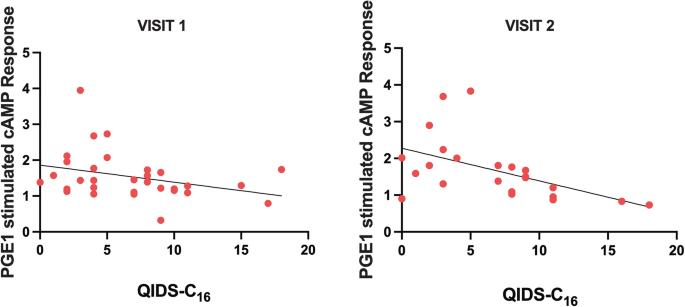
Previous studies have shown that the heterotrimeric G protein, Gsalpha (Gsα), is ensconced predominantly in lipid rafts in acutely depressed subjects with major depressive disorder (MDD) in contrast to healthy controls, and that effective antidepressant treatment (ADT) facilitates translocation of Gsα from lipid rafts. The measurement of Gsα via prostaglandin E1 stimulation of adenylyl cyclase (PGE1 stimulation) has been proposed as a peripheral biomarker for assessing clinical status in MDD. We examined the Gsα biomarker in a new study. PGE1 stimulation was used to assess the coupling of Gsα with platelet adenylyl cyclase in depressed subjects in active treatment and healthy controls. The Quick Inventory of Depressive Symptomatology (QIDS-C16) measured thresholds of symptom severity at two study visits spaced 2 weeks apart. QIDS-C16 scores and PGE1 stimulated responses were stable between the two study visits. The QIDS-C16 was inversely correlated with PGE1 stimulated responses at each visit (rs = −0.33, rs = −0.60, respectively). MDD subjects with mild-moderate depressive symptoms (defined by QIDS-C16 ≥ 6) had significantly lower PGE1 stimulated responses than asymptomatic MDD subjects (QIDS-C16 < 6) or healthy controls (p = 0.001 and 0.002 respectively). MDD subjects with moderate depressive symptoms (QIDS-C16 ≥ 10) had the lowest PGE1 responses of all subjects (Fisher’s exact = 0.012). These results support our earlier findings that a simple, high-throughput-capable platelet assay may be a useful biomarker to assess the clinical status of depressed subjects. Larger studies are needed to evaluate the utility of this biomarker for diagnosis and treatment response.
期刊介绍:
Molecular Psychiatry focuses on publishing research that aims to uncover the biological mechanisms behind psychiatric disorders and their treatment. The journal emphasizes studies that bridge pre-clinical and clinical research, covering cellular, molecular, integrative, clinical, imaging, and psychopharmacology levels.




 京公网安备 11010802042870号
京ICP备2023020795号-1
京公网安备 11010802042870号
京ICP备2023020795号-1

 分享
分享
 求助内容:
求助内容: 应助结果提醒方式:
 扫码关注我们
