{"title":"Moisture-Resistant, Expansive, and Disordered Interlayer Microenvironment-Enabled Robust Sodium Oxide Cathodes","authors":"Zhouhan Lin, Yanyi Wang, Minfeng Chen, Jianhui Zhu, Zhiyi Xie, Ming Yang, Ning Zhao, Hongwei Mi, Jizhang Chen, Chuanxin He, Dingtao Ma, Peixin Zhang","doi":"10.1021/acsnano.4c17035","DOIUrl":null,"url":null,"abstract":"Layered transition metal oxides are some of the most attractive cathode candidates for sodium-ion batteries (SIBs). The main challenge of achieving superior storage performance is to simultaneously boost the ion diffusion kinetics and restrain the undesirable OP4 phase transition upon long-term cycling. In this report, a step-by-step molecule–ion exchange approach is presented to design the high air-stability disordered Ca<sub>0.065</sub>Na<sub>0.55</sub>MnO<sub>2.05</sub> (CNMO-1) cathode functionalized with an expansive and disordered interlayer microenvironment. Theoretical and experimental investigations revealed that water mediation and ion exchange enhance ion diffusion, while Ca ions stabilize the alkali metal layer, preventing phase transition and manganese (Mn) migration during high-voltage cycling. It exhibits a high specific capacity of 135.4 mA h g<sup>–1</sup> at 0.2 A g<sup>–1</sup>. Beyond that, it can also deliver 81.3 mA h g<sup>–1</sup> at the harsh condition of 5 A g<sup>–1</sup> with a high 93.3% retention even after 2000 cycles, surpassing most previous achievements. This proposed strategy can be extended to other K<sup>+</sup>, Zn<sup>2+</sup>, and La<sup>3+</sup> cases, showing an innovative method for designing robust cathodes that enhance the performance of SIBs.","PeriodicalId":21,"journal":{"name":"ACS Nano","volume":"211 1","pages":""},"PeriodicalIF":16.0000,"publicationDate":"2025-03-03","publicationTypes":"Journal Article","fieldsOfStudy":null,"isOpenAccess":false,"openAccessPdf":"","citationCount":"0","resultStr":null,"platform":"Semanticscholar","paperid":null,"PeriodicalName":"ACS Nano","FirstCategoryId":"88","ListUrlMain":"https://doi.org/10.1021/acsnano.4c17035","RegionNum":1,"RegionCategory":"材料科学","ArticlePicture":[],"TitleCN":null,"AbstractTextCN":null,"PMCID":null,"EPubDate":"","PubModel":"","JCR":"Q1","JCRName":"CHEMISTRY, MULTIDISCIPLINARY","Score":null,"Total":0}
引用次数: 0
Abstract
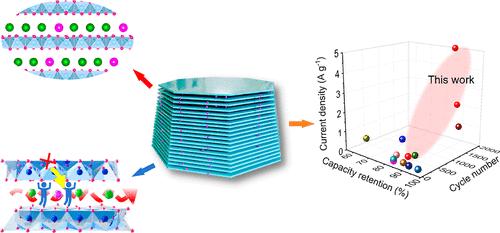
Layered transition metal oxides are some of the most attractive cathode candidates for sodium-ion batteries (SIBs). The main challenge of achieving superior storage performance is to simultaneously boost the ion diffusion kinetics and restrain the undesirable OP4 phase transition upon long-term cycling. In this report, a step-by-step molecule–ion exchange approach is presented to design the high air-stability disordered Ca0.065Na0.55MnO2.05 (CNMO-1) cathode functionalized with an expansive and disordered interlayer microenvironment. Theoretical and experimental investigations revealed that water mediation and ion exchange enhance ion diffusion, while Ca ions stabilize the alkali metal layer, preventing phase transition and manganese (Mn) migration during high-voltage cycling. It exhibits a high specific capacity of 135.4 mA h g–1 at 0.2 A g–1. Beyond that, it can also deliver 81.3 mA h g–1 at the harsh condition of 5 A g–1 with a high 93.3% retention even after 2000 cycles, surpassing most previous achievements. This proposed strategy can be extended to other K+, Zn2+, and La3+ cases, showing an innovative method for designing robust cathodes that enhance the performance of SIBs.
层状过渡金属氧化物是钠离子电池(sib)最有吸引力的阴极候选材料之一。实现优异存储性能的主要挑战是同时提高离子扩散动力学和抑制长期循环时不良的OP4相变。本文采用分子-离子交换的方法设计了具有膨胀无序层间微环境的高空气稳定性无序Ca0.065Na0.55MnO2.05 (CNMO-1)阴极。理论和实验研究表明,水的中介作用和离子交换促进了离子的扩散,而钙离子则稳定了碱金属层,阻止了高压循环过程中的相变和锰(Mn)的迁移。它在0.2 a g-1时具有135.4 mA h g-1的高比容量。除此之外,它还可以在5a g-1的恶劣条件下提供81.3 mA h - 1,即使在2000次循环后也有93.3%的保留率,超过了之前的大多数成就。该策略可以扩展到其他K+, Zn2+和La3+情况,显示了一种创新的方法来设计稳健的阴极,提高sib的性能。
期刊介绍:
ACS Nano, published monthly, serves as an international forum for comprehensive articles on nanoscience and nanotechnology research at the intersections of chemistry, biology, materials science, physics, and engineering. The journal fosters communication among scientists in these communities, facilitating collaboration, new research opportunities, and advancements through discoveries. ACS Nano covers synthesis, assembly, characterization, theory, and simulation of nanostructures, nanobiotechnology, nanofabrication, methods and tools for nanoscience and nanotechnology, and self- and directed-assembly. Alongside original research articles, it offers thorough reviews, perspectives on cutting-edge research, and discussions envisioning the future of nanoscience and nanotechnology.



 京公网安备 11010802042870号
京ICP备2023020795号-1
京公网安备 11010802042870号
京ICP备2023020795号-1

 分享
分享
 求助内容:
求助内容: 应助结果提醒方式:
 扫码关注我们
