{"title":"Bimetallic Alloy Air Cathode Promoting Superoxide Formation for High-Performance Na-Air Batteries","authors":"Wenwen Yin, Xing Zhi, Yanyan Li, Jiawei Ma, Bernt Johannessen, Fangxi Xie, Mingmei Wu","doi":"10.1002/smll.202500109","DOIUrl":null,"url":null,"abstract":"<p>Sodium superoxide is considered the preferred discharge product for sodium-air batteries (SABs) due to the reversible electrochemistry of the O<sub>2</sub>/O<sub>2</sub><sup>−</sup> redox pair and the consequent low charge overpotential. However, air cathodes of SABs based on mono-metal systems have not yet achieved optimal adsorption of the discharge products, leading to suboptimal performance of SABs. In this study, we present FeCo bimetallic alloy particles anchored on carbon nanotubes (FeCo/C) as a demonstration of a bimetal-based air cathode for SABs. Na-air batteries with FeCo/C cathode can achieve a low overpotential gap of 500 mV, a high discharge capacity of 3392.20 mAh g<sup>−1</sup>, and excellent cyclic stability over 200 cycles (800 h). Ex-situ spectroscopy confirms the successful formation of sodium superoxide as the main discharge product, establishing a clear correlation between excellent performance and discharge product composition and verifying the effectiveness of the bimetallic alloy cathode. Theoretical calculations further reveal that the bimetallic-based air cathode exhibits improved adsorption of sodium superoxide, significantly enhancing the performance of SABs. This work pioneers the use of bimetal alloy strategies to optimize discharge products in SABs, paving the way for their practical application.</p>","PeriodicalId":228,"journal":{"name":"Small","volume":"21 15","pages":""},"PeriodicalIF":12.1000,"publicationDate":"2025-03-04","publicationTypes":"Journal Article","fieldsOfStudy":null,"isOpenAccess":false,"openAccessPdf":"","citationCount":"0","resultStr":null,"platform":"Semanticscholar","paperid":null,"PeriodicalName":"Small","FirstCategoryId":"88","ListUrlMain":"https://onlinelibrary.wiley.com/doi/10.1002/smll.202500109","RegionNum":2,"RegionCategory":"材料科学","ArticlePicture":[],"TitleCN":null,"AbstractTextCN":null,"PMCID":null,"EPubDate":"","PubModel":"","JCR":"Q1","JCRName":"CHEMISTRY, MULTIDISCIPLINARY","Score":null,"Total":0}
引用次数: 0
Abstract
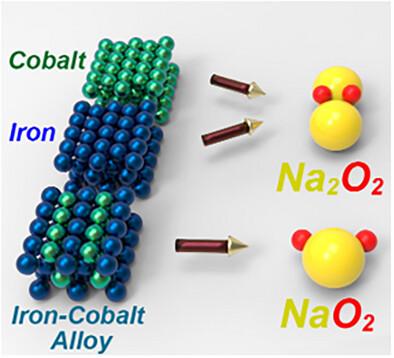
Sodium superoxide is considered the preferred discharge product for sodium-air batteries (SABs) due to the reversible electrochemistry of the O2/O2− redox pair and the consequent low charge overpotential. However, air cathodes of SABs based on mono-metal systems have not yet achieved optimal adsorption of the discharge products, leading to suboptimal performance of SABs. In this study, we present FeCo bimetallic alloy particles anchored on carbon nanotubes (FeCo/C) as a demonstration of a bimetal-based air cathode for SABs. Na-air batteries with FeCo/C cathode can achieve a low overpotential gap of 500 mV, a high discharge capacity of 3392.20 mAh g−1, and excellent cyclic stability over 200 cycles (800 h). Ex-situ spectroscopy confirms the successful formation of sodium superoxide as the main discharge product, establishing a clear correlation between excellent performance and discharge product composition and verifying the effectiveness of the bimetallic alloy cathode. Theoretical calculations further reveal that the bimetallic-based air cathode exhibits improved adsorption of sodium superoxide, significantly enhancing the performance of SABs. This work pioneers the use of bimetal alloy strategies to optimize discharge products in SABs, paving the way for their practical application.
由于O2/O2−氧化还原对的可逆电化学特性以及由此产生的低电荷过电位,超氧化钠被认为是钠-空气电池(SABs)的首选放电产物。然而,基于单金属体系的SABs空气阴极对放电产物的吸附尚未达到最佳,导致SABs性能不佳。在这项研究中,我们提出了FeCo双金属合金颗粒锚定在碳纳米管(FeCo/C)上,作为双金属基空气阴极用于SABs的演示。采用FeCo/C阴极的na -空气电池可实现500 mV的低过电位间隙,3392.20 mAh g - 1的高放电容量,200次循环(800 h)以上的优异循环稳定性。非原位光谱证实了超氧化钠作为主要放电产物的成功形成,建立了优异的性能与放电产物组成之间的明确相关性,验证了双金属合金阴极的有效性。理论计算进一步表明,双金属基空气阴极对超氧化物钠的吸附性能有所提高,显著提高了SABs的性能。这项工作开创了使用双金属合金策略来优化SABs放电产品的先河,为其实际应用铺平了道路。
期刊介绍:
Small serves as an exceptional platform for both experimental and theoretical studies in fundamental and applied interdisciplinary research at the nano- and microscale. The journal offers a compelling mix of peer-reviewed Research Articles, Reviews, Perspectives, and Comments.
With a remarkable 2022 Journal Impact Factor of 13.3 (Journal Citation Reports from Clarivate Analytics, 2023), Small remains among the top multidisciplinary journals, covering a wide range of topics at the interface of materials science, chemistry, physics, engineering, medicine, and biology.
Small's readership includes biochemists, biologists, biomedical scientists, chemists, engineers, information technologists, materials scientists, physicists, and theoreticians alike.




 京公网安备 11010802042870号
京ICP备2023020795号-1
京公网安备 11010802042870号
京ICP备2023020795号-1

 分享
分享
 求助内容:
求助内容: 应助结果提醒方式:
 扫码关注我们
