Jiaqi Huang, Xinglin Tang, Yuqi Zhou, Ting Wang, Fangzhou Zhao, Weijian Wang, Yan Meng, Wanglai Cen and Yongzhi Zhang
{"title":"Enhanced cycling stability and suppressed voltage decay of LiMn0.8Fe0.2PO4/C by Zn-gradient doping†","authors":"Jiaqi Huang, Xinglin Tang, Yuqi Zhou, Ting Wang, Fangzhou Zhao, Weijian Wang, Yan Meng, Wanglai Cen and Yongzhi Zhang","doi":"10.1039/D5TA00706B","DOIUrl":null,"url":null,"abstract":"<p >The practical application of manganese-rich lithium manganese iron phosphate, <em>i.e.</em>, LiMn<small><sub>0.8</sub></small>Fe<small><sub>0.2</sub></small>PO<small><sub>4</sub></small>, is limited by poor cycling stability and severe voltage decay. In this study, a novel and facile Zn-gradient doping strategy has been employed to enhance the structural stability and lithium-ion de-intercalation kinetics, thereby suppressing the voltage decay of LiMn<small><sub>0.8</sub></small>Fe<small><sub>0.2</sub></small>PO<small><sub>4</sub></small>/C (LMFP/C). Compared to the pristine LMFP/C, the Zn-gradient doped LiMn<small><sub>0.8</sub></small>Fe<small><sub>0.2</sub></small>PO<small><sub>4</sub></small>/C (Zn-LMFP/C) exhibits significantly enhanced cycling stability with the capacity retention increasing from 64.11% to 97.47% and suppressed voltage decay with the energy retention increasing from 60.75% to 96.06% after 300 cycles at 1C. Furthermore, the reversible capacity of Zn-LMFP/C is 157.21 mA h g<small><sup>−1</sup></small> at 0.1C and 138.88 mA h g<small><sup>−1</sup></small> at 5C, much higher than those of most of the Mn-rich LMFP/C materials reported in previous literature. Cyclic voltammetry (CV) and Galvanostatic Intermittent Titration Technique (GITT) results show that the delithiation/lithiation kinetics of Zn-LMFP/C are notably enhanced. Further first-principles calculations confirm that Zn-LMFP/C possesses superior structural stability and lithium-ion diffusion kinetics. These findings underscore the effectiveness of gradient doping in improving the electrochemical stability of LMFP, providing a promising strategy to mitigate voltage decay and enhance the long-term performance of high-capacity cathode materials for lithium-ion batteries.</p>","PeriodicalId":82,"journal":{"name":"Journal of Materials Chemistry A","volume":" 15","pages":" 10550-10560"},"PeriodicalIF":9.5000,"publicationDate":"2025-03-04","publicationTypes":"Journal Article","fieldsOfStudy":null,"isOpenAccess":false,"openAccessPdf":"","citationCount":"0","resultStr":null,"platform":"Semanticscholar","paperid":null,"PeriodicalName":"Journal of Materials Chemistry A","FirstCategoryId":"88","ListUrlMain":"https://pubs.rsc.org/en/content/articlelanding/2025/ta/d5ta00706b","RegionNum":2,"RegionCategory":"材料科学","ArticlePicture":[],"TitleCN":null,"AbstractTextCN":null,"PMCID":null,"EPubDate":"","PubModel":"","JCR":"Q1","JCRName":"CHEMISTRY, PHYSICAL","Score":null,"Total":0}
引用次数: 0
Abstract
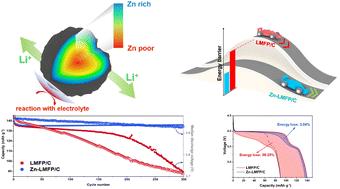
The practical application of manganese-rich lithium manganese iron phosphate, i.e., LiMn0.8Fe0.2PO4, is limited by poor cycling stability and severe voltage decay. In this study, a novel and facile Zn-gradient doping strategy has been employed to enhance the structural stability and lithium-ion de-intercalation kinetics, thereby suppressing the voltage decay of LiMn0.8Fe0.2PO4/C (LMFP/C). Compared to the pristine LMFP/C, the Zn-gradient doped LiMn0.8Fe0.2PO4/C (Zn-LMFP/C) exhibits significantly enhanced cycling stability with the capacity retention increasing from 64.11% to 97.47% and suppressed voltage decay with the energy retention increasing from 60.75% to 96.06% after 300 cycles at 1C. Furthermore, the reversible capacity of Zn-LMFP/C is 157.21 mA h g−1 at 0.1C and 138.88 mA h g−1 at 5C, much higher than those of most of the Mn-rich LMFP/C materials reported in previous literature. Cyclic voltammetry (CV) and Galvanostatic Intermittent Titration Technique (GITT) results show that the delithiation/lithiation kinetics of Zn-LMFP/C are notably enhanced. Further first-principles calculations confirm that Zn-LMFP/C possesses superior structural stability and lithium-ion diffusion kinetics. These findings underscore the effectiveness of gradient doping in improving the electrochemical stability of LMFP, providing a promising strategy to mitigate voltage decay and enhance the long-term performance of high-capacity cathode materials for lithium-ion batteries.
富锰磷酸锰铁锂(LiMn0.8Fe0.2PO4)的实际应用受到循环稳定性差和电压衰减严重的限制。在本研究中,采用了一种新颖且简便的锌梯度掺杂策略来提高结构稳定性和锂离子脱插动力学,从而抑制LiMn0.8Fe0.2PO4/C (LMFP/C)的电压衰减。与原始的LMFP/C相比,锌梯度掺杂的LiMn0.8Fe0.2PO4/C (Zn-LMFP/C)在1℃下循环300次后,其循环稳定性得到了显著增强,容量保留率从64.11%提高到97.47%,抑制了电压衰减,能量保留率从60.75%提高到96.06%,并且在0.1℃和5℃下的可逆容量分别为157.21 mAh g-1和138.88 mAh g-1。远高于珍贵文献报道的大多数富锰LMFP/C材料。循环伏安法(CV)和恒流间歇滴定法(git)结果表明,Zn-LMFP/C的锂化动力学明显增强。进一步的第一性原理计算证实,Zn-LMFP/C具有优越的结构稳定性和锂离子扩散动力学。这些发现强调了梯度掺杂在提高LMFP电化学稳定性方面的有效性,为减轻电压衰减和提高锂离子电池高容量正极材料的长期性能提供了一种有前途的策略。
期刊介绍:
The Journal of Materials Chemistry A, B & C covers a wide range of high-quality studies in the field of materials chemistry, with each section focusing on specific applications of the materials studied. Journal of Materials Chemistry A emphasizes applications in energy and sustainability, including topics such as artificial photosynthesis, batteries, and fuel cells. Journal of Materials Chemistry B focuses on applications in biology and medicine, while Journal of Materials Chemistry C covers applications in optical, magnetic, and electronic devices. Example topic areas within the scope of Journal of Materials Chemistry A include catalysis, green/sustainable materials, sensors, and water treatment, among others.




 京公网安备 11010802042870号
京ICP备2023020795号-1
京公网安备 11010802042870号
京ICP备2023020795号-1

 分享
分享
 求助内容:
求助内容: 应助结果提醒方式:
 扫码关注我们
