{"title":"Boosting Degradation of Polyethylene at Room Temperature","authors":"Yiyi Zhao, Peng Liu, Xin-Yu Meng, Yu-Long Men, Hongmin Ma, Jiafu Zou, Tingwei Wang, Yun-Xiang Pan","doi":"10.1021/acs.iecr.4c04725","DOIUrl":null,"url":null,"abstract":"Utilization of polyethylene (PE) has caused serious white pollution. Degradation of PE-based wastes has been a great concern. The traditional pyrolysis strategy for degrading PE-based wastes has problems, including operation temperature being higher than 200 °C and products being complex mixtures. Herein, PE is first degraded into CO<sub>2</sub> and H<sub>2</sub> at room temperature lower than 33 °C via a room-temperature discharge-driven degradation (RT-DD) process, with a degradation rate as high as 7.6 kg h<sup>–1</sup> m<sup>–2</sup>. Then, the CO<sub>2</sub> and H<sub>2</sub> formed from the RT-DD process are converted into CO on a molybdenum carbide-based catalyst at 450 °C, with a CO selectivity of 100%. The RT-DD process effectively breaks and thoroughly oxidizes PE chains through the generation of high-energy electrons, oxygen radicals, and other active species. Moreover, through parallel connection, RT-DD reactors can be easily assembled into a larger system with the area of the working zone reaching 1 m<sup>2</sup>. This offers a great potential for commercialization.","PeriodicalId":39,"journal":{"name":"Industrial & Engineering Chemistry Research","volume":"130 1","pages":""},"PeriodicalIF":3.9000,"publicationDate":"2025-03-04","publicationTypes":"Journal Article","fieldsOfStudy":null,"isOpenAccess":false,"openAccessPdf":"","citationCount":"0","resultStr":null,"platform":"Semanticscholar","paperid":null,"PeriodicalName":"Industrial & Engineering Chemistry Research","FirstCategoryId":"5","ListUrlMain":"https://doi.org/10.1021/acs.iecr.4c04725","RegionNum":3,"RegionCategory":"工程技术","ArticlePicture":[],"TitleCN":null,"AbstractTextCN":null,"PMCID":null,"EPubDate":"","PubModel":"","JCR":"Q2","JCRName":"ENGINEERING, CHEMICAL","Score":null,"Total":0}
引用次数: 0
Abstract
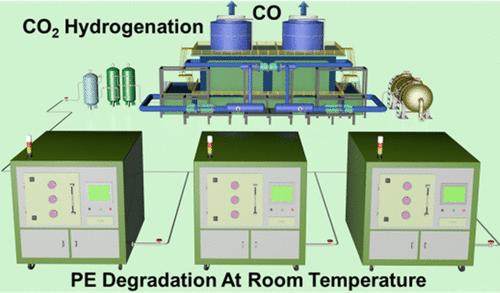
Utilization of polyethylene (PE) has caused serious white pollution. Degradation of PE-based wastes has been a great concern. The traditional pyrolysis strategy for degrading PE-based wastes has problems, including operation temperature being higher than 200 °C and products being complex mixtures. Herein, PE is first degraded into CO2 and H2 at room temperature lower than 33 °C via a room-temperature discharge-driven degradation (RT-DD) process, with a degradation rate as high as 7.6 kg h–1 m–2. Then, the CO2 and H2 formed from the RT-DD process are converted into CO on a molybdenum carbide-based catalyst at 450 °C, with a CO selectivity of 100%. The RT-DD process effectively breaks and thoroughly oxidizes PE chains through the generation of high-energy electrons, oxygen radicals, and other active species. Moreover, through parallel connection, RT-DD reactors can be easily assembled into a larger system with the area of the working zone reaching 1 m2. This offers a great potential for commercialization.
聚乙烯(PE)的利用造成了严重的白色污染。聚乙烯基废物的降解一直是人们非常关注的问题。传统热解方法降解聚乙烯基废弃物存在操作温度高于200℃、产物混合物复杂等问题。在此,PE首先在低于33℃的室温条件下通过室温放电驱动降解(RT-DD)过程降解为CO2和H2,降解率高达7.6 kg h-1 m-2。然后,将RT-DD工艺生成的CO2和H2在碳化钼基催化剂上,在450℃下转化为CO, CO选择性为100%。RT-DD过程通过产生高能电子、氧自由基和其他活性物质,有效地破坏和彻底氧化PE链。此外,通过并联,RT-DD电抗器可以很容易地组装成一个更大的系统,工作区域的面积达到1平方米。这为商业化提供了巨大的潜力。
期刊介绍:
ndustrial & Engineering Chemistry, with variations in title and format, has been published since 1909 by the American Chemical Society. Industrial & Engineering Chemistry Research is a weekly publication that reports industrial and academic research in the broad fields of applied chemistry and chemical engineering with special focus on fundamentals, processes, and products.



 京公网安备 11010802042870号
京ICP备2023020795号-1
京公网安备 11010802042870号
京ICP备2023020795号-1

 分享
分享
 求助内容:
求助内容: 应助结果提醒方式:
 扫码关注我们
