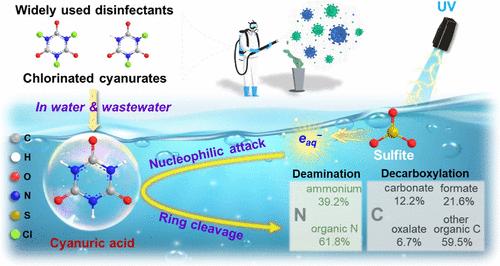
{"title":"Hydrated Electrons Trigger the Breakdown of Recalcitrant Cyanuric Acid in Wastewater","authors":"Xin Luo, Wenxiao Zheng, Qiaoxin Li, Huanxin Ma, Rundong Chen, Xueming Liu, Chunhua Feng","doi":"10.1021/acs.est.4c11652","DOIUrl":null,"url":null,"abstract":"Cyanuric acid (CA), a triazine-ring compound commonly used as a stabilizer for free chlorine to enhance disinfection, often persists in wastewater for the production of chlorinated cyanurates (Cl-CAs), posing challenges for treatment. This study demonstrates that conventional advanced oxidation processes (UV/H<sub>2</sub>O<sub>2</sub> and UV/peroxydisulfate) are ineffective in degrading CA, while the UV/sulfite system successfully achieves its breakdown. Hydrated electrons (e<sub>aq</sub><sup>–</sup>) were identified as the primary reactive species responsible for cleaving the stable triazine ring, with minimal contributions from SO<sub>3</sub><sup>•–</sup> and H<sup>•</sup>. The pH value influences both the activity of e<sub>aq</sub><sup>–</sup> and the degradability of CA by altering its structure; lower pH increases the electron-deficient regions in dihydrogen CA, enhancing its susceptibility to nucleophilic attack by e<sub>aq</sub><sup>–</sup>. The high concentrations of Cl<sup>–</sup> can inhibit CA removal, likely due to the formation of reactive chlorine species that react with sulfite and suppress e<sub>aq</sub><sup>–</sup> production. Effective CA degradation was also demonstrated in real wastewater, highlighting the UV/sulfite system as a sustainable solution for water treatment. These findings offer valuable insights into CA transformation and present effective approaches for eliminating emerging contaminants in the context of the extensive use of disinfectants.","PeriodicalId":36,"journal":{"name":"环境科学与技术","volume":"90 1","pages":""},"PeriodicalIF":11.3000,"publicationDate":"2025-03-03","publicationTypes":"Journal Article","fieldsOfStudy":null,"isOpenAccess":false,"openAccessPdf":"","citationCount":"0","resultStr":null,"platform":"Semanticscholar","paperid":null,"PeriodicalName":"环境科学与技术","FirstCategoryId":"1","ListUrlMain":"https://doi.org/10.1021/acs.est.4c11652","RegionNum":1,"RegionCategory":"环境科学与生态学","ArticlePicture":[],"TitleCN":null,"AbstractTextCN":null,"PMCID":null,"EPubDate":"","PubModel":"","JCR":"Q1","JCRName":"ENGINEERING, ENVIRONMENTAL","Score":null,"Total":0}
引用次数: 0
Abstract
Cyanuric acid (CA), a triazine-ring compound commonly used as a stabilizer for free chlorine to enhance disinfection, often persists in wastewater for the production of chlorinated cyanurates (Cl-CAs), posing challenges for treatment. This study demonstrates that conventional advanced oxidation processes (UV/H2O2 and UV/peroxydisulfate) are ineffective in degrading CA, while the UV/sulfite system successfully achieves its breakdown. Hydrated electrons (eaq–) were identified as the primary reactive species responsible for cleaving the stable triazine ring, with minimal contributions from SO3•– and H•. The pH value influences both the activity of eaq– and the degradability of CA by altering its structure; lower pH increases the electron-deficient regions in dihydrogen CA, enhancing its susceptibility to nucleophilic attack by eaq–. The high concentrations of Cl– can inhibit CA removal, likely due to the formation of reactive chlorine species that react with sulfite and suppress eaq– production. Effective CA degradation was also demonstrated in real wastewater, highlighting the UV/sulfite system as a sustainable solution for water treatment. These findings offer valuable insights into CA transformation and present effective approaches for eliminating emerging contaminants in the context of the extensive use of disinfectants.
期刊介绍:
Environmental Science & Technology (ES&T) is a co-sponsored academic and technical magazine by the Hubei Provincial Environmental Protection Bureau and the Hubei Provincial Academy of Environmental Sciences.
Environmental Science & Technology (ES&T) holds the status of Chinese core journals, scientific papers source journals of China, Chinese Science Citation Database source journals, and Chinese Academic Journal Comprehensive Evaluation Database source journals. This publication focuses on the academic field of environmental protection, featuring articles related to environmental protection and technical advancements.



 京公网安备 11010802042870号
京ICP备2023020795号-1
京公网安备 11010802042870号
京ICP备2023020795号-1

 分享
分享
 求助内容:
求助内容: 应助结果提醒方式:
 扫码关注我们
