Lizhi OuYang, Ze Lin, Xi He, Jiaqi Sun, Jiewen Liao, Yuheng Liao, Xudong Xie, Weixian Hu, Ruiyin Zeng, Ranyang Tao, Mengfei Liu, Yun Sun, Bobin Mi, Guohui Liu
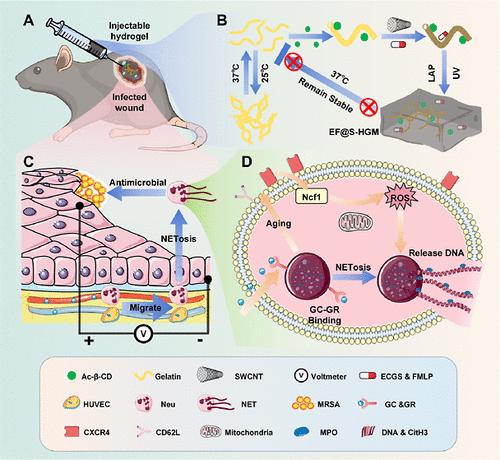
{"title":"Conductive Hydrogel Inspires Neutrophil Extracellular Traps to Combat Bacterial Infections in Wounds","authors":"Lizhi OuYang, Ze Lin, Xi He, Jiaqi Sun, Jiewen Liao, Yuheng Liao, Xudong Xie, Weixian Hu, Ruiyin Zeng, Ranyang Tao, Mengfei Liu, Yun Sun, Bobin Mi, Guohui Liu","doi":"10.1021/acsnano.4c14487","DOIUrl":null,"url":null,"abstract":"Thetreatment of infected wounds is currently a major challenge in clinical medicine, and enhancing antimicrobial and angiogenic capacity is one of the most common strategies. However, the current treatment makes it difficult to balance the antimicrobial effect in the early stage and the angiogenic effect in the later stages of wound healing, leading to an increased rate of poor prognosis. Here, we present a nanoconductive hydrogel EF@S-HGM, consisting of HGM with ECGS, FMLP, and SWCNT. The host–guest supramolecular macromolecule (HGM) hydrogel is biocompatible and can be injected in situ in the wound. The endothelial cell growth factor (ECGS) accelerates vascular remodeling and repairs wounds by promoting the proliferation of endothelial cells. N-Formyl-Met-Leu-Phe (FMLP) recruits neutrophils and increases the antimicrobial capacity. Single-walled carbon nanotubes (SWCNT) make the hydrogel conductive, enabling the hydrogel to utilize the endogenous electric field in the wound to recruit multiple kinds of cells. In addition, we found that the EF@S-HGM hydrogel activates the glucocorticoid receptor senescence pathway and promotes the formation of NET, which enhances the antimicrobial effect. As tissue-engineered skin, the conductive hydrogel EF@S-HGM is a promising material for regenerative medicine that may provide a potential option for the treatment and care of infected wounds and significantly improve patient outcomes and prognosis.","PeriodicalId":21,"journal":{"name":"ACS Nano","volume":"62 3 1","pages":""},"PeriodicalIF":16.0000,"publicationDate":"2025-03-03","publicationTypes":"Journal Article","fieldsOfStudy":null,"isOpenAccess":false,"openAccessPdf":"","citationCount":"0","resultStr":null,"platform":"Semanticscholar","paperid":null,"PeriodicalName":"ACS Nano","FirstCategoryId":"88","ListUrlMain":"https://doi.org/10.1021/acsnano.4c14487","RegionNum":1,"RegionCategory":"材料科学","ArticlePicture":[],"TitleCN":null,"AbstractTextCN":null,"PMCID":null,"EPubDate":"","PubModel":"","JCR":"Q1","JCRName":"CHEMISTRY, MULTIDISCIPLINARY","Score":null,"Total":0}
引用次数: 0
Abstract
Thetreatment of infected wounds is currently a major challenge in clinical medicine, and enhancing antimicrobial and angiogenic capacity is one of the most common strategies. However, the current treatment makes it difficult to balance the antimicrobial effect in the early stage and the angiogenic effect in the later stages of wound healing, leading to an increased rate of poor prognosis. Here, we present a nanoconductive hydrogel EF@S-HGM, consisting of HGM with ECGS, FMLP, and SWCNT. The host–guest supramolecular macromolecule (HGM) hydrogel is biocompatible and can be injected in situ in the wound. The endothelial cell growth factor (ECGS) accelerates vascular remodeling and repairs wounds by promoting the proliferation of endothelial cells. N-Formyl-Met-Leu-Phe (FMLP) recruits neutrophils and increases the antimicrobial capacity. Single-walled carbon nanotubes (SWCNT) make the hydrogel conductive, enabling the hydrogel to utilize the endogenous electric field in the wound to recruit multiple kinds of cells. In addition, we found that the EF@S-HGM hydrogel activates the glucocorticoid receptor senescence pathway and promotes the formation of NET, which enhances the antimicrobial effect. As tissue-engineered skin, the conductive hydrogel EF@S-HGM is a promising material for regenerative medicine that may provide a potential option for the treatment and care of infected wounds and significantly improve patient outcomes and prognosis.
期刊介绍:
ACS Nano, published monthly, serves as an international forum for comprehensive articles on nanoscience and nanotechnology research at the intersections of chemistry, biology, materials science, physics, and engineering. The journal fosters communication among scientists in these communities, facilitating collaboration, new research opportunities, and advancements through discoveries. ACS Nano covers synthesis, assembly, characterization, theory, and simulation of nanostructures, nanobiotechnology, nanofabrication, methods and tools for nanoscience and nanotechnology, and self- and directed-assembly. Alongside original research articles, it offers thorough reviews, perspectives on cutting-edge research, and discussions envisioning the future of nanoscience and nanotechnology.



 京公网安备 11010802042870号
京ICP备2023020795号-1
京公网安备 11010802042870号
京ICP备2023020795号-1

 分享
分享
 求助内容:
求助内容: 应助结果提醒方式:
 扫码关注我们
