Harnessing Transfer Deep Learning Framework for the Investigation of Transition Metal Perovskite Oxides with Advanced p-n Transformation Sensing Performance
Shaofeng Shao, Liangwei Yan, Jiale Li, Yizhou Zhang, Jun Zhang, Hyoun Woo Kim, Sang Sub Kim
{"title":"Harnessing Transfer Deep Learning Framework for the Investigation of Transition Metal Perovskite Oxides with Advanced p-n Transformation Sensing Performance","authors":"Shaofeng Shao, Liangwei Yan, Jiale Li, Yizhou Zhang, Jun Zhang, Hyoun Woo Kim, Sang Sub Kim","doi":"10.1021/acssensors.4c03085","DOIUrl":null,"url":null,"abstract":"Gas sensing materials based on transition metal perovskite oxides (TMPOs) have garnered extensive attention across various fields such as air quality control, environmental monitoring, healthcare, and national defense security. To overcome challenges encountered in traditional research, a deep learning framework combining natural language processing technology (Word2Vec) and crystal graph convolutional neural network (CGCNN) was adopted in this study, proposing a predictive method that incorporates a comprehensive data set consisting of 1.2 million literature abstracts and 110,000 crystal structure data entries. This method assessed the optimal combination of zinc–cobalt bimetallic ions complexed with ligands as precursors for perovskite oxides. The regulatory function of ligand concentration on the p-n transformation of zinc–cobalt oxide sensing performance was identified, and optimization strategies were provided. The Zn(II)/Co(III)/1-methyl-1<i>H</i>-imidazole-2-carboxylic acid complex was synthesized and demonstrated exceptional sensitivity and selectivity toward volatile organic compounds (VOCs), particularly 3-hydroxy-2-butanone (3H-2B). The p-n transformation mechanism of sensing performance was deeply analyzed through the construction of the hyper-synergistic ligand interaction matrix model for n-type sensors (HSLIM-n) and the parametrized surface-ligand resonance model for p-type sensors (PSLRM-p), enhancing the fundamental understanding of the sensing material properties. Even in highly interfering environments, the functionalized perovskite oxides exhibited outstanding sensitivity and selectivity toward 3H-2B gas, with a low detection limit of 25 parts per billion (ppb). This comprehensive research approach has facilitated the construction of a transfer learning-enhanced deep learning framework, which has shown high efficiency in predicting the performance and precise design of perovskite oxides, and its effectiveness was meticulously verified through detailed experimental validation.","PeriodicalId":24,"journal":{"name":"ACS Sensors","volume":"56 1","pages":""},"PeriodicalIF":9.1000,"publicationDate":"2025-03-03","publicationTypes":"Journal Article","fieldsOfStudy":null,"isOpenAccess":false,"openAccessPdf":"","citationCount":"0","resultStr":null,"platform":"Semanticscholar","paperid":null,"PeriodicalName":"ACS Sensors","FirstCategoryId":"92","ListUrlMain":"https://doi.org/10.1021/acssensors.4c03085","RegionNum":1,"RegionCategory":"化学","ArticlePicture":[],"TitleCN":null,"AbstractTextCN":null,"PMCID":null,"EPubDate":"","PubModel":"","JCR":"Q1","JCRName":"CHEMISTRY, ANALYTICAL","Score":null,"Total":0}
引用次数: 0
Abstract
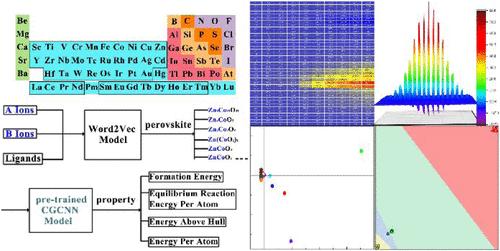
Gas sensing materials based on transition metal perovskite oxides (TMPOs) have garnered extensive attention across various fields such as air quality control, environmental monitoring, healthcare, and national defense security. To overcome challenges encountered in traditional research, a deep learning framework combining natural language processing technology (Word2Vec) and crystal graph convolutional neural network (CGCNN) was adopted in this study, proposing a predictive method that incorporates a comprehensive data set consisting of 1.2 million literature abstracts and 110,000 crystal structure data entries. This method assessed the optimal combination of zinc–cobalt bimetallic ions complexed with ligands as precursors for perovskite oxides. The regulatory function of ligand concentration on the p-n transformation of zinc–cobalt oxide sensing performance was identified, and optimization strategies were provided. The Zn(II)/Co(III)/1-methyl-1H-imidazole-2-carboxylic acid complex was synthesized and demonstrated exceptional sensitivity and selectivity toward volatile organic compounds (VOCs), particularly 3-hydroxy-2-butanone (3H-2B). The p-n transformation mechanism of sensing performance was deeply analyzed through the construction of the hyper-synergistic ligand interaction matrix model for n-type sensors (HSLIM-n) and the parametrized surface-ligand resonance model for p-type sensors (PSLRM-p), enhancing the fundamental understanding of the sensing material properties. Even in highly interfering environments, the functionalized perovskite oxides exhibited outstanding sensitivity and selectivity toward 3H-2B gas, with a low detection limit of 25 parts per billion (ppb). This comprehensive research approach has facilitated the construction of a transfer learning-enhanced deep learning framework, which has shown high efficiency in predicting the performance and precise design of perovskite oxides, and its effectiveness was meticulously verified through detailed experimental validation.
期刊介绍:
ACS Sensors is a peer-reviewed research journal that focuses on the dissemination of new and original knowledge in the field of sensor science, particularly those that selectively sense chemical or biological species or processes. The journal covers a broad range of topics, including but not limited to biosensors, chemical sensors, gas sensors, intracellular sensors, single molecule sensors, cell chips, and microfluidic devices. It aims to publish articles that address conceptual advances in sensing technology applicable to various types of analytes or application papers that report on the use of existing sensing concepts in new ways or for new analytes.




 京公网安备 11010802042870号
京ICP备2023020795号-1
京公网安备 11010802042870号
京ICP备2023020795号-1

 分享
分享
 求助内容:
求助内容: 应助结果提醒方式:
 扫码关注我们
