Jie Liu, Zichun Song, Jing Luo, To Ngai, Guanqing Sun
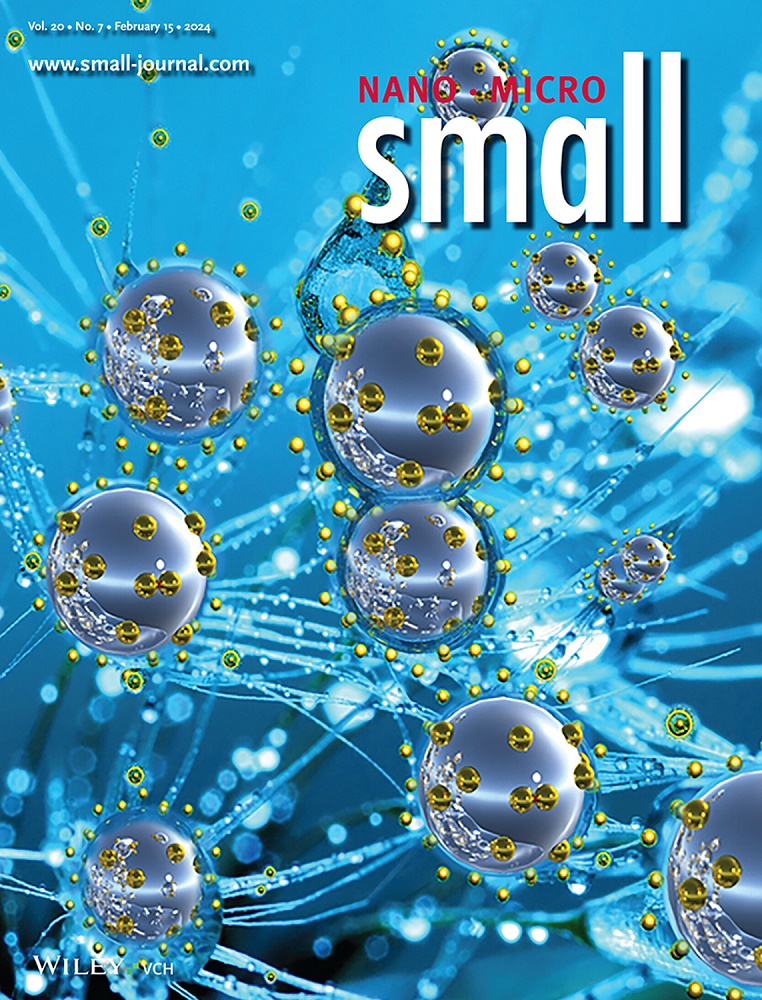
{"title":"Programmable Control of Active Ingredient Release in Pickering Emulsions Using Light","authors":"Jie Liu, Zichun Song, Jing Luo, To Ngai, Guanqing Sun","doi":"10.1002/smll.202412361","DOIUrl":null,"url":null,"abstract":"<p>Pickering emulsions have garnered significant attention for their ability to facilitate the controlled and effective delivery of active ingredients across various sectors, including drug release, agriculture, cosmetics, and interfacial catalysis. However, achieving the release of encapsulated active substances typically requires the disruption of emulsion droplets, making programmable release a notable challenge. This study develops a colloidal layer with nanogates at the oil-water interface of Pickering emulsion, utilizing UV light as a non-contact, remote stimulus to enable effective programmable release of encapsulated active substances. By alternating UV and visible light irradiation, this work induces cis-trans isomerization of azobenzene molecules on silica particles, allowing the gaps between colloidal particles to open and close. This demonstrated a promising nanogate effect under UV irradiation, facilitating the programmable release of active substance (perylene) from the Pickering emulsion droplets. This Pickering emulsion system offers precise control over the release amount of perylene by adjusting the colloidal particle size and the duration of UV–visible light exposure, all while maintaining emulsion stability. The successful implementation of this strategy presents a promising platform for non-invasive, programmable release of active substances across diverse applications in food, cosmetics and pharmaceutical fields.</p>","PeriodicalId":228,"journal":{"name":"Small","volume":"21 13","pages":""},"PeriodicalIF":12.1000,"publicationDate":"2025-03-04","publicationTypes":"Journal Article","fieldsOfStudy":null,"isOpenAccess":false,"openAccessPdf":"","citationCount":"0","resultStr":null,"platform":"Semanticscholar","paperid":null,"PeriodicalName":"Small","FirstCategoryId":"88","ListUrlMain":"https://onlinelibrary.wiley.com/doi/10.1002/smll.202412361","RegionNum":2,"RegionCategory":"材料科学","ArticlePicture":[],"TitleCN":null,"AbstractTextCN":null,"PMCID":null,"EPubDate":"","PubModel":"","JCR":"Q1","JCRName":"CHEMISTRY, MULTIDISCIPLINARY","Score":null,"Total":0}
引用次数: 0
Abstract
Pickering emulsions have garnered significant attention for their ability to facilitate the controlled and effective delivery of active ingredients across various sectors, including drug release, agriculture, cosmetics, and interfacial catalysis. However, achieving the release of encapsulated active substances typically requires the disruption of emulsion droplets, making programmable release a notable challenge. This study develops a colloidal layer with nanogates at the oil-water interface of Pickering emulsion, utilizing UV light as a non-contact, remote stimulus to enable effective programmable release of encapsulated active substances. By alternating UV and visible light irradiation, this work induces cis-trans isomerization of azobenzene molecules on silica particles, allowing the gaps between colloidal particles to open and close. This demonstrated a promising nanogate effect under UV irradiation, facilitating the programmable release of active substance (perylene) from the Pickering emulsion droplets. This Pickering emulsion system offers precise control over the release amount of perylene by adjusting the colloidal particle size and the duration of UV–visible light exposure, all while maintaining emulsion stability. The successful implementation of this strategy presents a promising platform for non-invasive, programmable release of active substances across diverse applications in food, cosmetics and pharmaceutical fields.
期刊介绍:
Small serves as an exceptional platform for both experimental and theoretical studies in fundamental and applied interdisciplinary research at the nano- and microscale. The journal offers a compelling mix of peer-reviewed Research Articles, Reviews, Perspectives, and Comments.
With a remarkable 2022 Journal Impact Factor of 13.3 (Journal Citation Reports from Clarivate Analytics, 2023), Small remains among the top multidisciplinary journals, covering a wide range of topics at the interface of materials science, chemistry, physics, engineering, medicine, and biology.
Small's readership includes biochemists, biologists, biomedical scientists, chemists, engineers, information technologists, materials scientists, physicists, and theoreticians alike.




 京公网安备 11010802042870号
京ICP备2023020795号-1
京公网安备 11010802042870号
京ICP备2023020795号-1

 分享
分享
 求助内容:
求助内容: 应助结果提醒方式:
 扫码关注我们
