{"title":"Self-Rectifying Dynamic Memristor Circuits for Periodic LIF Refractory Period Emulation and TTFS/Rate Signal Encoding","authors":"Song-Xian You, Sheng-Jie Hong, Kuan-Ting Chen, Li-Chung Shih, Jen-Sue Chen","doi":"10.1002/smll.202408233","DOIUrl":null,"url":null,"abstract":"<p>Spiking Neural Networks (SNNs) have gained attention due to their potential to improve computational efficiency compared to traditional artificial neural networks. This study investigates the use of dynamic memristors Ta/IGZO/TaO<sub>x</sub>/Pt combined with peripheral circuits to emulate the leaky integrate-and-fire behavior of neurons, focusing on incorporating a refractory period. The refractory period is crucial as it prevents neurons from becoming overactive and ensures precise timing in signal processing. This improvement allows the memristor to mimic biological neuron behavior more accurately. The memristor's transient resistance exhibits nonlinear <i>I–V</i> hysteresis and changes in response to pulses, enabling functions of integration, leakage, and firing. Additionally, the memristor is configured as an encoder, converting external signals into voltage pulse sequences. Using coding methods, including rate coding and time-to-first-spike (TTFS) coding, the encoder demonstrates improved signal processing, with TTFS occurring within 21 to 62 ms and encoder frequencies from 2500 to 9500 Hz. Experimental results show that this approach enhances SNN performance, making it more suitable for real-time applications and complex temporal signal processing tasks. This research highlights the potential of dynamic memristors to bridge the gap between neurons and artificial neurons, paving the way for more efficient neuromorphic computing systems.</p>","PeriodicalId":228,"journal":{"name":"Small","volume":"21 15","pages":""},"PeriodicalIF":12.1000,"publicationDate":"2025-03-04","publicationTypes":"Journal Article","fieldsOfStudy":null,"isOpenAccess":false,"openAccessPdf":"","citationCount":"0","resultStr":null,"platform":"Semanticscholar","paperid":null,"PeriodicalName":"Small","FirstCategoryId":"88","ListUrlMain":"https://onlinelibrary.wiley.com/doi/10.1002/smll.202408233","RegionNum":2,"RegionCategory":"材料科学","ArticlePicture":[],"TitleCN":null,"AbstractTextCN":null,"PMCID":null,"EPubDate":"","PubModel":"","JCR":"Q1","JCRName":"CHEMISTRY, MULTIDISCIPLINARY","Score":null,"Total":0}
引用次数: 0
Abstract
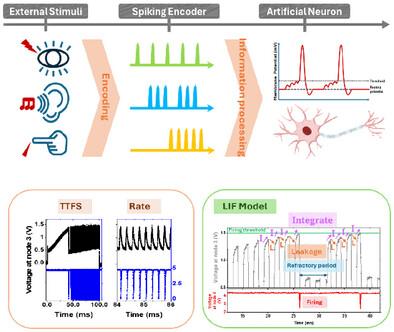
Spiking Neural Networks (SNNs) have gained attention due to their potential to improve computational efficiency compared to traditional artificial neural networks. This study investigates the use of dynamic memristors Ta/IGZO/TaOx/Pt combined with peripheral circuits to emulate the leaky integrate-and-fire behavior of neurons, focusing on incorporating a refractory period. The refractory period is crucial as it prevents neurons from becoming overactive and ensures precise timing in signal processing. This improvement allows the memristor to mimic biological neuron behavior more accurately. The memristor's transient resistance exhibits nonlinear I–V hysteresis and changes in response to pulses, enabling functions of integration, leakage, and firing. Additionally, the memristor is configured as an encoder, converting external signals into voltage pulse sequences. Using coding methods, including rate coding and time-to-first-spike (TTFS) coding, the encoder demonstrates improved signal processing, with TTFS occurring within 21 to 62 ms and encoder frequencies from 2500 to 9500 Hz. Experimental results show that this approach enhances SNN performance, making it more suitable for real-time applications and complex temporal signal processing tasks. This research highlights the potential of dynamic memristors to bridge the gap between neurons and artificial neurons, paving the way for more efficient neuromorphic computing systems.
期刊介绍:
Small serves as an exceptional platform for both experimental and theoretical studies in fundamental and applied interdisciplinary research at the nano- and microscale. The journal offers a compelling mix of peer-reviewed Research Articles, Reviews, Perspectives, and Comments.
With a remarkable 2022 Journal Impact Factor of 13.3 (Journal Citation Reports from Clarivate Analytics, 2023), Small remains among the top multidisciplinary journals, covering a wide range of topics at the interface of materials science, chemistry, physics, engineering, medicine, and biology.
Small's readership includes biochemists, biologists, biomedical scientists, chemists, engineers, information technologists, materials scientists, physicists, and theoreticians alike.




 京公网安备 11010802042870号
京ICP备2023020795号-1
京公网安备 11010802042870号
京ICP备2023020795号-1

 分享
分享
 求助内容:
求助内容: 应助结果提醒方式:
 扫码关注我们
