{"title":"Beat the heat: need for research studying plant cell death induced by extreme temperatures","authors":"Joanna Kacprzyk, Paul F. McCabe, Carl K-Y. Ng","doi":"10.1111/nph.70045","DOIUrl":null,"url":null,"abstract":"<p>Extreme temperatures surpassing 45°C can cause widespread plant damage and mortality, with severe consequences for ecosystem health, agricultural productivity, and urban greenery, thus negatively impacting human well-being. The global land area experiencing regular heatwaves is increasing, and this trend is expected to continue for the foreseeable future. Despite this alarming scenario, the molecular mechanisms underlying plant thermotolerance and responses to extreme heat-induced damage are not fully understood. As cells are the basic building blocks of the plant, studies at the cellular level are required to elucidate the fine-tuned signaling pathways regulating plant cell death and survival under high heat stress, thereby generating knowledge needed to better understand extreme temperature responses at the whole plant level. Well-established model systems that allow accurate measurement and quantification of stress-induced programmed cell death have a strong potential to enable multifactorial studies, including the use of heat regimes informed by natural settings and combinatorial stress experiments. The knowledge gained as a result can inform the development of effective heat stress mitigation strategies. Studying how plant cells cope with extreme heat is aligned with the One Health approach, several United Nations Sustainable Development Goals, and is, therefore, a research area that demands urgent attention.</p>","PeriodicalId":214,"journal":{"name":"New Phytologist","volume":"246 4","pages":"1451-1456"},"PeriodicalIF":8.1000,"publicationDate":"2025-03-04","publicationTypes":"Journal Article","fieldsOfStudy":null,"isOpenAccess":false,"openAccessPdf":"https://onlinelibrary.wiley.com/doi/epdf/10.1111/nph.70045","citationCount":"0","resultStr":null,"platform":"Semanticscholar","paperid":null,"PeriodicalName":"New Phytologist","FirstCategoryId":"99","ListUrlMain":"https://nph.onlinelibrary.wiley.com/doi/10.1111/nph.70045","RegionNum":1,"RegionCategory":"生物学","ArticlePicture":[],"TitleCN":null,"AbstractTextCN":null,"PMCID":null,"EPubDate":"","PubModel":"","JCR":"Q1","JCRName":"PLANT SCIENCES","Score":null,"Total":0}
引用次数: 0
Abstract
Extreme temperatures surpassing 45°C can cause widespread plant damage and mortality, with severe consequences for ecosystem health, agricultural productivity, and urban greenery, thus negatively impacting human well-being. The global land area experiencing regular heatwaves is increasing, and this trend is expected to continue for the foreseeable future. Despite this alarming scenario, the molecular mechanisms underlying plant thermotolerance and responses to extreme heat-induced damage are not fully understood. As cells are the basic building blocks of the plant, studies at the cellular level are required to elucidate the fine-tuned signaling pathways regulating plant cell death and survival under high heat stress, thereby generating knowledge needed to better understand extreme temperature responses at the whole plant level. Well-established model systems that allow accurate measurement and quantification of stress-induced programmed cell death have a strong potential to enable multifactorial studies, including the use of heat regimes informed by natural settings and combinatorial stress experiments. The knowledge gained as a result can inform the development of effective heat stress mitigation strategies. Studying how plant cells cope with extreme heat is aligned with the One Health approach, several United Nations Sustainable Development Goals, and is, therefore, a research area that demands urgent attention.
期刊介绍:
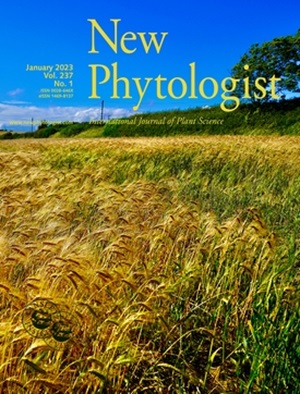
New Phytologist is an international electronic journal published 24 times a year. It is owned by the New Phytologist Foundation, a non-profit-making charitable organization dedicated to promoting plant science. The journal publishes excellent, novel, rigorous, and timely research and scholarship in plant science and its applications. The articles cover topics in five sections: Physiology & Development, Environment, Interaction, Evolution, and Transformative Plant Biotechnology. These sections encompass intracellular processes, global environmental change, and encourage cross-disciplinary approaches. The journal recognizes the use of techniques from molecular and cell biology, functional genomics, modeling, and system-based approaches in plant science. Abstracting and Indexing Information for New Phytologist includes Academic Search, AgBiotech News & Information, Agroforestry Abstracts, Biochemistry & Biophysics Citation Index, Botanical Pesticides, CAB Abstracts®, Environment Index, Global Health, and Plant Breeding Abstracts, and others.





 京公网安备 11010802042870号
京ICP备2023020795号-1
京公网安备 11010802042870号
京ICP备2023020795号-1

 分享
分享
 求助内容:
求助内容: 应助结果提醒方式:
 扫码关注我们
