Yunsong Wang, Bocan Yang, Shujuan Liu, Jiahe Song, Jinghuai Zhang, Xiangqun Chen, Nannan Zheng, Liangcan He, Wei Cai and Shaoqin Liu
{"title":"Semiconductor-mediated radiosensitizers: progress, challenges and perspectives","authors":"Yunsong Wang, Bocan Yang, Shujuan Liu, Jiahe Song, Jinghuai Zhang, Xiangqun Chen, Nannan Zheng, Liangcan He, Wei Cai and Shaoqin Liu","doi":"10.1039/D4MH01703J","DOIUrl":null,"url":null,"abstract":"<p >Radiotherapy has become one indispensable treatment strategy for treating malignant tumors. However, the therapeutic effect of radiotherapy is limited due to the low sensitivity and large side effects of existing radiosensitizers. The rapid development of nanotechnology has created opportunities for various novel kinds of radiosensitizers with excellent radiosensitivity to sprout recently. In particular, due to the ease of modification and potential utilization capacity for a multifunctional radiotherapy platform, semiconductor radiosensitizers have attracted more and more attention. Recently, many novel semiconductor based radiosensitizers have been reported, which provides new ideas for the improvement of radiotherapy efficacy. To make further breakthroughs in semiconductor radiosensitizers, a systematic review is urgently needed and is herein provided. This review first elaborates on the principle of semiconductor induced radiosensitization, and then focuses on strategies such as doping and constructing heterojunctions to enhance the radiosensitivity of semiconductors. Next, it introduces in detail the principle and progress of different types of semiconductor radiosensitizers. Finally, challenges and perspectives of semiconductor radiosensitizers are proposed and discussed, offering guidance for future commercial applications of semiconductor radiosensitizers.</p>","PeriodicalId":87,"journal":{"name":"Materials Horizons","volume":" 11","pages":" 3598-3621"},"PeriodicalIF":10.7000,"publicationDate":"2025-02-18","publicationTypes":"Journal Article","fieldsOfStudy":null,"isOpenAccess":false,"openAccessPdf":"","citationCount":"0","resultStr":null,"platform":"Semanticscholar","paperid":null,"PeriodicalName":"Materials Horizons","FirstCategoryId":"88","ListUrlMain":"https://pubs.rsc.org/en/content/articlelanding/2025/mh/d4mh01703j","RegionNum":2,"RegionCategory":"材料科学","ArticlePicture":[],"TitleCN":null,"AbstractTextCN":null,"PMCID":null,"EPubDate":"","PubModel":"","JCR":"Q1","JCRName":"CHEMISTRY, MULTIDISCIPLINARY","Score":null,"Total":0}
引用次数: 0
Abstract
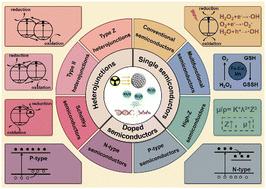
Radiotherapy has become one indispensable treatment strategy for treating malignant tumors. However, the therapeutic effect of radiotherapy is limited due to the low sensitivity and large side effects of existing radiosensitizers. The rapid development of nanotechnology has created opportunities for various novel kinds of radiosensitizers with excellent radiosensitivity to sprout recently. In particular, due to the ease of modification and potential utilization capacity for a multifunctional radiotherapy platform, semiconductor radiosensitizers have attracted more and more attention. Recently, many novel semiconductor based radiosensitizers have been reported, which provides new ideas for the improvement of radiotherapy efficacy. To make further breakthroughs in semiconductor radiosensitizers, a systematic review is urgently needed and is herein provided. This review first elaborates on the principle of semiconductor induced radiosensitization, and then focuses on strategies such as doping and constructing heterojunctions to enhance the radiosensitivity of semiconductors. Next, it introduces in detail the principle and progress of different types of semiconductor radiosensitizers. Finally, challenges and perspectives of semiconductor radiosensitizers are proposed and discussed, offering guidance for future commercial applications of semiconductor radiosensitizers.



 京公网安备 11010802042870号
京ICP备2023020795号-1
京公网安备 11010802042870号
京ICP备2023020795号-1

 分享
分享
 求助内容:
求助内容: 应助结果提醒方式:
 扫码关注我们
