Phosphoric Acid Versus Biogenic Mineralization of Hydroxyapatite and Carbonate Apatite in Relation to Infection-Induced Urinary Stones: Physical, Chemical and Microbiological Aspects
{"title":"Phosphoric Acid Versus Biogenic Mineralization of Hydroxyapatite and Carbonate Apatite in Relation to Infection-Induced Urinary Stones: Physical, Chemical and Microbiological Aspects","authors":"Jolanta Prywer, Ewa Mielniczek-Brzóska, Agnieszka Torzewska","doi":"10.1002/cplu.202400712","DOIUrl":null,"url":null,"abstract":"<p>In recent years, there has been an increase in the incidence of urinary stones, including infection urinary stones, especially in highly developed countries. One of the areas where the cause of the increased morbidity in these countries can be found is food products and their ingredients, which are not as common in other countries. Very often, attention is drawn to the greater consumption of highly processed food, the production of which uses flavour enhancers and various preservatives. One of the substances used in the food industry as an acidity regulator or antioxidant is phosphoric acid. It is used in the production of many products from food, sweets, beers to soft drinks, e. g. Coca-Cola. In this paper, we present the results of research on the effect of phosphoric acid (H<sub>3</sub>PO<sub>4</sub>) on the mineralization and growth of carbonate apatite Ca<sub>10</sub>(PO<sub>4</sub>)<sub>6</sub>CO<sub>3</sub> (CA) and hydroxyapatite Ca<sub>10</sub>(PO<sub>4</sub>)<sub>6</sub>(OH)<sub>2</sub> (HAP), which are one of the main components of infection urinary stones, next to struvite. The research was conducted in an artificial urine environment in two ways: in the presence of <i>Proteus mirabilis</i> bacteria and without them. In the latter case, bacterial urease activity was simulated by adding an aqueous ammonia solution. The results obtained, both in the presence of bacteria and without them, indicate that phosphoric acid present in artificial urine causes a shift in the mineralization of CA and HAP towards a lower pH, which means that these components mineralize earlier in artificial urine compared to the control sample. On the other hand, the amount of solid phases formed is smaller, the higher the concentration of phosphoric acid. The effect of phosphoric acid on the mineralization of CA and HAP was explained on the basis of theoretical speciation analysis of chemical complexes formed in urine in the presence of the tested acid. This analysis indicates that the experimentally observed shift in the formation of solid phases towards a lower pH with increasing phosphoric acid concentration is related to the earlier appearance of C<sub>10</sub>(PO<sub>4</sub>)<sub>6</sub>(OH)<sub>2</sub> complexes, forming HAP, and not to C<sub>10</sub>(PO<sub>4</sub>)<sub>6</sub>CO<sub>3</sub> complexes, forming CA. It should be remembered that the described effect of this acid on the formation of CA and HAP is possible only when the urinary tract is infected with urease-positive bacteria. In the absence of infection, phosphoric acid will not cause the formation of solid phases characteristic of infection urinary stones.</p>","PeriodicalId":148,"journal":{"name":"ChemPlusChem","volume":"90 5","pages":""},"PeriodicalIF":2.8000,"publicationDate":"2025-03-03","publicationTypes":"Journal Article","fieldsOfStudy":null,"isOpenAccess":false,"openAccessPdf":"https://onlinelibrary.wiley.com/doi/epdf/10.1002/cplu.202400712","citationCount":"0","resultStr":null,"platform":"Semanticscholar","paperid":null,"PeriodicalName":"ChemPlusChem","FirstCategoryId":"92","ListUrlMain":"https://chemistry-europe.onlinelibrary.wiley.com/doi/10.1002/cplu.202400712","RegionNum":4,"RegionCategory":"化学","ArticlePicture":[],"TitleCN":null,"AbstractTextCN":null,"PMCID":null,"EPubDate":"","PubModel":"","JCR":"Q2","JCRName":"CHEMISTRY, MULTIDISCIPLINARY","Score":null,"Total":0}
引用次数: 0
Abstract
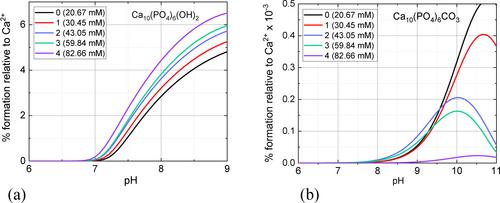
In recent years, there has been an increase in the incidence of urinary stones, including infection urinary stones, especially in highly developed countries. One of the areas where the cause of the increased morbidity in these countries can be found is food products and their ingredients, which are not as common in other countries. Very often, attention is drawn to the greater consumption of highly processed food, the production of which uses flavour enhancers and various preservatives. One of the substances used in the food industry as an acidity regulator or antioxidant is phosphoric acid. It is used in the production of many products from food, sweets, beers to soft drinks, e. g. Coca-Cola. In this paper, we present the results of research on the effect of phosphoric acid (H3PO4) on the mineralization and growth of carbonate apatite Ca10(PO4)6CO3 (CA) and hydroxyapatite Ca10(PO4)6(OH)2 (HAP), which are one of the main components of infection urinary stones, next to struvite. The research was conducted in an artificial urine environment in two ways: in the presence of Proteus mirabilis bacteria and without them. In the latter case, bacterial urease activity was simulated by adding an aqueous ammonia solution. The results obtained, both in the presence of bacteria and without them, indicate that phosphoric acid present in artificial urine causes a shift in the mineralization of CA and HAP towards a lower pH, which means that these components mineralize earlier in artificial urine compared to the control sample. On the other hand, the amount of solid phases formed is smaller, the higher the concentration of phosphoric acid. The effect of phosphoric acid on the mineralization of CA and HAP was explained on the basis of theoretical speciation analysis of chemical complexes formed in urine in the presence of the tested acid. This analysis indicates that the experimentally observed shift in the formation of solid phases towards a lower pH with increasing phosphoric acid concentration is related to the earlier appearance of C10(PO4)6(OH)2 complexes, forming HAP, and not to C10(PO4)6CO3 complexes, forming CA. It should be remembered that the described effect of this acid on the formation of CA and HAP is possible only when the urinary tract is infected with urease-positive bacteria. In the absence of infection, phosphoric acid will not cause the formation of solid phases characteristic of infection urinary stones.
期刊介绍:
ChemPlusChem is a peer-reviewed, general chemistry journal that brings readers the very best in multidisciplinary research centering on chemistry. It is published on behalf of Chemistry Europe, an association of 16 European chemical societies.
Fully comprehensive in its scope, ChemPlusChem publishes articles covering new results from at least two different aspects (subfields) of chemistry or one of chemistry and one of another scientific discipline (one chemistry topic plus another one, hence the title ChemPlusChem). All suitable submissions undergo balanced peer review by experts in the field to ensure the highest quality, originality, relevance, significance, and validity.





 京公网安备 11010802042870号
京ICP备2023020795号-1
京公网安备 11010802042870号
京ICP备2023020795号-1

 分享
分享
 求助内容:
求助内容: 应助结果提醒方式:
 扫码关注我们
