Seasonality in the reproductive cycles of the coconut palm: an analysis of basal temperatures, duration and harvest estimates in the Northeast of Pará, Brazil
Gabriel Siqueira Tavares Fernandes, João Vitor Ferreira da Silva, Matheus Lima Rua, Luis Roberto da Trindade Ribeiro, Leandro Monteiro Navarro, Breno Rodrigues de Miranda, Erika de Oliveira Teixeira de Carvalho, João Vitor de Nóvoa Pinto, Paulo Manoel Pontes Lins, Samuel Ortega-Farias, Paulo Jorge de Oliveira Ponte de Souza
{"title":"Seasonality in the reproductive cycles of the coconut palm: an analysis of basal temperatures, duration and harvest estimates in the Northeast of Pará, Brazil","authors":"Gabriel Siqueira Tavares Fernandes, João Vitor Ferreira da Silva, Matheus Lima Rua, Luis Roberto da Trindade Ribeiro, Leandro Monteiro Navarro, Breno Rodrigues de Miranda, Erika de Oliveira Teixeira de Carvalho, João Vitor de Nóvoa Pinto, Paulo Manoel Pontes Lins, Samuel Ortega-Farias, Paulo Jorge de Oliveira Ponte de Souza","doi":"10.1007/s00484-025-02883-x","DOIUrl":null,"url":null,"abstract":"<div><p>The green dwarf coconut (<i>Cocos nucifera</i> L.) has an extreme economic importance in Brazil, especially in the state of Pará, the third largest national producer. The phenological aspects of these plants can undergo changes according to the environment to which they are subjected, so the objective was to determine the basal temperatures, quantify the duration of the reproductive phase and verify the effect of climatic seasonality on the thermal accumulation of the green dwarf coconut tree, in the northeast region of Pará, Brazil. The experiment was conducted at the Fazenda Reunidas Sococo, considering two different areas, one with irrigation and the other without water exchange. The experiment was carried out between September 2020 and February 2022, with phenological observations every 2 days, for a total of about 60 reproductive cycles in each area. The lower and upper basal temperatures for coconut cultivation corresponded to 10 °C and 33 °C, respectively, the average thermal demand found for the commercial reproductive cycle was 3866.2 °C day for the irrigated condition and 3696.3 °C day when rainfed. In a non-irrigated condition, the coconut tree has a well-defined seasonality of cycle length, indicating that greater accumulated rainfall guarantees longer cycles, both in days and degree-days, with their shortening associated with lower water availability. The crop prediction model using thermal units performed well. The results obtained facilitate the understanding of the impact of meteorological conditions on coconut production and assist in the management of the crop in the region.</p></div>","PeriodicalId":588,"journal":{"name":"International Journal of Biometeorology","volume":"69 5","pages":"1127 - 1138"},"PeriodicalIF":2.6000,"publicationDate":"2025-03-04","publicationTypes":"Journal Article","fieldsOfStudy":null,"isOpenAccess":false,"openAccessPdf":"","citationCount":"0","resultStr":null,"platform":"Semanticscholar","paperid":null,"PeriodicalName":"International Journal of Biometeorology","FirstCategoryId":"89","ListUrlMain":"https://link.springer.com/article/10.1007/s00484-025-02883-x","RegionNum":3,"RegionCategory":"地球科学","ArticlePicture":[],"TitleCN":null,"AbstractTextCN":null,"PMCID":null,"EPubDate":"","PubModel":"","JCR":"Q2","JCRName":"BIOPHYSICS","Score":null,"Total":0}
引用次数: 0
Abstract
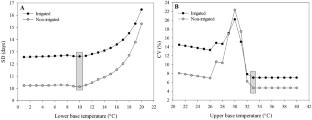
The green dwarf coconut (Cocos nucifera L.) has an extreme economic importance in Brazil, especially in the state of Pará, the third largest national producer. The phenological aspects of these plants can undergo changes according to the environment to which they are subjected, so the objective was to determine the basal temperatures, quantify the duration of the reproductive phase and verify the effect of climatic seasonality on the thermal accumulation of the green dwarf coconut tree, in the northeast region of Pará, Brazil. The experiment was conducted at the Fazenda Reunidas Sococo, considering two different areas, one with irrigation and the other without water exchange. The experiment was carried out between September 2020 and February 2022, with phenological observations every 2 days, for a total of about 60 reproductive cycles in each area. The lower and upper basal temperatures for coconut cultivation corresponded to 10 °C and 33 °C, respectively, the average thermal demand found for the commercial reproductive cycle was 3866.2 °C day for the irrigated condition and 3696.3 °C day when rainfed. In a non-irrigated condition, the coconut tree has a well-defined seasonality of cycle length, indicating that greater accumulated rainfall guarantees longer cycles, both in days and degree-days, with their shortening associated with lower water availability. The crop prediction model using thermal units performed well. The results obtained facilitate the understanding of the impact of meteorological conditions on coconut production and assist in the management of the crop in the region.
期刊介绍:
The Journal publishes original research papers, review articles and short communications on studies examining the interactions between living organisms and factors of the natural and artificial atmospheric environment.
Living organisms extend from single cell organisms, to plants and animals, including humans. The atmospheric environment includes climate and weather, electromagnetic radiation, and chemical and biological pollutants. The journal embraces basic and applied research and practical aspects such as living conditions, agriculture, forestry, and health.
The journal is published for the International Society of Biometeorology, and most membership categories include a subscription to the Journal.



 京公网安备 11010802042870号
京ICP备2023020795号-1
京公网安备 11010802042870号
京ICP备2023020795号-1

 分享
分享
 求助内容:
求助内容: 应助结果提醒方式:
 扫码关注我们
