Eric V. Regehr, Erik M. Andersen, Melissa P. Galicia, Samuel A. Iverson, Lindsey S. Mangipane, Evan S. Richardson, Fernando Ugarte, Susannah P. Woodruff
{"title":"International consensus principles for the sustainable harvest of polar bears","authors":"Eric V. Regehr, Erik M. Andersen, Melissa P. Galicia, Samuel A. Iverson, Lindsey S. Mangipane, Evan S. Richardson, Fernando Ugarte, Susannah P. Woodruff","doi":"10.1111/cobi.70010","DOIUrl":null,"url":null,"abstract":"<p>Multilateral agreements are required for the effective management of large carnivores with ranges that cross geopolitical boundaries. This is particularly important for species subject to rapid changes in distribution or demographic status due to climate warming. We considered 3 international consensus principles for the sustainable harvest of polar bears (<i>Ursus maritimus</i>), a circumpolar species threatened by sea-ice loss and harvested by Indigenous Peoples for subsistence. First, we defined a biologically sustainable harvest as one that occurs at a rate likely to maintain subpopulation abundance above maximum net productivity level. Second, we determined the type of scientific assessment needed to identify a sustainable harvest, which includes synthesizing or collecting information on habitat conditions, spatial population structure, and human-caused removals and conducting a field study to estimate ecological indices or demographic parameters. Third, we delineated the components of a sustainable harvest management regime, which include implementing harvest at a biologically sustainable rate, having the ability to monitor and adjust harvest levels, and following a state-dependent management approach. The consensus principles are supported by the 5 nations with polar bears (Canada, Greenland, Norway, Russia, and the United States) under an international treaty. They are designed to provide consistent guidance while allowing different jurisdictions the flexibility to tailor harvest strategies to their situations. Adapting similar principles to other systems could help mitigate the global conservation crisis for large carnivores.</p>","PeriodicalId":10689,"journal":{"name":"Conservation Biology","volume":"39 4","pages":""},"PeriodicalIF":5.5000,"publicationDate":"2025-03-03","publicationTypes":"Journal Article","fieldsOfStudy":null,"isOpenAccess":false,"openAccessPdf":"https://onlinelibrary.wiley.com/doi/epdf/10.1111/cobi.70010","citationCount":"0","resultStr":null,"platform":"Semanticscholar","paperid":null,"PeriodicalName":"Conservation Biology","FirstCategoryId":"93","ListUrlMain":"https://conbio.onlinelibrary.wiley.com/doi/10.1111/cobi.70010","RegionNum":1,"RegionCategory":"环境科学与生态学","ArticlePicture":[],"TitleCN":null,"AbstractTextCN":null,"PMCID":null,"EPubDate":"","PubModel":"","JCR":"Q1","JCRName":"BIODIVERSITY CONSERVATION","Score":null,"Total":0}
引用次数: 0
Abstract
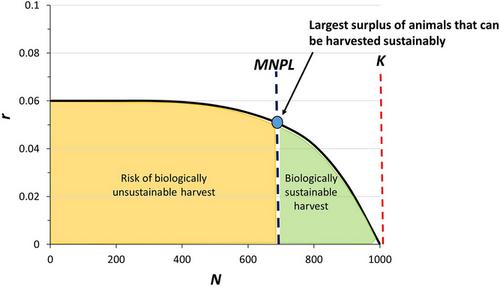
Multilateral agreements are required for the effective management of large carnivores with ranges that cross geopolitical boundaries. This is particularly important for species subject to rapid changes in distribution or demographic status due to climate warming. We considered 3 international consensus principles for the sustainable harvest of polar bears (Ursus maritimus), a circumpolar species threatened by sea-ice loss and harvested by Indigenous Peoples for subsistence. First, we defined a biologically sustainable harvest as one that occurs at a rate likely to maintain subpopulation abundance above maximum net productivity level. Second, we determined the type of scientific assessment needed to identify a sustainable harvest, which includes synthesizing or collecting information on habitat conditions, spatial population structure, and human-caused removals and conducting a field study to estimate ecological indices or demographic parameters. Third, we delineated the components of a sustainable harvest management regime, which include implementing harvest at a biologically sustainable rate, having the ability to monitor and adjust harvest levels, and following a state-dependent management approach. The consensus principles are supported by the 5 nations with polar bears (Canada, Greenland, Norway, Russia, and the United States) under an international treaty. They are designed to provide consistent guidance while allowing different jurisdictions the flexibility to tailor harvest strategies to their situations. Adapting similar principles to other systems could help mitigate the global conservation crisis for large carnivores.
期刊介绍:
Conservation Biology welcomes submissions that address the science and practice of conserving Earth's biological diversity. We encourage submissions that emphasize issues germane to any of Earth''s ecosystems or geographic regions and that apply diverse approaches to analyses and problem solving. Nevertheless, manuscripts with relevance to conservation that transcend the particular ecosystem, species, or situation described will be prioritized for publication.





 京公网安备 11010802042870号
京ICP备2023020795号-1
京公网安备 11010802042870号
京ICP备2023020795号-1

 分享
分享
 求助内容:
求助内容: 应助结果提醒方式:
 扫码关注我们
