A P Martinez-Cedillo, N Gavrila, A Mishra, E Geangu, T Foulsham
{"title":"Cognitive load affects gaze dynamics during real-world tasks.","authors":"A P Martinez-Cedillo, N Gavrila, A Mishra, E Geangu, T Foulsham","doi":"10.1007/s00221-025-07037-4","DOIUrl":null,"url":null,"abstract":"<p><p>In everyday tasks, active gaze is used to gather information for the actions we perform. The cognitive resources required for such gaze control have rarely been investigated. We examined how a secondary cognitive load task would affect gaze during tea- and sandwich-making, everyday tasks which involve sequences of object-related actions (Hayhoe in Vis Cogn 7(1-3):43-64, 2000 and Land et al. in Perception 28(11):1311-1328, 1999). Participants performed these tasks while wearing a mobile eye-tracker, while also counting backwards by threes (high cognitive load) or by ones (low cognitive load). Our findings revealed that participants were slower in tasks and sub-tasks and exhibited more fixations on irrelevant objects in high-load than low-load conditions. Furthermore, the eye-hand span was reduced under high-load conditions, meaning that participants were less likely to look ahead of their manual actions. These findings reveal specific effects of cognitive load in realistic, everyday situations, and begin to shed light on the mechanisms behind gaze control in active tasks. These mechanisms are not resource-free.</p>","PeriodicalId":12268,"journal":{"name":"Experimental Brain Research","volume":"243 4","pages":"82"},"PeriodicalIF":1.6000,"publicationDate":"2025-03-03","publicationTypes":"Journal Article","fieldsOfStudy":null,"isOpenAccess":false,"openAccessPdf":"https://www.ncbi.nlm.nih.gov/pmc/articles/PMC11876210/pdf/","citationCount":"0","resultStr":null,"platform":"Semanticscholar","paperid":null,"PeriodicalName":"Experimental Brain Research","FirstCategoryId":"3","ListUrlMain":"https://doi.org/10.1007/s00221-025-07037-4","RegionNum":4,"RegionCategory":"医学","ArticlePicture":[],"TitleCN":null,"AbstractTextCN":null,"PMCID":null,"EPubDate":"","PubModel":"","JCR":"Q4","JCRName":"NEUROSCIENCES","Score":null,"Total":0}
引用次数: 0
Abstract
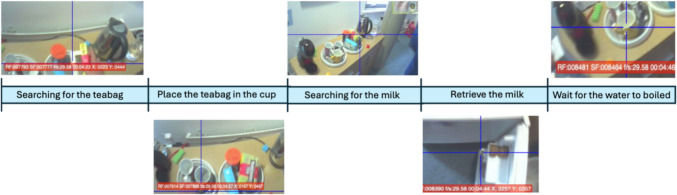
In everyday tasks, active gaze is used to gather information for the actions we perform. The cognitive resources required for such gaze control have rarely been investigated. We examined how a secondary cognitive load task would affect gaze during tea- and sandwich-making, everyday tasks which involve sequences of object-related actions (Hayhoe in Vis Cogn 7(1-3):43-64, 2000 and Land et al. in Perception 28(11):1311-1328, 1999). Participants performed these tasks while wearing a mobile eye-tracker, while also counting backwards by threes (high cognitive load) or by ones (low cognitive load). Our findings revealed that participants were slower in tasks and sub-tasks and exhibited more fixations on irrelevant objects in high-load than low-load conditions. Furthermore, the eye-hand span was reduced under high-load conditions, meaning that participants were less likely to look ahead of their manual actions. These findings reveal specific effects of cognitive load in realistic, everyday situations, and begin to shed light on the mechanisms behind gaze control in active tasks. These mechanisms are not resource-free.
在日常任务中,主动凝视用于收集我们执行的动作的信息。这种凝视控制所需的认知资源很少被研究过。我们研究了次要认知负荷任务如何影响茶和三明治制作过程中的凝视,这些日常任务涉及与物体相关的动作序列(Hayhoe in Vis Cogn 7(1-3):43- 64,2000和Land et al. in Perception 28(11):1311- 1328,1999)。参与者在执行这些任务时戴着移动眼动仪,同时倒数三次(高认知负荷)或倒数一次(低认知负荷)。我们的研究结果表明,在高负荷条件下,参与者在任务和子任务中速度较慢,并且在不相关的物体上表现出更多的注视。此外,在高负荷条件下,眼手跨度减小,这意味着参与者不太可能提前看到他们的手动动作。这些发现揭示了认知负荷在现实的日常情况下的具体影响,并开始揭示活跃任务中凝视控制背后的机制。这些机制并不是没有资源的。
期刊介绍:
Founded in 1966, Experimental Brain Research publishes original contributions on many aspects of experimental research of the central and peripheral nervous system. The focus is on molecular, physiology, behavior, neurochemistry, developmental, cellular and molecular neurobiology, and experimental pathology relevant to general problems of cerebral function. The journal publishes original papers, reviews, and mini-reviews.





 京公网安备 11010802042870号
京ICP备2023020795号-1
京公网安备 11010802042870号
京ICP备2023020795号-1

 分享
分享
 求助内容:
求助内容: 应助结果提醒方式:
 扫码关注我们
