{"title":"Visually induced motion sickness correlates with on-road car sickness while performing a visual task.","authors":"Tugrul Irmak, Ksander N de Winkel, Riender Happee","doi":"10.1007/s00221-025-07020-z","DOIUrl":null,"url":null,"abstract":"<p><p>Previous literature suggests that the motion sickness susceptibility questionnaire (MSSQ) is inadequate for prediction of motion sickness under naturalistic driving conditions. In this study, we investigated whether visually induced motion sickness using a virtual reality headset could be used as a quick and reliable way to predict participant susceptibility. We recruited 22 participants to complete a two-part experiment. In randomised order, we determined their susceptibility to visual motion sickness and their susceptibility to car sickness. To determine visual susceptibility, the visual scene was sequentially rotated at constant velocity around an earth-vertical yaw axis and rolled about the nasiooccipital axis, in 30 s intervals. Car sickness, on the other hand, was elicited under completely naturalistic conditions, being driven in the backseat of a car in the city of Delft, performing a visual task on a laptop. Sickness ratings were collected at regular intervals in both parts of the experiment. We found that the frequencies excited by naturalistic driving are very low, which has important consequences for motion sickness modelling and mitigation in automated vehicles. We found that individual car sickness correlated positively with visual motion sickness. This indicates that both are influenced by a common sickness susceptibility factor. Car sickness correlated similarly with visual motion sickness and MSSQ. Overall, our results indicate that combining measurements of sickness responses to a visual stimulus and MSSQ can yield a reliable method for determining individual sickness susceptibility. To this end the visual stimulus and the weighting with MSSQ responses can be refined using a much larger sample and considering additional visual conditions in driving.</p>","PeriodicalId":12268,"journal":{"name":"Experimental Brain Research","volume":"243 4","pages":"81"},"PeriodicalIF":1.6000,"publicationDate":"2025-03-03","publicationTypes":"Journal Article","fieldsOfStudy":null,"isOpenAccess":false,"openAccessPdf":"https://www.ncbi.nlm.nih.gov/pmc/articles/PMC11876265/pdf/","citationCount":"0","resultStr":null,"platform":"Semanticscholar","paperid":null,"PeriodicalName":"Experimental Brain Research","FirstCategoryId":"3","ListUrlMain":"https://doi.org/10.1007/s00221-025-07020-z","RegionNum":4,"RegionCategory":"医学","ArticlePicture":[],"TitleCN":null,"AbstractTextCN":null,"PMCID":null,"EPubDate":"","PubModel":"","JCR":"Q4","JCRName":"NEUROSCIENCES","Score":null,"Total":0}
引用次数: 0
Abstract
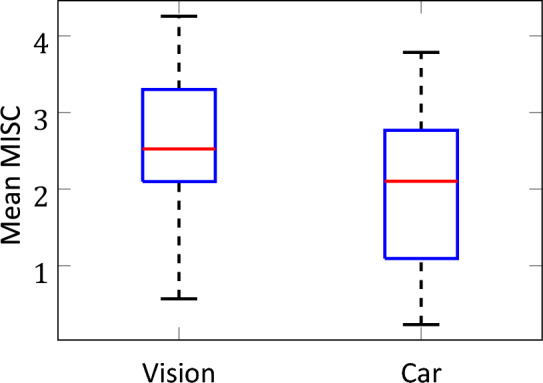
Previous literature suggests that the motion sickness susceptibility questionnaire (MSSQ) is inadequate for prediction of motion sickness under naturalistic driving conditions. In this study, we investigated whether visually induced motion sickness using a virtual reality headset could be used as a quick and reliable way to predict participant susceptibility. We recruited 22 participants to complete a two-part experiment. In randomised order, we determined their susceptibility to visual motion sickness and their susceptibility to car sickness. To determine visual susceptibility, the visual scene was sequentially rotated at constant velocity around an earth-vertical yaw axis and rolled about the nasiooccipital axis, in 30 s intervals. Car sickness, on the other hand, was elicited under completely naturalistic conditions, being driven in the backseat of a car in the city of Delft, performing a visual task on a laptop. Sickness ratings were collected at regular intervals in both parts of the experiment. We found that the frequencies excited by naturalistic driving are very low, which has important consequences for motion sickness modelling and mitigation in automated vehicles. We found that individual car sickness correlated positively with visual motion sickness. This indicates that both are influenced by a common sickness susceptibility factor. Car sickness correlated similarly with visual motion sickness and MSSQ. Overall, our results indicate that combining measurements of sickness responses to a visual stimulus and MSSQ can yield a reliable method for determining individual sickness susceptibility. To this end the visual stimulus and the weighting with MSSQ responses can be refined using a much larger sample and considering additional visual conditions in driving.
期刊介绍:
Founded in 1966, Experimental Brain Research publishes original contributions on many aspects of experimental research of the central and peripheral nervous system. The focus is on molecular, physiology, behavior, neurochemistry, developmental, cellular and molecular neurobiology, and experimental pathology relevant to general problems of cerebral function. The journal publishes original papers, reviews, and mini-reviews.





 京公网安备 11010802042870号
京ICP备2023020795号-1
京公网安备 11010802042870号
京ICP备2023020795号-1

 分享
分享
 求助内容:
求助内容: 应助结果提醒方式:
 扫码关注我们
