Associations between mobile phone involvement, BMI levels, and sleep quality among Chinese university students: evidence from a multi-regional large-scale survey.
{"title":"Associations between mobile phone involvement, BMI levels, and sleep quality among Chinese university students: evidence from a multi-regional large-scale survey.","authors":"Yukun Lu, Haodong Tian, Wentao Shi, Haowei Liu, Jinlong Wu, Yunfei Tao, Li Peng","doi":"10.3389/fpubh.2025.1533613","DOIUrl":null,"url":null,"abstract":"<p><strong>Objective: </strong>This study aims to explore the association between mobile phone involvement, body mass index (BMI) levels, and the sleep quality of Chinese university students.</p><p><strong>Methods: </strong>Using a cluster sampling method, we selected 17,085 university students from three universities in eastern, central, and western China as the study subjects. Demographic information such as age and sex were collected. The Pittsburgh Sleep Quality Index (PSQI) and the Mobile Phone Involvement Questionnaire (MPIQ) were utilized to measure their sleep quality scores and mobile phone involvement scores, respectively. Pearson correlation analysis, two-way ANOVA, and multiple linear regression were employed to examine the relationship between BMI levels, mobile phone involvement, and sleep quality.</p><p><strong>Results: </strong>The results show that 15.87% (2,712 participants) are classified as overweight, and 18.45% (3,151 participants) are classified as obese. Additionally, 35.87% (6,125 participants) exhibit mobile phone involvement, while 57.94% (9,899 participants) reported poor sleep quality. Pearson correlation analysis indicates a significant negative correlation (<i>p</i> < 0.01) between sleep quality and both BMI levels and mobile phone involvement. Two-way ANOVA shows the significant effect of BMI levels (<i>p</i> < 0.001) and mobile phone involvement (<i>p</i> < 0.001) on sleep quality, and there is no interaction effect between the two. Additionally, the sleep quality of overweight and obese individuals is significantly poorer than that of those with normal weight (<i>p</i> < 0.05), while the sleep quality of overweight individuals is significantly lower than that of obese individuals (<i>p</i> < 0.05). Multiple linear regression analysis indicates that, after controlling for age and gender, both BMI (<i>β</i> = -2.69) levels and mobile phone involvement (<i>β</i> = -1.34) are significantly negatively associated with sleep quality (<i>p</i> < 0.001), accounting for 19% of the variance in poor sleep quality.</p><p><strong>Conclusion: </strong>This study found that BMI levels and mobile phone involvement are both independently associated with sleep quality among Chinese university students. However, among individuals with excess BMI, although their sleep quality is worse than individuals with normal weight, overweight individuals may have poorer sleep quality than obese individuals. This study also revealed high rates of overweight and obesity, with over half of participants reporting poor sleep quality, highlighting the need for targeted interventions to address weight management and mobile phone usage to improve sleep health in this population.</p>","PeriodicalId":12548,"journal":{"name":"Frontiers in Public Health","volume":"13 ","pages":"1533613"},"PeriodicalIF":3.4000,"publicationDate":"2025-02-17","publicationTypes":"Journal Article","fieldsOfStudy":null,"isOpenAccess":false,"openAccessPdf":"https://www.ncbi.nlm.nih.gov/pmc/articles/PMC11872715/pdf/","citationCount":"0","resultStr":null,"platform":"Semanticscholar","paperid":null,"PeriodicalName":"Frontiers in Public Health","FirstCategoryId":"3","ListUrlMain":"https://doi.org/10.3389/fpubh.2025.1533613","RegionNum":3,"RegionCategory":"医学","ArticlePicture":[],"TitleCN":null,"AbstractTextCN":null,"PMCID":null,"EPubDate":"2025/1/1 0:00:00","PubModel":"eCollection","JCR":"Q2","JCRName":"PUBLIC, ENVIRONMENTAL & OCCUPATIONAL HEALTH","Score":null,"Total":0}
引用次数: 0
Abstract
Objective: This study aims to explore the association between mobile phone involvement, body mass index (BMI) levels, and the sleep quality of Chinese university students.
Methods: Using a cluster sampling method, we selected 17,085 university students from three universities in eastern, central, and western China as the study subjects. Demographic information such as age and sex were collected. The Pittsburgh Sleep Quality Index (PSQI) and the Mobile Phone Involvement Questionnaire (MPIQ) were utilized to measure their sleep quality scores and mobile phone involvement scores, respectively. Pearson correlation analysis, two-way ANOVA, and multiple linear regression were employed to examine the relationship between BMI levels, mobile phone involvement, and sleep quality.
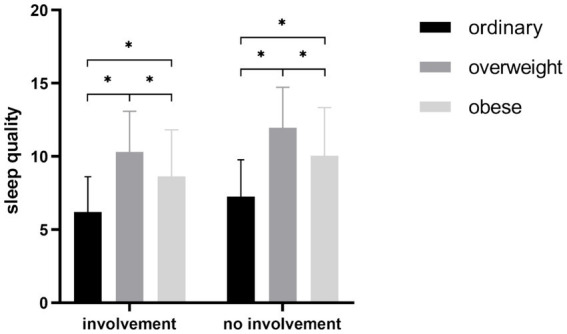
Results: The results show that 15.87% (2,712 participants) are classified as overweight, and 18.45% (3,151 participants) are classified as obese. Additionally, 35.87% (6,125 participants) exhibit mobile phone involvement, while 57.94% (9,899 participants) reported poor sleep quality. Pearson correlation analysis indicates a significant negative correlation (p < 0.01) between sleep quality and both BMI levels and mobile phone involvement. Two-way ANOVA shows the significant effect of BMI levels (p < 0.001) and mobile phone involvement (p < 0.001) on sleep quality, and there is no interaction effect between the two. Additionally, the sleep quality of overweight and obese individuals is significantly poorer than that of those with normal weight (p < 0.05), while the sleep quality of overweight individuals is significantly lower than that of obese individuals (p < 0.05). Multiple linear regression analysis indicates that, after controlling for age and gender, both BMI (β = -2.69) levels and mobile phone involvement (β = -1.34) are significantly negatively associated with sleep quality (p < 0.001), accounting for 19% of the variance in poor sleep quality.
Conclusion: This study found that BMI levels and mobile phone involvement are both independently associated with sleep quality among Chinese university students. However, among individuals with excess BMI, although their sleep quality is worse than individuals with normal weight, overweight individuals may have poorer sleep quality than obese individuals. This study also revealed high rates of overweight and obesity, with over half of participants reporting poor sleep quality, highlighting the need for targeted interventions to address weight management and mobile phone usage to improve sleep health in this population.
目的:本研究旨在探讨中国大学生手机使用时间、身体质量指数(BMI)水平和睡眠质量之间的关系。方法:采用整群抽样的方法,从东、中、西部三所高校抽取17085名大学生作为研究对象。收集了年龄、性别等人口统计信息。使用匹兹堡睡眠质量指数(PSQI)和手机介入问卷(MPIQ)分别测量他们的睡眠质量得分和手机介入得分。采用Pearson相关分析、双向方差分析和多元线性回归来检验BMI水平、手机使用时间和睡眠质量之间的关系。结果:超重的占15.87%(2712人),肥胖的占18.45%(3151人)。此外,35.87%(6125名参与者)的人使用手机,57.94%(9899名参与者)的人睡眠质量差。皮尔森相关分析表明显著负相关(p p p β = -2.69)水平和手机参与(β = -1.34)与睡眠质量显著负相关(p 结论:本研究发现BMI水平和手机的参与都是独立与中国大学生的睡眠质量。然而,在BMI超标的人群中,虽然他们的睡眠质量比正常体重的人差,但超重的人的睡眠质量可能比肥胖的人差。这项研究还揭示了超重和肥胖的高比例,超过一半的参与者报告睡眠质量差,强调需要有针对性的干预措施来解决体重管理和手机使用问题,以改善这一人群的睡眠健康。
期刊介绍:
Frontiers in Public Health is a multidisciplinary open-access journal which publishes rigorously peer-reviewed research and is at the forefront of disseminating and communicating scientific knowledge and impactful discoveries to researchers, academics, clinicians, policy makers and the public worldwide. The journal aims at overcoming current fragmentation in research and publication, promoting consistency in pursuing relevant scientific themes, and supporting finding dissemination and translation into practice.
Frontiers in Public Health is organized into Specialty Sections that cover different areas of research in the field. Please refer to the author guidelines for details on article types and the submission process.




 京公网安备 11010802042870号
京ICP备2023020795号-1
京公网安备 11010802042870号
京ICP备2023020795号-1

 分享
分享
 求助内容:
求助内容: 应助结果提醒方式:
 扫码关注我们
