Paula Duarte-Guterman, Dimitri A Skandalis, Ariane Merkl, Diana B Geissler, Günter Ehret
{"title":"Brain aromatase and its relationship with parental experience and behavior in male mice.","authors":"Paula Duarte-Guterman, Dimitri A Skandalis, Ariane Merkl, Diana B Geissler, Günter Ehret","doi":"10.3389/fnins.2025.1502764","DOIUrl":null,"url":null,"abstract":"<p><strong>Introduction: </strong>In most mammals, paternal care is not mandatory for raising offspring. In house mice, experience with pups governs the extent and quality of paternal care. First-time fathers undergo a dramatic transition from ignoring or killing pups to caring for pups. The behavioral shift occurs together with changes in brain estrogen signaling as indicated by changes in estrogen receptor presence and distribution in multiple areas regulating olfaction, emotion, and motivation.</p><p><strong>Methods: </strong>We measured changes in the expression of aromatase, the enzyme converting testosterone into estrogen, as an indirect measure of estrogen synthesis, in various areas of the limbic system in mice with increasing paternal experience.</p><p><strong>Results: </strong>The amount of paternal experience (5 or 27 days) was associated with increased numbers of immunocytochemically-identified aromatase expressing cells in the medial and cortical amygdala, posterior piriform cortex, and ventromedial hypothalamus. Functionally, these changes can be related to the disappearance of aggression or neglect towards pups when first-time fathers or, even more, well-experienced fathers are handling their own pups. In the lateral septum, the anterior piriform cortex and to some extent in the medial preoptic area, parental experience increased the number of aromatase-positive cells only in fathers with 27 days of experience, and only in the right hemisphere. This represents a novel case of brain-functional lateralization triggered by experience. Nuclei/areas associated with maternal care (medial preoptic area, bed nucleus of stria terminalis, nucleus accumbens) exhibited a left-hemisphere advantage in aromatase expressing cells, both in pup-naïve and pup-experienced males. This newly found lateralization may contribute to the left-hemisphere dominant processing and perception of pup calls to release parental behavior.</p><p><strong>Conclusion: </strong>In general, the experience-dependent changes in aromatase expression we observed in most brain areas did not mirror the previously reported changes in estrogen receptors (ERα) when pup-naïve males became pup-caring fathers. Hence, paternal behavior may depend, in a brain area-specific way, on the differential action of estrogen through its receptors and/or direct local modulation of neural processing.</p>","PeriodicalId":12639,"journal":{"name":"Frontiers in Neuroscience","volume":"19 ","pages":"1502764"},"PeriodicalIF":3.2000,"publicationDate":"2025-02-17","publicationTypes":"Journal Article","fieldsOfStudy":null,"isOpenAccess":false,"openAccessPdf":"https://www.ncbi.nlm.nih.gov/pmc/articles/PMC11872740/pdf/","citationCount":"0","resultStr":null,"platform":"Semanticscholar","paperid":null,"PeriodicalName":"Frontiers in Neuroscience","FirstCategoryId":"3","ListUrlMain":"https://doi.org/10.3389/fnins.2025.1502764","RegionNum":3,"RegionCategory":"医学","ArticlePicture":[],"TitleCN":null,"AbstractTextCN":null,"PMCID":null,"EPubDate":"2025/1/1 0:00:00","PubModel":"eCollection","JCR":"Q2","JCRName":"NEUROSCIENCES","Score":null,"Total":0}
引用次数: 0
Abstract
Introduction: In most mammals, paternal care is not mandatory for raising offspring. In house mice, experience with pups governs the extent and quality of paternal care. First-time fathers undergo a dramatic transition from ignoring or killing pups to caring for pups. The behavioral shift occurs together with changes in brain estrogen signaling as indicated by changes in estrogen receptor presence and distribution in multiple areas regulating olfaction, emotion, and motivation.
Methods: We measured changes in the expression of aromatase, the enzyme converting testosterone into estrogen, as an indirect measure of estrogen synthesis, in various areas of the limbic system in mice with increasing paternal experience.
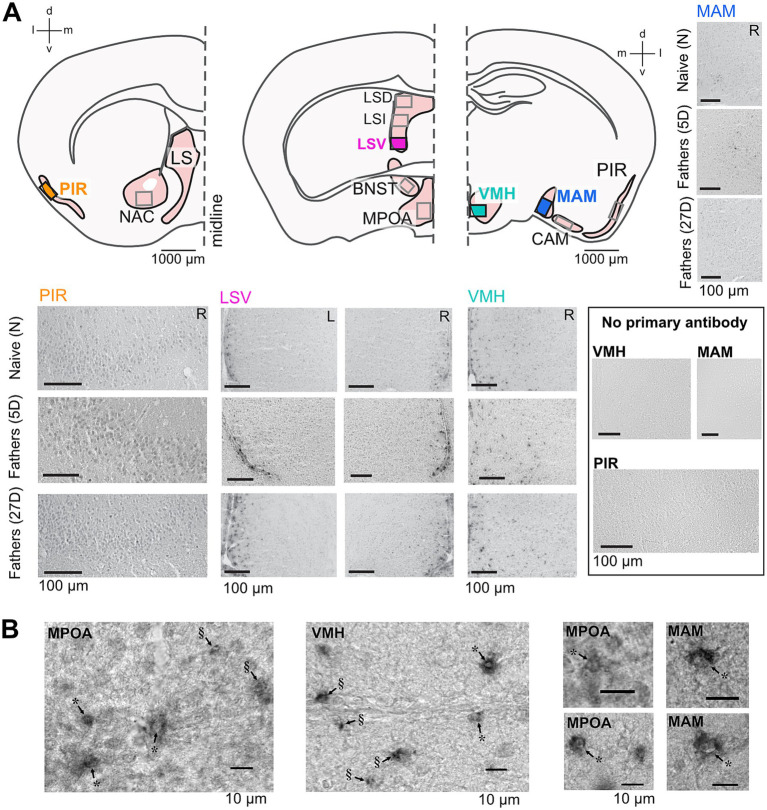
Results: The amount of paternal experience (5 or 27 days) was associated with increased numbers of immunocytochemically-identified aromatase expressing cells in the medial and cortical amygdala, posterior piriform cortex, and ventromedial hypothalamus. Functionally, these changes can be related to the disappearance of aggression or neglect towards pups when first-time fathers or, even more, well-experienced fathers are handling their own pups. In the lateral septum, the anterior piriform cortex and to some extent in the medial preoptic area, parental experience increased the number of aromatase-positive cells only in fathers with 27 days of experience, and only in the right hemisphere. This represents a novel case of brain-functional lateralization triggered by experience. Nuclei/areas associated with maternal care (medial preoptic area, bed nucleus of stria terminalis, nucleus accumbens) exhibited a left-hemisphere advantage in aromatase expressing cells, both in pup-naïve and pup-experienced males. This newly found lateralization may contribute to the left-hemisphere dominant processing and perception of pup calls to release parental behavior.
Conclusion: In general, the experience-dependent changes in aromatase expression we observed in most brain areas did not mirror the previously reported changes in estrogen receptors (ERα) when pup-naïve males became pup-caring fathers. Hence, paternal behavior may depend, in a brain area-specific way, on the differential action of estrogen through its receptors and/or direct local modulation of neural processing.
期刊介绍:
Neural Technology is devoted to the convergence between neurobiology and quantum-, nano- and micro-sciences. In our vision, this interdisciplinary approach should go beyond the technological development of sophisticated methods and should contribute in generating a genuine change in our discipline.





 京公网安备 11010802042870号
京ICP备2023020795号-1
京公网安备 11010802042870号
京ICP备2023020795号-1

 分享
分享
 求助内容:
求助内容: 应助结果提醒方式:
 扫码关注我们
