Zhen Ma;Xinyi Yang;Jiayuan Meng;Kun Wang;Minpeng Xu;Dong Ming
{"title":"Decoding Arm Movement Direction Using Ultra-High-Density EEG","authors":"Zhen Ma;Xinyi Yang;Jiayuan Meng;Kun Wang;Minpeng Xu;Dong Ming","doi":"10.1109/JBHI.2025.3545856","DOIUrl":null,"url":null,"abstract":"Detecting arm movement direction is significant for individuals with upper-limb motor disabilities to restore independent self-care abilities. It involves accurately decoding the fine movement patterns of the arm, which has become feasible using invasive brain-computer interfaces (BCIs). However, it is still a significant challenge for traditional electroencephalography (EEG) based BCIs to decode multi-directional arm movements effectively. This study designed an ultra-high-density (UHD) EEG system to decode multi-directional arm movements. The system contains 200 electrodes with an interval of about 4 mm. We analyzed the patterns of the UHD EEG signals induced by arm movements in different directions. To extract discriminative features from UHD EEG, we proposed a spatial filtering method combining principal component analysis (PCA) and discriminative spatial pattern (DSP). We collected EEG signals from five healthy subjects (two left-handed and three right-handed) to verify the system's feasibility. The movement-related cortical potentials (MRCPs) showed a certain degree of separability both in waveforms and spatial patterns for arm movements in different directions. This study achieved an average classification accuracy of 63.15 (8.71)% for both arms (eight-class task) with a peak accuracy of 77.24%. For the dominant arm (four-class task), we obtained an average accuracy of 75.31 (9.21)% with a peak accuracy of 85.00%. For the first time, this study simultaneously decodes multi-directional movements of both arms using UHD EEG. This study provides a promising approach for detecting information about arm movement directions, which is significant for the development of BCIs.","PeriodicalId":13073,"journal":{"name":"IEEE Journal of Biomedical and Health Informatics","volume":"29 6","pages":"4035-4045"},"PeriodicalIF":6.8000,"publicationDate":"2025-02-26","publicationTypes":"Journal Article","fieldsOfStudy":null,"isOpenAccess":false,"openAccessPdf":"","citationCount":"0","resultStr":null,"platform":"Semanticscholar","paperid":null,"PeriodicalName":"IEEE Journal of Biomedical and Health Informatics","FirstCategoryId":"5","ListUrlMain":"https://ieeexplore.ieee.org/document/10904212/","RegionNum":2,"RegionCategory":"医学","ArticlePicture":[],"TitleCN":null,"AbstractTextCN":null,"PMCID":null,"EPubDate":"","PubModel":"","JCR":"Q1","JCRName":"COMPUTER SCIENCE, INFORMATION SYSTEMS","Score":null,"Total":0}
引用次数: 0
Abstract
Detecting arm movement direction is significant for individuals with upper-limb motor disabilities to restore independent self-care abilities. It involves accurately decoding the fine movement patterns of the arm, which has become feasible using invasive brain-computer interfaces (BCIs). However, it is still a significant challenge for traditional electroencephalography (EEG) based BCIs to decode multi-directional arm movements effectively. This study designed an ultra-high-density (UHD) EEG system to decode multi-directional arm movements. The system contains 200 electrodes with an interval of about 4 mm. We analyzed the patterns of the UHD EEG signals induced by arm movements in different directions. To extract discriminative features from UHD EEG, we proposed a spatial filtering method combining principal component analysis (PCA) and discriminative spatial pattern (DSP). We collected EEG signals from five healthy subjects (two left-handed and three right-handed) to verify the system's feasibility. The movement-related cortical potentials (MRCPs) showed a certain degree of separability both in waveforms and spatial patterns for arm movements in different directions. This study achieved an average classification accuracy of 63.15 (8.71)% for both arms (eight-class task) with a peak accuracy of 77.24%. For the dominant arm (four-class task), we obtained an average accuracy of 75.31 (9.21)% with a peak accuracy of 85.00%. For the first time, this study simultaneously decodes multi-directional movements of both arms using UHD EEG. This study provides a promising approach for detecting information about arm movement directions, which is significant for the development of BCIs.
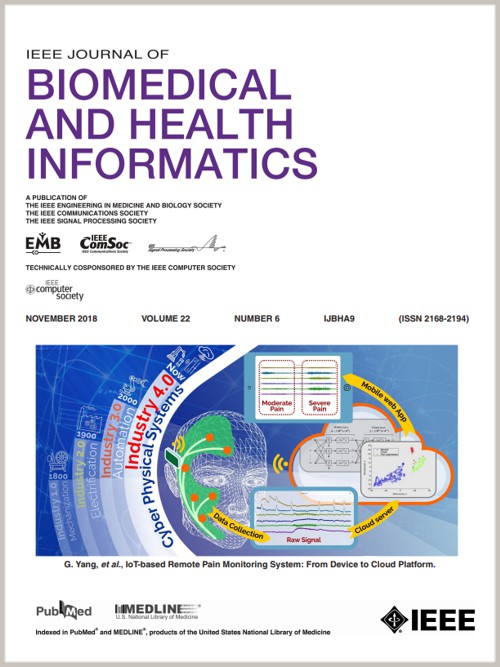
期刊介绍:
IEEE Journal of Biomedical and Health Informatics publishes original papers presenting recent advances where information and communication technologies intersect with health, healthcare, life sciences, and biomedicine. Topics include acquisition, transmission, storage, retrieval, management, and analysis of biomedical and health information. The journal covers applications of information technologies in healthcare, patient monitoring, preventive care, early disease diagnosis, therapy discovery, and personalized treatment protocols. It explores electronic medical and health records, clinical information systems, decision support systems, medical and biological imaging informatics, wearable systems, body area/sensor networks, and more. Integration-related topics like interoperability, evidence-based medicine, and secure patient data are also addressed.




 京公网安备 11010802042870号
京ICP备2023020795号-1
京公网安备 11010802042870号
京ICP备2023020795号-1

 分享
分享
 求助内容:
求助内容: 应助结果提醒方式:
 扫码关注我们
