Jiejiang Yu;Bingbing Li;Xipeng Pan;Zhenwei Shi;Huadeng Wang;Rushi Lan;Xiaonan Luo
{"title":"Semi-Supervised Gland Segmentation via Feature-Enhanced Contrastive Learning and Dual-Consistency Strategy","authors":"Jiejiang Yu;Bingbing Li;Xipeng Pan;Zhenwei Shi;Huadeng Wang;Rushi Lan;Xiaonan Luo","doi":"10.1109/JBHI.2025.3546698","DOIUrl":null,"url":null,"abstract":"In the field of gland segmentation in histopathology, deep-learning methods have made significant progress. However, most existing methods not only require a large amount of high-quality annotated data but also tend to confuse the internal of the gland with the background. To address this challenge, we propose a new semi-supervised method named DCCL-Seg for gland segmentation, which follows the teacher-student framework. Our approach can be divided into follows steps. First, we design a contrastive learning module to improve the ability of the student model's feature extractor to distinguish between gland and background features. Then, we introduce a Signed Distance Field (SDF) prediction task and employ dual-consistency strategy (across tasks and models) to better reinforce the learning of gland internal. Next, we proposed a pseudo label filtering and reweighting mechanism, which filters and reweights the pseudo labels generated by the teacher model based on confidence. However, even after reweighting, the pseudo labels may still be influenced by unreliable pixels. Finally, we further designed an assistant predictor to learn the reweighted pseudo labels, which do not interfere with the student model's predictor and ensure the reliability of the student model's predictions. Experimental results on the publicly available GlaS and CRAG datasets demonstrate that our method outperforms other semi-supervised medical image segmentation methods.","PeriodicalId":13073,"journal":{"name":"IEEE Journal of Biomedical and Health Informatics","volume":"29 6","pages":"4314-4324"},"PeriodicalIF":6.8000,"publicationDate":"2025-02-28","publicationTypes":"Journal Article","fieldsOfStudy":null,"isOpenAccess":false,"openAccessPdf":"","citationCount":"0","resultStr":null,"platform":"Semanticscholar","paperid":null,"PeriodicalName":"IEEE Journal of Biomedical and Health Informatics","FirstCategoryId":"5","ListUrlMain":"https://ieeexplore.ieee.org/document/10908057/","RegionNum":2,"RegionCategory":"医学","ArticlePicture":[],"TitleCN":null,"AbstractTextCN":null,"PMCID":null,"EPubDate":"","PubModel":"","JCR":"Q1","JCRName":"COMPUTER SCIENCE, INFORMATION SYSTEMS","Score":null,"Total":0}
引用次数: 0
Abstract
In the field of gland segmentation in histopathology, deep-learning methods have made significant progress. However, most existing methods not only require a large amount of high-quality annotated data but also tend to confuse the internal of the gland with the background. To address this challenge, we propose a new semi-supervised method named DCCL-Seg for gland segmentation, which follows the teacher-student framework. Our approach can be divided into follows steps. First, we design a contrastive learning module to improve the ability of the student model's feature extractor to distinguish between gland and background features. Then, we introduce a Signed Distance Field (SDF) prediction task and employ dual-consistency strategy (across tasks and models) to better reinforce the learning of gland internal. Next, we proposed a pseudo label filtering and reweighting mechanism, which filters and reweights the pseudo labels generated by the teacher model based on confidence. However, even after reweighting, the pseudo labels may still be influenced by unreliable pixels. Finally, we further designed an assistant predictor to learn the reweighted pseudo labels, which do not interfere with the student model's predictor and ensure the reliability of the student model's predictions. Experimental results on the publicly available GlaS and CRAG datasets demonstrate that our method outperforms other semi-supervised medical image segmentation methods.
期刊介绍:
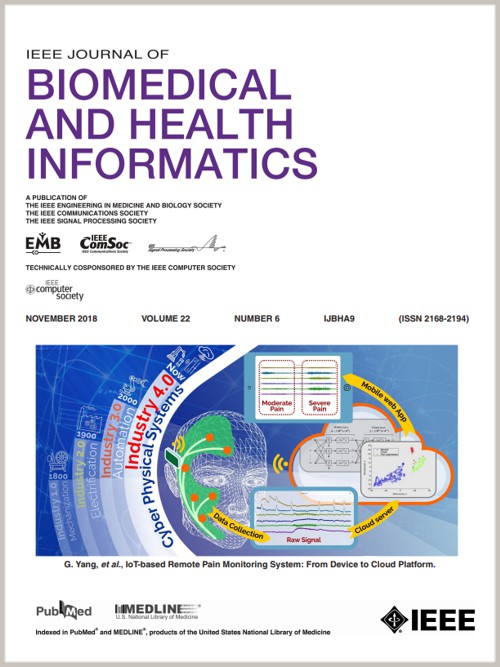
IEEE Journal of Biomedical and Health Informatics publishes original papers presenting recent advances where information and communication technologies intersect with health, healthcare, life sciences, and biomedicine. Topics include acquisition, transmission, storage, retrieval, management, and analysis of biomedical and health information. The journal covers applications of information technologies in healthcare, patient monitoring, preventive care, early disease diagnosis, therapy discovery, and personalized treatment protocols. It explores electronic medical and health records, clinical information systems, decision support systems, medical and biological imaging informatics, wearable systems, body area/sensor networks, and more. Integration-related topics like interoperability, evidence-based medicine, and secure patient data are also addressed.




 京公网安备 11010802042870号
京ICP备2023020795号-1
京公网安备 11010802042870号
京ICP备2023020795号-1

 分享
分享
 求助内容:
求助内容: 应助结果提醒方式:
 扫码关注我们
