{"title":"Identifying and Validating Prognostic Hyper-Inflammatory and Hypo-Inflammatory COVID-19 Clinical Phenotypes Using Machine Learning Methods.","authors":"Xiaojing Ji, Yiran Guo, Lujia Tang, Chengjin Gao","doi":"10.2147/JIR.S504028","DOIUrl":null,"url":null,"abstract":"<p><strong>Background: </strong>COVID-19 exhibits complex pathophysiological manifestations, characterized by significant clinical and biological heterogeneity. Identifying phenotypes may enhance our understanding of the disease's diverse trajectories, benefiting clinical practice and trials.</p><p><strong>Methods: </strong>This study included adult patients with COVID-19 from Xinhua Hospital, affiliated with Shanghai Jiao Tong University School of Medicine, between December 15, 2022, and February 15, 2023. The k-prototypes clustering method was employed using 50 clinical variables to identify phenotypes. Machine learning algorithms were then applied to select key classifier variables for phenotype recognition.</p><p><strong>Results: </strong>A total of 1376 patients met the inclusion criteria. K-prototypes clustering revealed two distinct subphenotypes: Hypo-inflammatory subphenotype (824 [59.9%]) and Hyper-inflammatory subphenotype (552 [40.1%]). Patients in Hypo-inflammatory subphenotype were younger, predominantly female, with low mortality and shorter hospital stays. In contrast, Hyper-inflammatory subphenotype patients were older, predominantly male, exhibiting a hyperinflammatory state with higher mortality and rates of organ dysfunction. The AdaBoost model performed best for subphenotype prediction (Accuracy: 0.975, Precision: 0.968, Recall: 0.976, F1: 0.972, AUROC: 0.975). \"CRP\", \"IL-2R\", \"D-dimer\", \"ST2\", \"BUN\", \"NT-proBNP\", \"neutrophil percentage\", and \"lymphocyte count\" were identified as the top-ranked variables in the AdaBoost model.</p><p><strong>Conclusion: </strong>This analysis identified two phenotypes based on COVID-19 symptoms and comorbidities. These phenotypes can be accurately recognized using machine learning models, with the AdaBoost model being optimal for predicting in-hospital mortality. The variables \"CRP\", \"IL-2R\", \"D-dimer\", \"ST2\", \"BUN\", \"NT-proBNP\", \"neutrophil percentage\", and \"lymphocyte count\" play a significant role in the prediction of subphenotypes. Use the identified subphenotypes for risk stratification in clinical practice. Hyper-inflammatory subphenotypes can be closely monitored, and preventive measures such as early admission to the intensive care unit or prophylactic anticoagulation can be taken.</p>","PeriodicalId":16107,"journal":{"name":"Journal of Inflammation Research","volume":"18 ","pages":"3009-3024"},"PeriodicalIF":4.1000,"publicationDate":"2025-02-27","publicationTypes":"Journal Article","fieldsOfStudy":null,"isOpenAccess":false,"openAccessPdf":"https://www.ncbi.nlm.nih.gov/pmc/articles/PMC11874972/pdf/","citationCount":"0","resultStr":null,"platform":"Semanticscholar","paperid":null,"PeriodicalName":"Journal of Inflammation Research","FirstCategoryId":"3","ListUrlMain":"https://doi.org/10.2147/JIR.S504028","RegionNum":2,"RegionCategory":"医学","ArticlePicture":[],"TitleCN":null,"AbstractTextCN":null,"PMCID":null,"EPubDate":"2025/1/1 0:00:00","PubModel":"eCollection","JCR":"Q2","JCRName":"IMMUNOLOGY","Score":null,"Total":0}
引用次数: 0
Abstract
Background: COVID-19 exhibits complex pathophysiological manifestations, characterized by significant clinical and biological heterogeneity. Identifying phenotypes may enhance our understanding of the disease's diverse trajectories, benefiting clinical practice and trials.
Methods: This study included adult patients with COVID-19 from Xinhua Hospital, affiliated with Shanghai Jiao Tong University School of Medicine, between December 15, 2022, and February 15, 2023. The k-prototypes clustering method was employed using 50 clinical variables to identify phenotypes. Machine learning algorithms were then applied to select key classifier variables for phenotype recognition.
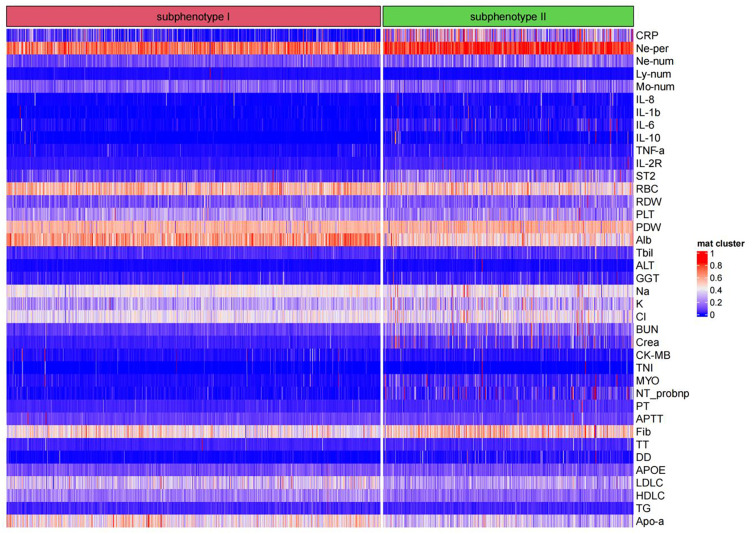
Results: A total of 1376 patients met the inclusion criteria. K-prototypes clustering revealed two distinct subphenotypes: Hypo-inflammatory subphenotype (824 [59.9%]) and Hyper-inflammatory subphenotype (552 [40.1%]). Patients in Hypo-inflammatory subphenotype were younger, predominantly female, with low mortality and shorter hospital stays. In contrast, Hyper-inflammatory subphenotype patients were older, predominantly male, exhibiting a hyperinflammatory state with higher mortality and rates of organ dysfunction. The AdaBoost model performed best for subphenotype prediction (Accuracy: 0.975, Precision: 0.968, Recall: 0.976, F1: 0.972, AUROC: 0.975). "CRP", "IL-2R", "D-dimer", "ST2", "BUN", "NT-proBNP", "neutrophil percentage", and "lymphocyte count" were identified as the top-ranked variables in the AdaBoost model.
Conclusion: This analysis identified two phenotypes based on COVID-19 symptoms and comorbidities. These phenotypes can be accurately recognized using machine learning models, with the AdaBoost model being optimal for predicting in-hospital mortality. The variables "CRP", "IL-2R", "D-dimer", "ST2", "BUN", "NT-proBNP", "neutrophil percentage", and "lymphocyte count" play a significant role in the prediction of subphenotypes. Use the identified subphenotypes for risk stratification in clinical practice. Hyper-inflammatory subphenotypes can be closely monitored, and preventive measures such as early admission to the intensive care unit or prophylactic anticoagulation can be taken.
期刊介绍:
An international, peer-reviewed, open access, online journal that welcomes laboratory and clinical findings on the molecular basis, cell biology and pharmacology of inflammation.






 京公网安备 11010802042870号
京ICP备2023020795号-1
京公网安备 11010802042870号
京ICP备2023020795号-1

 分享
分享
 求助内容:
求助内容: 应助结果提醒方式:
 扫码关注我们
