Saima Hasnin, Dipti A Dev, Carly Hillburn, Susan B Sisson, Alison Tovar
{"title":"Family child care home providers' perceived difficulty in serving vegetables to children: findings from a multi-method study.","authors":"Saima Hasnin, Dipti A Dev, Carly Hillburn, Susan B Sisson, Alison Tovar","doi":"10.1017/jns.2025.9","DOIUrl":null,"url":null,"abstract":"<p><p>The study aims to identify family child care home (FCCH) setting- and environment-level predictors related to providers' perceived difficulty in implementing the Child and Adult Care Food Program (CACFP) recommendations for serving vegetables to children. This was a cross-sectional study, which used a validated paper-based survey with a multi-method data analysis approach. Participants were licenced FCCH providers (N = 943) in Nebraska, who were predominantly White (94%), non-Hispanic (97%), CACFP-participants (89%), and in urban areas (64%). Reflective latent variable modelling was conducted in <i>Mplus</i> to explore associations between dependent variable and predictors. Dependent variable was providers' perceived difficulty to implement CACFP recommendations for serving vegetables. Predictors were providers' mealtime practices, perceived barriers to serve healthy foods, CACFP participation, geographic location, food access, food insecurity, and child poverty. Qualitative comments (n=122) from the survey were analysed using direct content analysis approach. Providers' perceived lack of time to prepare foods and perceived children's taste preferences increased their perceived difficulty; and CACFP-participation decreased their perceived difficulty to implement CACFP recommendations for serving vegetables. Qualitative comments highlighted that providers felt discouraged to serve vegetables knowing that vegetables would likely be wasted because of children's preferences. More tailored professional development is required to address FCCH providers' perceived difficulty and build providers' skills on preparing time saving, CACFP-reimbursable and appealing vegetable recipes, and on strategies to promote vegetable consumption in children.</p>","PeriodicalId":47536,"journal":{"name":"Journal of Nutritional Science","volume":"14 ","pages":"e21"},"PeriodicalIF":2.0000,"publicationDate":"2025-02-24","publicationTypes":"Journal Article","fieldsOfStudy":null,"isOpenAccess":false,"openAccessPdf":"https://www.ncbi.nlm.nih.gov/pmc/articles/PMC11867830/pdf/","citationCount":"0","resultStr":null,"platform":"Semanticscholar","paperid":null,"PeriodicalName":"Journal of Nutritional Science","FirstCategoryId":"1085","ListUrlMain":"https://doi.org/10.1017/jns.2025.9","RegionNum":0,"RegionCategory":null,"ArticlePicture":[],"TitleCN":null,"AbstractTextCN":null,"PMCID":null,"EPubDate":"2025/1/1 0:00:00","PubModel":"eCollection","JCR":"Q3","JCRName":"NUTRITION & DIETETICS","Score":null,"Total":0}
引用次数: 0
Abstract
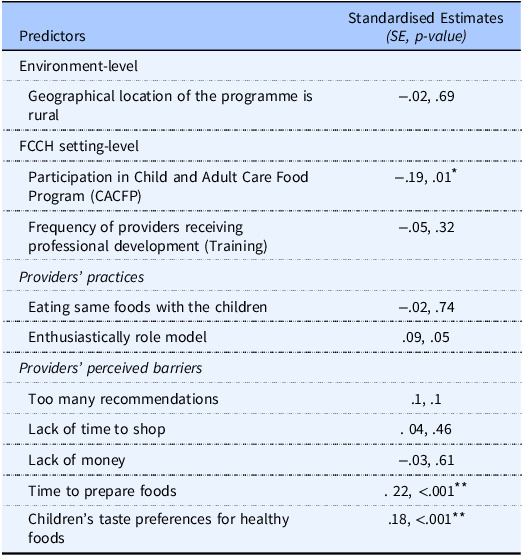
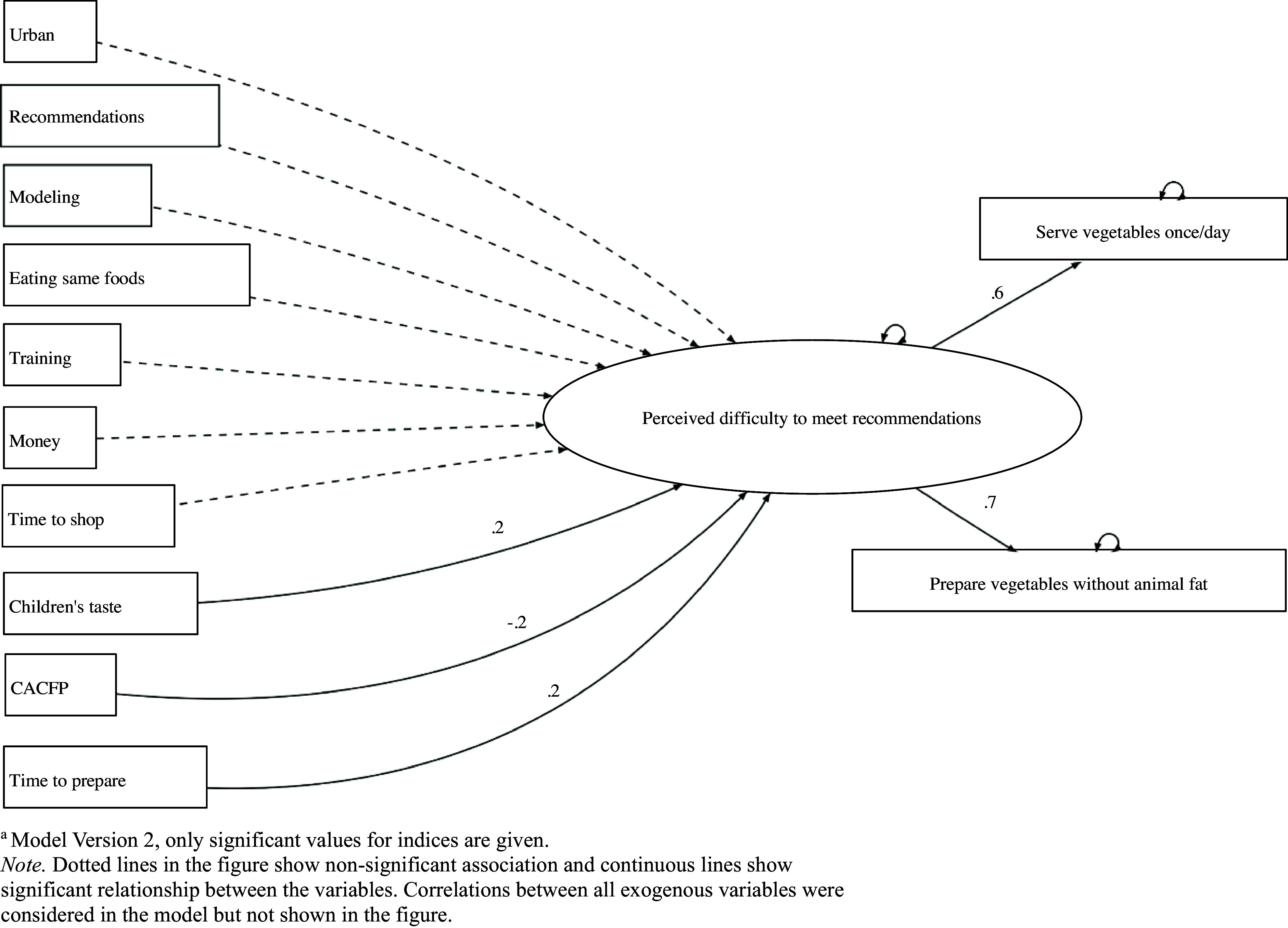
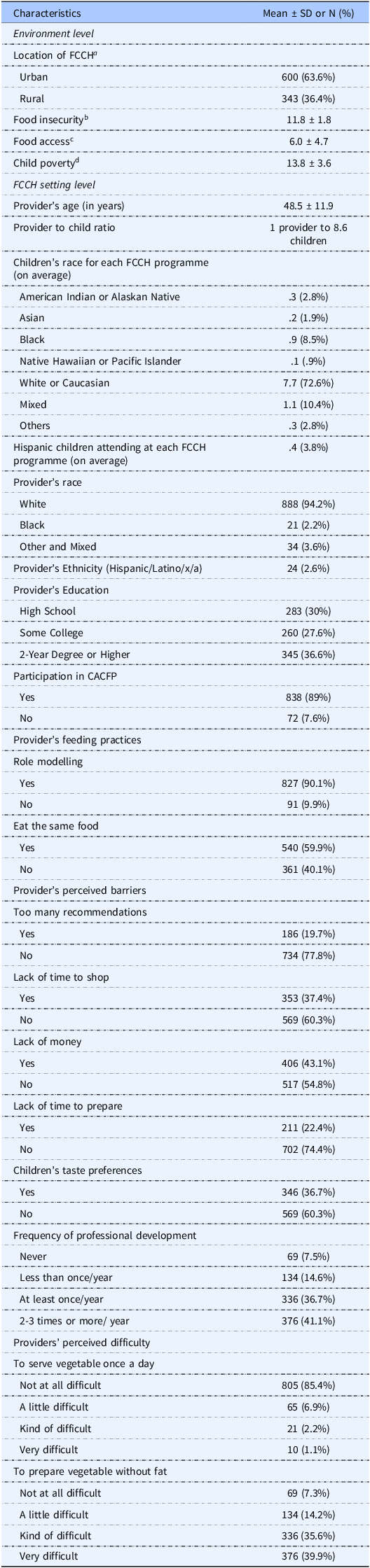
The study aims to identify family child care home (FCCH) setting- and environment-level predictors related to providers' perceived difficulty in implementing the Child and Adult Care Food Program (CACFP) recommendations for serving vegetables to children. This was a cross-sectional study, which used a validated paper-based survey with a multi-method data analysis approach. Participants were licenced FCCH providers (N = 943) in Nebraska, who were predominantly White (94%), non-Hispanic (97%), CACFP-participants (89%), and in urban areas (64%). Reflective latent variable modelling was conducted in Mplus to explore associations between dependent variable and predictors. Dependent variable was providers' perceived difficulty to implement CACFP recommendations for serving vegetables. Predictors were providers' mealtime practices, perceived barriers to serve healthy foods, CACFP participation, geographic location, food access, food insecurity, and child poverty. Qualitative comments (n=122) from the survey were analysed using direct content analysis approach. Providers' perceived lack of time to prepare foods and perceived children's taste preferences increased their perceived difficulty; and CACFP-participation decreased their perceived difficulty to implement CACFP recommendations for serving vegetables. Qualitative comments highlighted that providers felt discouraged to serve vegetables knowing that vegetables would likely be wasted because of children's preferences. More tailored professional development is required to address FCCH providers' perceived difficulty and build providers' skills on preparing time saving, CACFP-reimbursable and appealing vegetable recipes, and on strategies to promote vegetable consumption in children.
期刊介绍:
Journal of Nutritional Science is an international, peer-reviewed, online only, open access journal that welcomes high-quality research articles in all aspects of nutrition. The underlying aim of all work should be, as far as possible, to develop nutritional concepts. JNS encompasses the full spectrum of nutritional science including public health nutrition, epidemiology, dietary surveys, nutritional requirements, metabolic studies, body composition, energetics, appetite, obesity, ageing, endocrinology, immunology, neuroscience, microbiology, genetics, molecular and cellular biology and nutrigenomics. JNS welcomes Primary Research Papers, Brief Reports, Review Articles, Systematic Reviews, Workshop Reports, Letters to the Editor and Obituaries.




 京公网安备 11010802042870号
京ICP备2023020795号-1
京公网安备 11010802042870号
京ICP备2023020795号-1

 分享
分享
 求助内容:
求助内容: 应助结果提醒方式:
 扫码关注我们
