{"title":"The Boynton Illusion: Chromatic edge attraction to a luminance contour.","authors":"Jingyi He, Yesenia Taveras-Cruz, Rhea T Eskew","doi":"10.1167/jov.25.3.3","DOIUrl":null,"url":null,"abstract":"<p><p>In the Boynton Illusion, the perceived location of a low-contrast chromatic edge is altered by a nearby high-contrast luminance contour. Our study explores this color spreading effect across different chromatic directions using a position judgment task. We used the gap effect stimulus, which consists of a box evenly divided by a central contour, in half of the conditions. The suprathreshold chromatic test area embedded in the box provided a horizontal chromatic edge parallel to the central, high-contrast luminance contour that varied in its distance from the contour. An attraction effect of the nearest high-contrast contour on low-contrast chromatic and achromatic edges was observed. Specifically, when the test area is smaller than the region defined by the outer and middle contours, the edge is perceived to be closer to the middle contour (the colored area is perceived to be larger), a filling-in effect; conversely, when the test area extends beyond the middle contour, the edge is perceived to be closer to the middle contour (the colored area is perceived to be smaller), indicating a filling-out of color. Achromatic directions exhibit a relatively smaller effect than chromatic directions, whereas S-cone and equiluminant red and green edges show the same magnitude of positional displacement. The results can be interpreted as the visual system attempting to assign a single hue or brightness to a demarcated region.</p>","PeriodicalId":49955,"journal":{"name":"Journal of Vision","volume":"25 3","pages":"3"},"PeriodicalIF":2.3000,"publicationDate":"2025-03-03","publicationTypes":"Journal Article","fieldsOfStudy":null,"isOpenAccess":false,"openAccessPdf":"https://www.ncbi.nlm.nih.gov/pmc/articles/PMC11892525/pdf/","citationCount":"0","resultStr":null,"platform":"Semanticscholar","paperid":null,"PeriodicalName":"Journal of Vision","FirstCategoryId":"3","ListUrlMain":"https://doi.org/10.1167/jov.25.3.3","RegionNum":4,"RegionCategory":"心理学","ArticlePicture":[],"TitleCN":null,"AbstractTextCN":null,"PMCID":null,"EPubDate":"","PubModel":"","JCR":"Q2","JCRName":"OPHTHALMOLOGY","Score":null,"Total":0}
引用次数: 0
Abstract
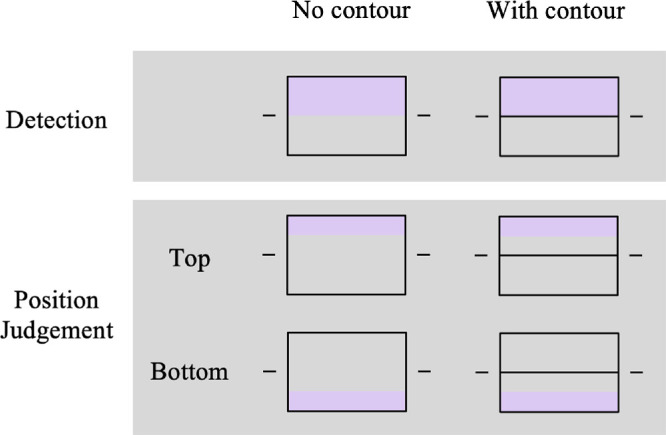
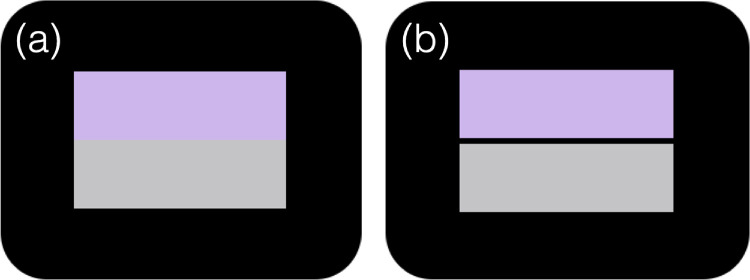
In the Boynton Illusion, the perceived location of a low-contrast chromatic edge is altered by a nearby high-contrast luminance contour. Our study explores this color spreading effect across different chromatic directions using a position judgment task. We used the gap effect stimulus, which consists of a box evenly divided by a central contour, in half of the conditions. The suprathreshold chromatic test area embedded in the box provided a horizontal chromatic edge parallel to the central, high-contrast luminance contour that varied in its distance from the contour. An attraction effect of the nearest high-contrast contour on low-contrast chromatic and achromatic edges was observed. Specifically, when the test area is smaller than the region defined by the outer and middle contours, the edge is perceived to be closer to the middle contour (the colored area is perceived to be larger), a filling-in effect; conversely, when the test area extends beyond the middle contour, the edge is perceived to be closer to the middle contour (the colored area is perceived to be smaller), indicating a filling-out of color. Achromatic directions exhibit a relatively smaller effect than chromatic directions, whereas S-cone and equiluminant red and green edges show the same magnitude of positional displacement. The results can be interpreted as the visual system attempting to assign a single hue or brightness to a demarcated region.
期刊介绍:
Exploring all aspects of biological visual function, including spatial vision, perception,
low vision, color vision and more, spanning the fields of neuroscience, psychology and psychophysics.




 京公网安备 11010802042870号
京ICP备2023020795号-1
京公网安备 11010802042870号
京ICP备2023020795号-1

 分享
分享
 求助内容:
求助内容: 应助结果提醒方式:
 扫码关注我们
