Oscar Fernandes Júnior, Ana Maria Jansen, Gabriel Carvalho de Macedo, Wesley Arruda Gimenes Nantes, Filipe Martins Santos, Nayara Yoshie Sano, Wanessa Teixeira Gomes Barreto, William Oliveira de Assis, Sany Caroline Liberal, Samanta Cristina das Chagas Xavier, Fernanda Moreira Alves, Maria Augusta Dario, Carina Elisei de Oliveira, André Luiz Rodrigues Roque, Heitor Miraglia Herrera
{"title":"Non-human primates as indicators of Kinetoplastida diversity in an urban environment in Midwest Brazil.","authors":"Oscar Fernandes Júnior, Ana Maria Jansen, Gabriel Carvalho de Macedo, Wesley Arruda Gimenes Nantes, Filipe Martins Santos, Nayara Yoshie Sano, Wanessa Teixeira Gomes Barreto, William Oliveira de Assis, Sany Caroline Liberal, Samanta Cristina das Chagas Xavier, Fernanda Moreira Alves, Maria Augusta Dario, Carina Elisei de Oliveira, André Luiz Rodrigues Roque, Heitor Miraglia Herrera","doi":"10.3389/fpara.2025.1547701","DOIUrl":null,"url":null,"abstract":"<p><strong>Introduction: </strong>Trypanosomatids are parasites widely distributed in nature, parasitizing several host species in single or co-infections. Campo Grande (CG), capital of Mato Grosso do Sul State, is characterized by several green areas and forest fragments where wild mammals have been reported infected by diverse trypanosomatid species. In this study, we evaluated the parasitism by trypanosomatids in the non-human primates (NHP) Sapajus cay and <i>Alouatta caraya</i> sampled in three different areas of CG.</p><p><strong>Material and methods: </strong>For the detection of infections and identification of trypanosomatid species, we made hemoculture, blood smears, molecular and serological tests.</p><p><strong>Results: </strong>We detected trypanosomatids in 37/55 (67.3%) of sampled animals, all by the molecular test. DNA sequencing analyzes were performed on 32 samples, resulting in the following species identification: <i>Trypanosoma cruzi</i>, <i>T. minasense</i>, <i>T. rangeli</i>, <i>Leishmania (L.)</i> infantum and <i>L. (L.) amazonensis</i> (species already recorded in primates in Latin America), and for the first time <i>T. lainsoni</i>, a parasite related to small mammals, and <i>Trypanosoma</i> sp. DID, originally reported in marsupials <i>Didelphis</i> sp.</p><p><strong>Discussion: </strong>The detection of trypanosomatids of public health importance as <i>L. infantum</i>, <i>L. amazonensis</i> and <i>T. cruzi</i> (genotypes TcI, TcII/TcVI and TcIV) indicates the enzootic character of these species in the studied area. Also, the presence of <i>T. cruzi</i> TcIV and <i>T. minasense</i> in the conservation area supports previous studies that these parasites would be associated with the arboreal stratum. We conclude that (i) the NHP at CG participate in a complex reservoir system for parasites of great importance for Public Health in the studied area, such as <i>L. infantum</i>, <i>L. amazonensis</i> and <i>T. cruzi</i>, and (ii) there is a great diversity of trypanosomatids circulating in the urban area of this city located in the Brazilian Midwest.</p>","PeriodicalId":73098,"journal":{"name":"Frontiers in parasitology","volume":"4 ","pages":"1547701"},"PeriodicalIF":0.0000,"publicationDate":"2025-02-17","publicationTypes":"Journal Article","fieldsOfStudy":null,"isOpenAccess":false,"openAccessPdf":"https://www.ncbi.nlm.nih.gov/pmc/articles/PMC11873808/pdf/","citationCount":"0","resultStr":null,"platform":"Semanticscholar","paperid":null,"PeriodicalName":"Frontiers in parasitology","FirstCategoryId":"1085","ListUrlMain":"https://doi.org/10.3389/fpara.2025.1547701","RegionNum":0,"RegionCategory":null,"ArticlePicture":[],"TitleCN":null,"AbstractTextCN":null,"PMCID":null,"EPubDate":"2025/1/1 0:00:00","PubModel":"eCollection","JCR":"","JCRName":"","Score":null,"Total":0}
引用次数: 0
Abstract
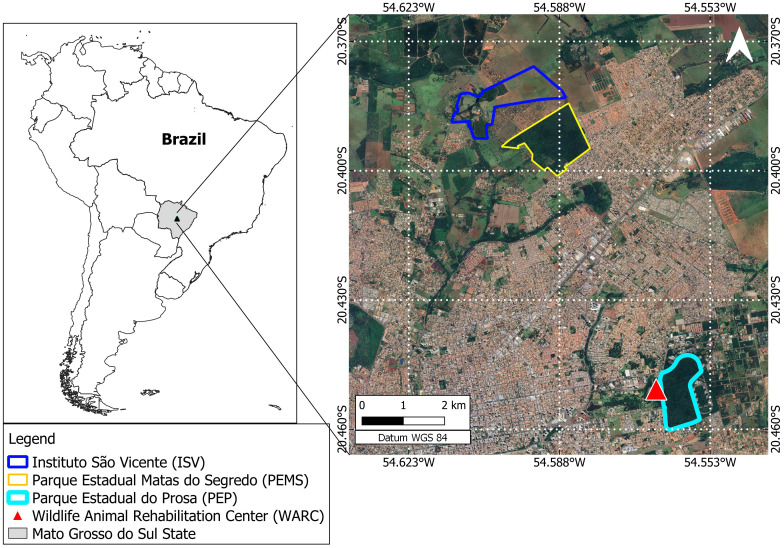
Introduction: Trypanosomatids are parasites widely distributed in nature, parasitizing several host species in single or co-infections. Campo Grande (CG), capital of Mato Grosso do Sul State, is characterized by several green areas and forest fragments where wild mammals have been reported infected by diverse trypanosomatid species. In this study, we evaluated the parasitism by trypanosomatids in the non-human primates (NHP) Sapajus cay and Alouatta caraya sampled in three different areas of CG.
Material and methods: For the detection of infections and identification of trypanosomatid species, we made hemoculture, blood smears, molecular and serological tests.
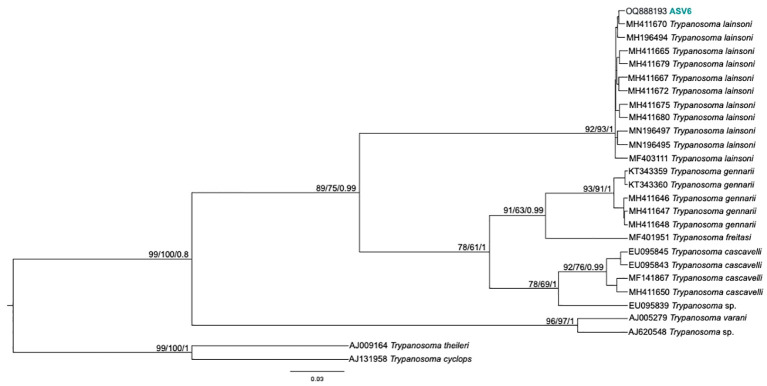
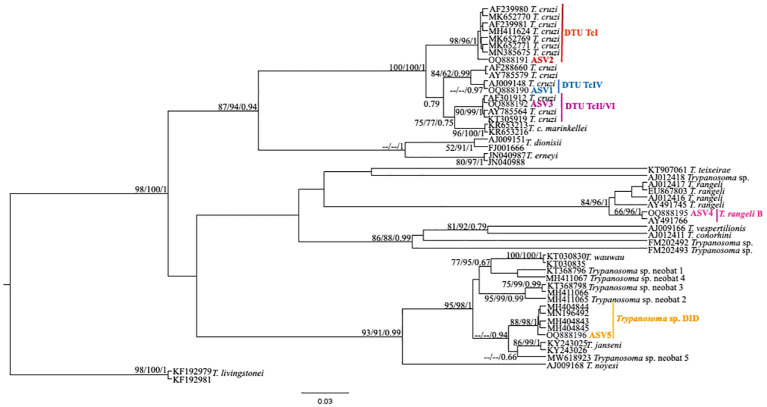
Results: We detected trypanosomatids in 37/55 (67.3%) of sampled animals, all by the molecular test. DNA sequencing analyzes were performed on 32 samples, resulting in the following species identification: Trypanosoma cruzi, T. minasense, T. rangeli, Leishmania (L.) infantum and L. (L.) amazonensis (species already recorded in primates in Latin America), and for the first time T. lainsoni, a parasite related to small mammals, and Trypanosoma sp. DID, originally reported in marsupials Didelphis sp.
Discussion: The detection of trypanosomatids of public health importance as L. infantum, L. amazonensis and T. cruzi (genotypes TcI, TcII/TcVI and TcIV) indicates the enzootic character of these species in the studied area. Also, the presence of T. cruzi TcIV and T. minasense in the conservation area supports previous studies that these parasites would be associated with the arboreal stratum. We conclude that (i) the NHP at CG participate in a complex reservoir system for parasites of great importance for Public Health in the studied area, such as L. infantum, L. amazonensis and T. cruzi, and (ii) there is a great diversity of trypanosomatids circulating in the urban area of this city located in the Brazilian Midwest.



 京公网安备 11010802042870号
京ICP备2023020795号-1
京公网安备 11010802042870号
京ICP备2023020795号-1

 分享
分享

 求助内容:
求助内容: 应助结果提醒方式:
 扫码关注我们
