Age-Related Differences in Adaptation of Lean Body Mass, Muscle Strength, and Performance Following 6 Weeks of Blood Flow Restriction Training in Young and Older Adults.
Julia K Arnason, Amy M Thomson, Logan E Peskett, Dawson A Nancekievill, Danielle R Bouchard, Martin Sénéchal
{"title":"Age-Related Differences in Adaptation of Lean Body Mass, Muscle Strength, and Performance Following 6 Weeks of Blood Flow Restriction Training in Young and Older Adults.","authors":"Julia K Arnason, Amy M Thomson, Logan E Peskett, Dawson A Nancekievill, Danielle R Bouchard, Martin Sénéchal","doi":"10.22540/JFSF-10-037","DOIUrl":null,"url":null,"abstract":"<p><strong>Objectives: </strong>The primary objective was to test the influence of age on lean body mass (LBM), muscle strength, and isokinetic performance adaptation following a 6-week blood-flow restriction training (BFRT) intervention.</p><p><strong>Methods: </strong>A total of 38 young adults (23.5±3.1) and 34 older adults (72.7±5.5) completed a 6-week BFRT program. Exercises were performed three times per week at 30% of 1-repetition maximums (1-RMs) and 60% of each limb's arterial occlusion pressure. Body composition was assessed using dual-energy X-ray absorptiometry, muscle strength was measured using 1-RMs, and muscular performance was measured using an isokinetic dynamometer.</p><p><strong>Results: </strong>A significant increase in LBM was observed in young adults (0.9±1.5kg; p<0.001) but not in older adults (0.3±1.3kg; p>0.05) following the intervention. Both age groups significantly improved 1-RMs for knee extension, knee flexion, and chest press, with the young group displaying greater improvements (all ps<0.001). A significant increase in knee flexion torque and power was observed in young adults (all ps<0.001) but not in older adults, while a significant difference between groups was observed (p<0.05).</p><p><strong>Conclusions: </strong>The results from our study suggest that young adults improve LBM and muscle performance following 6-weeks of BFRT, while older adults enhance performance, despite a lack of improvement in LBM. Clinicaltrials.gov ID: NCT05615831.</p>","PeriodicalId":73754,"journal":{"name":"Journal of frailty, sarcopenia and falls","volume":"10 1","pages":"37-47"},"PeriodicalIF":0.0000,"publicationDate":"2025-03-01","publicationTypes":"Journal Article","fieldsOfStudy":null,"isOpenAccess":false,"openAccessPdf":"https://www.ncbi.nlm.nih.gov/pmc/articles/PMC11872252/pdf/","citationCount":"0","resultStr":null,"platform":"Semanticscholar","paperid":null,"PeriodicalName":"Journal of frailty, sarcopenia and falls","FirstCategoryId":"1085","ListUrlMain":"https://doi.org/10.22540/JFSF-10-037","RegionNum":0,"RegionCategory":null,"ArticlePicture":[],"TitleCN":null,"AbstractTextCN":null,"PMCID":null,"EPubDate":"","PubModel":"","JCR":"","JCRName":"","Score":null,"Total":0}
引用次数: 0
Abstract
Objectives: The primary objective was to test the influence of age on lean body mass (LBM), muscle strength, and isokinetic performance adaptation following a 6-week blood-flow restriction training (BFRT) intervention.
Methods: A total of 38 young adults (23.5±3.1) and 34 older adults (72.7±5.5) completed a 6-week BFRT program. Exercises were performed three times per week at 30% of 1-repetition maximums (1-RMs) and 60% of each limb's arterial occlusion pressure. Body composition was assessed using dual-energy X-ray absorptiometry, muscle strength was measured using 1-RMs, and muscular performance was measured using an isokinetic dynamometer.
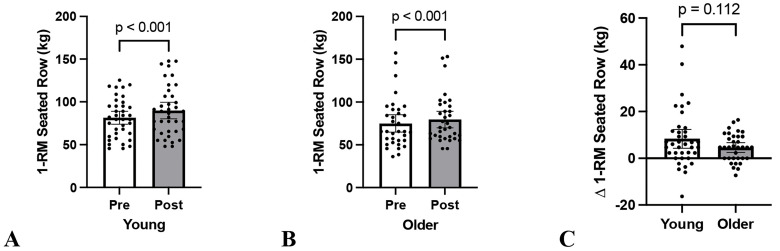
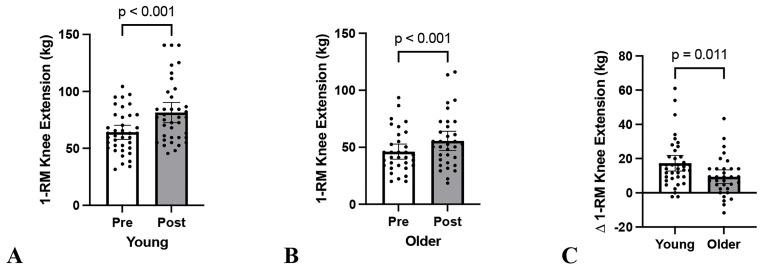
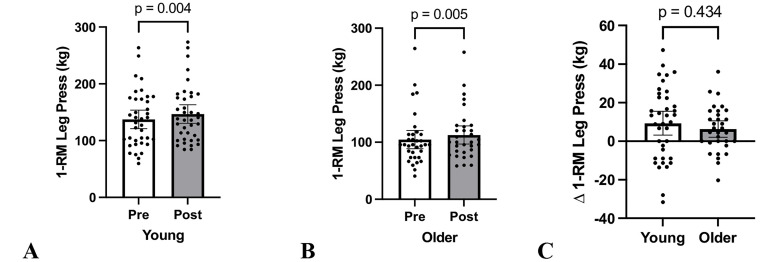
Results: A significant increase in LBM was observed in young adults (0.9±1.5kg; p<0.001) but not in older adults (0.3±1.3kg; p>0.05) following the intervention. Both age groups significantly improved 1-RMs for knee extension, knee flexion, and chest press, with the young group displaying greater improvements (all ps<0.001). A significant increase in knee flexion torque and power was observed in young adults (all ps<0.001) but not in older adults, while a significant difference between groups was observed (p<0.05).
Conclusions: The results from our study suggest that young adults improve LBM and muscle performance following 6-weeks of BFRT, while older adults enhance performance, despite a lack of improvement in LBM. Clinicaltrials.gov ID: NCT05615831.



 京公网安备 11010802042870号
京ICP备2023020795号-1
京公网安备 11010802042870号
京ICP备2023020795号-1

 分享
分享

 求助内容:
求助内容: 应助结果提醒方式:
 扫码关注我们
