{"title":"Accurate Identification and Mechanistic Evaluation of Pathogenic Missense Variants with <i>Rhapsody-2</i>.","authors":"Anupam Banerjee, Anthony Bogetti, Ivet Bahar","doi":"10.1101/2025.02.17.638727","DOIUrl":null,"url":null,"abstract":"<p><p>Understanding the effects of missense mutations or single amino acid variants (SAVs) on protein function is crucial for elucidating the molecular basis of diseases/disorders and designing rational therapies. We introduce here Rhapsody-2, a machine learning tool for discriminating pathogenic and neutral SAVs, significantly expanding on a precursor limited by the availability of structural data. With the advent of AlphaFold2 as a powerful tool for structure prediction, Rhapsody-2 is trained on a significantly expanded dataset of 117,525 SAVs corresponding to 12,094 human proteins reported in the ClinVar database. Adopting a broad set of descriptors composed of sequence evolutionary, structural, dynamic, and energetics features in the training algorithm, Rhapsody-2 achieved an AUROC of 0.94 in 10-fold cross-validation when all SAVs of a particular test protein (mutant) were excluded from the training set. Benchmarking against a variety of testing datasets demonstrated the high performance of Rhapsody-2. While sequence evolutionary descriptors play a dominant role in pathogenicity prediction, those based on structural dynamics provide a mechanistic interpretation. Notably, residues involved in allosteric communication, and those distinguished by pronounced fluctuations in the high frequency modes of motion or subject to spatial constraints in soft modes usually give rise to pathogenicity when mutated. Overall, Rhapsody-2 provides an efficient and transparent tool for accurately predicting the pathogenicity of SAVs and unraveling the mechanistic basis of the observed behavior, thus advancing our understanding of genotype-to-phenotype relations.</p>","PeriodicalId":519960,"journal":{"name":"bioRxiv : the preprint server for biology","volume":" ","pages":""},"PeriodicalIF":0.0000,"publicationDate":"2025-03-06","publicationTypes":"Journal Article","fieldsOfStudy":null,"isOpenAccess":false,"openAccessPdf":"https://www.ncbi.nlm.nih.gov/pmc/articles/PMC11870481/pdf/","citationCount":"0","resultStr":null,"platform":"Semanticscholar","paperid":null,"PeriodicalName":"bioRxiv : the preprint server for biology","FirstCategoryId":"1085","ListUrlMain":"https://doi.org/10.1101/2025.02.17.638727","RegionNum":0,"RegionCategory":null,"ArticlePicture":[],"TitleCN":null,"AbstractTextCN":null,"PMCID":null,"EPubDate":"","PubModel":"","JCR":"","JCRName":"","Score":null,"Total":0}
引用次数: 0
Abstract
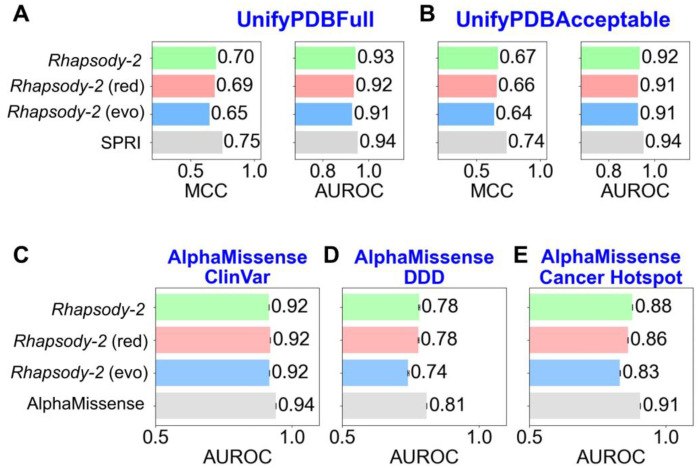
Understanding the effects of missense mutations or single amino acid variants (SAVs) on protein function is crucial for elucidating the molecular basis of diseases/disorders and designing rational therapies. We introduce here Rhapsody-2, a machine learning tool for discriminating pathogenic and neutral SAVs, significantly expanding on a precursor limited by the availability of structural data. With the advent of AlphaFold2 as a powerful tool for structure prediction, Rhapsody-2 is trained on a significantly expanded dataset of 117,525 SAVs corresponding to 12,094 human proteins reported in the ClinVar database. Adopting a broad set of descriptors composed of sequence evolutionary, structural, dynamic, and energetics features in the training algorithm, Rhapsody-2 achieved an AUROC of 0.94 in 10-fold cross-validation when all SAVs of a particular test protein (mutant) were excluded from the training set. Benchmarking against a variety of testing datasets demonstrated the high performance of Rhapsody-2. While sequence evolutionary descriptors play a dominant role in pathogenicity prediction, those based on structural dynamics provide a mechanistic interpretation. Notably, residues involved in allosteric communication, and those distinguished by pronounced fluctuations in the high frequency modes of motion or subject to spatial constraints in soft modes usually give rise to pathogenicity when mutated. Overall, Rhapsody-2 provides an efficient and transparent tool for accurately predicting the pathogenicity of SAVs and unraveling the mechanistic basis of the observed behavior, thus advancing our understanding of genotype-to-phenotype relations.





 京公网安备 11010802042870号
京ICP备2023020795号-1
京公网安备 11010802042870号
京ICP备2023020795号-1

 分享
分享

 求助内容:
求助内容: 应助结果提醒方式:
 扫码关注我们
