Helen L. Hayden , Reza Ghaderi , Conrad Trollip , Hang-Wei Hu , Ji-Zheng He
{"title":"Advancing the use of metabarcoding derived nematode-based indices as soil health bioindicators in agricultural and natural environments","authors":"Helen L. Hayden , Reza Ghaderi , Conrad Trollip , Hang-Wei Hu , Ji-Zheng He","doi":"10.1016/j.soilbio.2025.109772","DOIUrl":null,"url":null,"abstract":"<div><div>Effective frameworks for assessing soil health are a priority, yet the value and adoption of soil biological indicators remain debated. Biological indicators provide essential information on ecosystem functions such as nutrient cycling, population regulation, and organic matter decomposition. Nematode-based indices (NBIs) have long been used by soil ecologists to study biodiversity, the soil food web and ecosystem functions. DNA metabarcoding of soil nematode communities is being increasingly used as a more cost-efficient and high-throughput approach than traditional morphology-based identification. Molecular-based NBIs have great potential as soil health bioindicators if method uncertainties can be addressed. We critically review recent nematode metabarcoding methods for soils and highlight the advantages and limitations associated with different workflow steps including the nematode elutriation method, DNA extraction method, barcode and primer choices, and database selection. Based on an analysis of 95 studies, we propose an updated standardised metabarcoding workflow that includes (a) nematode elutriation from large soil quantities, (b) bulk nematode DNA extraction, (c) the use of the 18S rRNA primers NF1/18Sr2b and (d) curated reference databases for sequence identification. While challenges in concordance between molecular and morphological NBIs remain, improved standardisation of DNA metabarcoding protocols may enable more detailed investigations of nematode distribution across diverse environments and testing of molecular-based NBIs in relation to soil disturbances, management practices, temporal scales, soil functional processes, and soil physicochemical properties. These efforts could strengthen the inclusion of NBIs in models and frameworks supporting soil health management strategies.</div></div>","PeriodicalId":21888,"journal":{"name":"Soil Biology & Biochemistry","volume":"205 ","pages":"Article 109772"},"PeriodicalIF":10.3000,"publicationDate":"2025-03-05","publicationTypes":"Journal Article","fieldsOfStudy":null,"isOpenAccess":false,"openAccessPdf":"","citationCount":"0","resultStr":null,"platform":"Semanticscholar","paperid":null,"PeriodicalName":"Soil Biology & Biochemistry","FirstCategoryId":"97","ListUrlMain":"https://www.sciencedirect.com/science/article/pii/S0038071725000653","RegionNum":1,"RegionCategory":"农林科学","ArticlePicture":[],"TitleCN":null,"AbstractTextCN":null,"PMCID":null,"EPubDate":"","PubModel":"","JCR":"Q1","JCRName":"SOIL SCIENCE","Score":null,"Total":0}
引用次数: 0
Abstract
Effective frameworks for assessing soil health are a priority, yet the value and adoption of soil biological indicators remain debated. Biological indicators provide essential information on ecosystem functions such as nutrient cycling, population regulation, and organic matter decomposition. Nematode-based indices (NBIs) have long been used by soil ecologists to study biodiversity, the soil food web and ecosystem functions. DNA metabarcoding of soil nematode communities is being increasingly used as a more cost-efficient and high-throughput approach than traditional morphology-based identification. Molecular-based NBIs have great potential as soil health bioindicators if method uncertainties can be addressed. We critically review recent nematode metabarcoding methods for soils and highlight the advantages and limitations associated with different workflow steps including the nematode elutriation method, DNA extraction method, barcode and primer choices, and database selection. Based on an analysis of 95 studies, we propose an updated standardised metabarcoding workflow that includes (a) nematode elutriation from large soil quantities, (b) bulk nematode DNA extraction, (c) the use of the 18S rRNA primers NF1/18Sr2b and (d) curated reference databases for sequence identification. While challenges in concordance between molecular and morphological NBIs remain, improved standardisation of DNA metabarcoding protocols may enable more detailed investigations of nematode distribution across diverse environments and testing of molecular-based NBIs in relation to soil disturbances, management practices, temporal scales, soil functional processes, and soil physicochemical properties. These efforts could strengthen the inclusion of NBIs in models and frameworks supporting soil health management strategies.
期刊介绍:
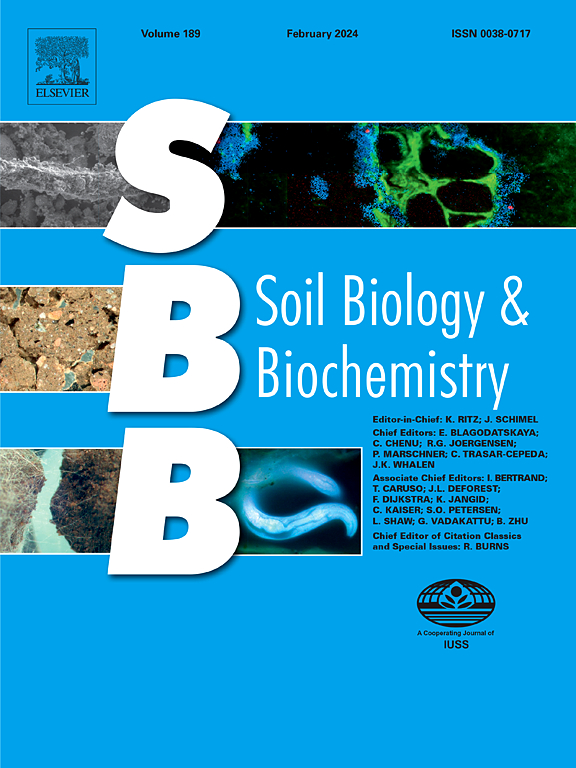
Soil Biology & Biochemistry publishes original research articles of international significance focusing on biological processes in soil and their applications to soil and environmental quality. Major topics include the ecology and biochemical processes of soil organisms, their effects on the environment, and interactions with plants. The journal also welcomes state-of-the-art reviews and discussions on contemporary research in soil biology and biochemistry.



 京公网安备 11010802042870号
京ICP备2023020795号-1
京公网安备 11010802042870号
京ICP备2023020795号-1

 分享
分享
 求助内容:
求助内容: 应助结果提醒方式:
 扫码关注我们
