Coherent Single-Atom Dipole–Dipole Coupling Mediates Holistic Regulation of K+ Migration for Superior Energy Storage and Dendrite-Free Metal Deposition
{"title":"Coherent Single-Atom Dipole–Dipole Coupling Mediates Holistic Regulation of K+ Migration for Superior Energy Storage and Dendrite-Free Metal Deposition","authors":"Yen-Yang Tseng, Hsing-Yu Tuan","doi":"10.1002/adfm.202423387","DOIUrl":null,"url":null,"abstract":"<p>Potassium-based batteries, including potassium-ion (PIBs) and potassium metal batteries (PMBs), are gaining attention as alternatives to lithium-ion batteries (LIBs). However, potassium's large ionic radius (1.38 Å) reduces charge density, weakens solvation, and increases energy barriers for K<sup>+</sup> diffusion, leading to slower reaction kinetics, thicker solid electrolyte interphase (SEI) layers, and dendrite formation. To address these challenges, a novel single-atom Fe-N<sub>4</sub> dipole–dipole coupling (SA.Fe) is proposed. The unique Fe-N<sub>4</sub> coordination and highly conductive Ketjen black (KB) substrate establish a rapid horizontal electron transfer network, enhancing electrode interface reactions. Moreover, Fe-N-C coordination generates a short-range polar electric field, improving K<sup>+</sup> affinity and diffusion. This coherent single-atom coupling effectively regulates K<sup>+</sup> migration, significantly enhancing reaction kinetics and lowering diffusion barriers. The SA.Fe anode delivers high reversible capacities (446.3 mAh g<sup>−1</sup>) and exceptional durability (10 000 cycles at 2.0 A g<sup>−1</sup>) in PIBs, alongside remarkable stability (600 cycles at 0.5 mA cm<sup>−2</sup>) and fast potassium metal (K metal) deposition without dendrite formation in PMBs. This study highlights the potential of coherent single-atom dipole coupling for efficient K<sup>+</sup> storage and dendrite-free batteries, offering a promising pathway for next-generation potassium-based energy systems.</p>","PeriodicalId":112,"journal":{"name":"Advanced Functional Materials","volume":"35 31","pages":""},"PeriodicalIF":19.0000,"publicationDate":"2025-03-05","publicationTypes":"Journal Article","fieldsOfStudy":null,"isOpenAccess":false,"openAccessPdf":"","citationCount":"0","resultStr":null,"platform":"Semanticscholar","paperid":null,"PeriodicalName":"Advanced Functional Materials","FirstCategoryId":"88","ListUrlMain":"https://advanced.onlinelibrary.wiley.com/doi/10.1002/adfm.202423387","RegionNum":1,"RegionCategory":"材料科学","ArticlePicture":[],"TitleCN":null,"AbstractTextCN":null,"PMCID":null,"EPubDate":"","PubModel":"","JCR":"Q1","JCRName":"CHEMISTRY, MULTIDISCIPLINARY","Score":null,"Total":0}
引用次数: 0
Abstract
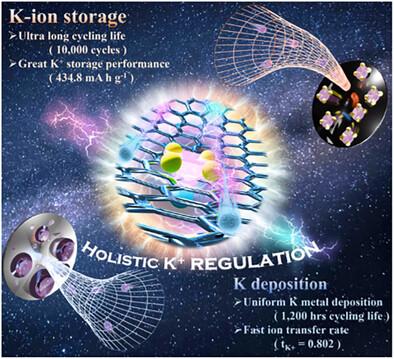
Potassium-based batteries, including potassium-ion (PIBs) and potassium metal batteries (PMBs), are gaining attention as alternatives to lithium-ion batteries (LIBs). However, potassium's large ionic radius (1.38 Å) reduces charge density, weakens solvation, and increases energy barriers for K+ diffusion, leading to slower reaction kinetics, thicker solid electrolyte interphase (SEI) layers, and dendrite formation. To address these challenges, a novel single-atom Fe-N4 dipole–dipole coupling (SA.Fe) is proposed. The unique Fe-N4 coordination and highly conductive Ketjen black (KB) substrate establish a rapid horizontal electron transfer network, enhancing electrode interface reactions. Moreover, Fe-N-C coordination generates a short-range polar electric field, improving K+ affinity and diffusion. This coherent single-atom coupling effectively regulates K+ migration, significantly enhancing reaction kinetics and lowering diffusion barriers. The SA.Fe anode delivers high reversible capacities (446.3 mAh g−1) and exceptional durability (10 000 cycles at 2.0 A g−1) in PIBs, alongside remarkable stability (600 cycles at 0.5 mA cm−2) and fast potassium metal (K metal) deposition without dendrite formation in PMBs. This study highlights the potential of coherent single-atom dipole coupling for efficient K+ storage and dendrite-free batteries, offering a promising pathway for next-generation potassium-based energy systems.
钾基电池,包括钾离子电池(PIBs)和钾金属电池(PMBs),正作为锂离子电池(lib)的替代品而受到关注。然而,钾的大离子半径(1.38 Å)降低了电荷密度,减弱了溶剂化作用,增加了K+扩散的能量垒,导致反应动力学变慢,固体电解质间相(SEI)层变厚,以及枝晶的形成。为了解决这些挑战,提出了一种新的单原子Fe-N4偶极子-偶极子耦合(SA.Fe)。独特的Fe-N4配位和高导电性的Ketjen black (KB)衬底建立了快速的水平电子转移网络,增强了电极界面反应。此外,Fe-N-C配位产生了短程极性电场,改善了K+的亲和力和扩散。这种相干单原子耦合有效地调节了K+迁移,显著提高了反应动力学,降低了扩散障碍。SA。铁阳极在PIBs中具有高可逆容量(446.3 mAh g−1)和卓越的耐久性(2.0 A g−1下10,000次循环),以及卓越的稳定性(0.5 mA cm−2下600次循环)和快速金属钾(K金属)沉积而不形成枝晶。这项研究强调了相干单原子偶极子耦合在高效K+存储和无枝晶电池中的潜力,为下一代钾基能源系统提供了一条有希望的途径。
期刊介绍:
Firmly established as a top-tier materials science journal, Advanced Functional Materials reports breakthrough research in all aspects of materials science, including nanotechnology, chemistry, physics, and biology every week.
Advanced Functional Materials is known for its rapid and fair peer review, quality content, and high impact, making it the first choice of the international materials science community.






 京公网安备 11010802042870号
京ICP备2023020795号-1
京公网安备 11010802042870号
京ICP备2023020795号-1

 分享
分享
 求助内容:
求助内容: 应助结果提醒方式:
 扫码关注我们
