Haoze Zhang, Malur C. Nagashree, Richard F. Webster, Zhipeng Wang, Xiaoran Zheng, Suresh D. Kulkarni, Rajendra B. Venkataramana, Jan Seidel, Pankaj Sharma
{"title":"Optical Control of Ferroelectric Imprint in BiFeO3","authors":"Haoze Zhang, Malur C. Nagashree, Richard F. Webster, Zhipeng Wang, Xiaoran Zheng, Suresh D. Kulkarni, Rajendra B. Venkataramana, Jan Seidel, Pankaj Sharma","doi":"10.1002/adfm.202502700","DOIUrl":null,"url":null,"abstract":"<p>Achieving reliable performance in advanced ferroelectric thin-film devices depends on effectively controlling ferroelectric imprint—an internal electric field that can cause polarization fatigue and retention loss challenges. This imprint arises from factors such as charged defects, strain, and electrostatic boundary conditions, and thus can be influenced by the chemical environment, growth conditions, and external stimuli like temperature and light. In this work, dynamic optical control of imprint behavior in high-performance BiFeO₃ (BFO) thin films fabricated via low-cost, scalable spray pyrolysis, using above-bandgap light irradiation at room temperature is achieved. Through X-ray photoelectron spectroscopy, transmission electron and scanning probe microscopy, it is revealed that the distribution of charged defects, including Fe<sup>2</sup>⁺ ions and oxygen vacancies at the interface and bulk, corresponds to the real-space mapping of the “frozen-in” imprint patterns and pristine polarization. Interestingly, while the electrical reversal of the polarization direction leaves the imprint behavior unchanged, it can be finely tuned using the above-band-gap light. This light stimulus generates non-equilibrium photocarriers with much faster kinetics, reducing the internal electric field and enabling polarization reorientation. These results pave the way for optically controlled polarization switching at room temperature, offering exciting possibilities for the development of ferroelectric optoelectronic memory and sensing devices.</p>","PeriodicalId":112,"journal":{"name":"Advanced Functional Materials","volume":"35 31","pages":""},"PeriodicalIF":19.0000,"publicationDate":"2025-03-05","publicationTypes":"Journal Article","fieldsOfStudy":null,"isOpenAccess":false,"openAccessPdf":"https://advanced.onlinelibrary.wiley.com/doi/epdf/10.1002/adfm.202502700","citationCount":"0","resultStr":null,"platform":"Semanticscholar","paperid":null,"PeriodicalName":"Advanced Functional Materials","FirstCategoryId":"88","ListUrlMain":"https://advanced.onlinelibrary.wiley.com/doi/10.1002/adfm.202502700","RegionNum":1,"RegionCategory":"材料科学","ArticlePicture":[],"TitleCN":null,"AbstractTextCN":null,"PMCID":null,"EPubDate":"","PubModel":"","JCR":"Q1","JCRName":"CHEMISTRY, MULTIDISCIPLINARY","Score":null,"Total":0}
引用次数: 0
Abstract
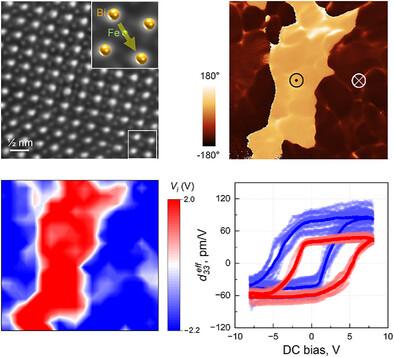
Achieving reliable performance in advanced ferroelectric thin-film devices depends on effectively controlling ferroelectric imprint—an internal electric field that can cause polarization fatigue and retention loss challenges. This imprint arises from factors such as charged defects, strain, and electrostatic boundary conditions, and thus can be influenced by the chemical environment, growth conditions, and external stimuli like temperature and light. In this work, dynamic optical control of imprint behavior in high-performance BiFeO₃ (BFO) thin films fabricated via low-cost, scalable spray pyrolysis, using above-bandgap light irradiation at room temperature is achieved. Through X-ray photoelectron spectroscopy, transmission electron and scanning probe microscopy, it is revealed that the distribution of charged defects, including Fe2⁺ ions and oxygen vacancies at the interface and bulk, corresponds to the real-space mapping of the “frozen-in” imprint patterns and pristine polarization. Interestingly, while the electrical reversal of the polarization direction leaves the imprint behavior unchanged, it can be finely tuned using the above-band-gap light. This light stimulus generates non-equilibrium photocarriers with much faster kinetics, reducing the internal electric field and enabling polarization reorientation. These results pave the way for optically controlled polarization switching at room temperature, offering exciting possibilities for the development of ferroelectric optoelectronic memory and sensing devices.
期刊介绍:
Firmly established as a top-tier materials science journal, Advanced Functional Materials reports breakthrough research in all aspects of materials science, including nanotechnology, chemistry, physics, and biology every week.
Advanced Functional Materials is known for its rapid and fair peer review, quality content, and high impact, making it the first choice of the international materials science community.






 京公网安备 11010802042870号
京ICP备2023020795号-1
京公网安备 11010802042870号
京ICP备2023020795号-1

 分享
分享
 求助内容:
求助内容: 应助结果提醒方式:
 扫码关注我们
