Elliot D. Hill, Pratik Kashyap, Elizabeth Raffanello, Yun Wang, Terrie E. Moffitt, Avshalom Caspi, Matthew Engelhard, Jonathan Posner
{"title":"Prediction of mental health risk in adolescents","authors":"Elliot D. Hill, Pratik Kashyap, Elizabeth Raffanello, Yun Wang, Terrie E. Moffitt, Avshalom Caspi, Matthew Engelhard, Jonathan Posner","doi":"10.1038/s41591-025-03560-7","DOIUrl":null,"url":null,"abstract":"Prospective prediction of mental health risk in adolescence can facilitate early preventive interventions. Here, using psychosocial questionnaires and neuroimaging measures from over 11,000 children in the Adolescent Brain and Cognitive Development Study, we trained neural network models to stratify general psychopathology risk. The model trained on current symptoms accurately predicted which participants would convert into the highest psychiatric illness risk group in the following year (area under the receiver operating characteristic curve = 0.84). The model trained solely on potential etiologies or disease mechanisms achieved an area under the receiver operating characteristic curve of 0.75 without relying on the child’s current symptom burden. Sleep disturbances emerged as the most influential predictor of high-risk status, surpassing adverse childhood experiences and family mental health history. Including neuroimaging measures did not enhance predictive performance. These findings suggest that artificial intelligence models trained on readily available psychosocial questionnaires can effectively predict future psychiatric risk while highlighting potential targets for intervention. This is a promising step toward artificial intelligence-based mental health screening for clinical decision support systems. Using longitudinal survey and neuroimaging data from more than 11,000 adolescents in the United States, a machine learning model shows promising performance in identifying individuals at greater risk of transitioning to psychopathology, pinpointing sleep disturbances as the most predictive risk factor.","PeriodicalId":19037,"journal":{"name":"Nature Medicine","volume":"31 6","pages":"1840-1846"},"PeriodicalIF":50.0000,"publicationDate":"2025-03-05","publicationTypes":"Journal Article","fieldsOfStudy":null,"isOpenAccess":false,"openAccessPdf":"","citationCount":"0","resultStr":null,"platform":"Semanticscholar","paperid":null,"PeriodicalName":"Nature Medicine","FirstCategoryId":"3","ListUrlMain":"https://www.nature.com/articles/s41591-025-03560-7","RegionNum":1,"RegionCategory":"医学","ArticlePicture":[],"TitleCN":null,"AbstractTextCN":null,"PMCID":null,"EPubDate":"","PubModel":"","JCR":"Q1","JCRName":"BIOCHEMISTRY & MOLECULAR BIOLOGY","Score":null,"Total":0}
引用次数: 0
Abstract
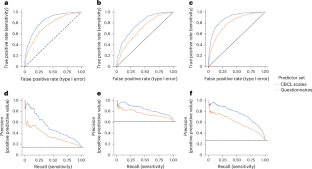
Prospective prediction of mental health risk in adolescence can facilitate early preventive interventions. Here, using psychosocial questionnaires and neuroimaging measures from over 11,000 children in the Adolescent Brain and Cognitive Development Study, we trained neural network models to stratify general psychopathology risk. The model trained on current symptoms accurately predicted which participants would convert into the highest psychiatric illness risk group in the following year (area under the receiver operating characteristic curve = 0.84). The model trained solely on potential etiologies or disease mechanisms achieved an area under the receiver operating characteristic curve of 0.75 without relying on the child’s current symptom burden. Sleep disturbances emerged as the most influential predictor of high-risk status, surpassing adverse childhood experiences and family mental health history. Including neuroimaging measures did not enhance predictive performance. These findings suggest that artificial intelligence models trained on readily available psychosocial questionnaires can effectively predict future psychiatric risk while highlighting potential targets for intervention. This is a promising step toward artificial intelligence-based mental health screening for clinical decision support systems. Using longitudinal survey and neuroimaging data from more than 11,000 adolescents in the United States, a machine learning model shows promising performance in identifying individuals at greater risk of transitioning to psychopathology, pinpointing sleep disturbances as the most predictive risk factor.
期刊介绍:
Nature Medicine is a monthly journal publishing original peer-reviewed research in all areas of medicine. The publication focuses on originality, timeliness, interdisciplinary interest, and the impact on improving human health. In addition to research articles, Nature Medicine also publishes commissioned content such as News, Reviews, and Perspectives. This content aims to provide context for the latest advances in translational and clinical research, reaching a wide audience of M.D. and Ph.D. readers. All editorial decisions for the journal are made by a team of full-time professional editors.
Nature Medicine consider all types of clinical research, including:
-Case-reports and small case series
-Clinical trials, whether phase 1, 2, 3 or 4
-Observational studies
-Meta-analyses
-Biomarker studies
-Public and global health studies
Nature Medicine is also committed to facilitating communication between translational and clinical researchers. As such, we consider “hybrid” studies with preclinical and translational findings reported alongside data from clinical studies.




 京公网安备 11010802042870号
京ICP备2023020795号-1
京公网安备 11010802042870号
京ICP备2023020795号-1

 分享
分享
 求助内容:
求助内容: 应助结果提醒方式:
 扫码关注我们
