Bai Cui, Huandong Luo, Bin He, Xinyu Liu, Dekang Lv, Xiaoyu Zhang, Keyu Su, Sijia Zheng, Jinxin Lu, Cenxin Wang, Yuqing Yang, Zhuoran Zhao, Xianxian Liu, Xu Wang, Yingrui Zhao, Xiaoshan Nie, Yuanyuan Jiang, Ziyu Zhang, Congcong Liu, Xinyi Chen, Anqi Cai, Zhumeng Lv, Zhihang Liu, Fan An, Yunkun Zhang, Qiulong Yan, Keith W. Kelley, Guowang Xu, Lingzhi Xu, Quentin Liu, Fei Peng
{"title":"Gut dysbiosis conveys psychological stress to activate LRP5/β-catenin pathway promoting cancer stemness","authors":"Bai Cui, Huandong Luo, Bin He, Xinyu Liu, Dekang Lv, Xiaoyu Zhang, Keyu Su, Sijia Zheng, Jinxin Lu, Cenxin Wang, Yuqing Yang, Zhuoran Zhao, Xianxian Liu, Xu Wang, Yingrui Zhao, Xiaoshan Nie, Yuanyuan Jiang, Ziyu Zhang, Congcong Liu, Xinyi Chen, Anqi Cai, Zhumeng Lv, Zhihang Liu, Fan An, Yunkun Zhang, Qiulong Yan, Keith W. Kelley, Guowang Xu, Lingzhi Xu, Quentin Liu, Fei Peng","doi":"10.1038/s41392-025-02159-1","DOIUrl":null,"url":null,"abstract":"<p>Psychological stress causes gut microbial dysbiosis and cancer progression, yet how gut microbiota determines psychological stress-induced tumor development remains unclear. Here we showed that psychological stress promotes breast tumor growth and cancer stemness, an outcome that depends on gut microbiota in germ-free and antibiotic-treated mice. Metagenomic and metabolomic analyses revealed that psychological stress markedly alters the composition and abundance of gut microbiota, especially <i>Akkermansia muciniphila</i> (<i>A. muciniphila</i>), and decreases short-chain fatty acid butyrate. Supplement of active <i>A. muciniphila</i>, butyrate or a butyrate-producing high fiber diet dramatically reversed the oncogenic property and anxiety-like behavior of psychological stress in a murine spontaneous tumor model or an orthotopic tumor model. Mechanistically, RNA sequencing analysis screened out that butyrate decreases LRP5 expression to block the activation of Wnt/β-catenin signaling pathway, dampening breast cancer stemness. Moreover, butyrate as a HDAC inhibitor elevated histone H3K9 acetylation level to transcriptionally activate ZFP36, which further accelerates LRP5 mRNA decay by binding adenine uridine-rich (AU-rich) elements of LRP5 transcript. Clinically, fecal <i>A. muciniphila</i> and serum butyrate were inversely correlated with tumoral LRP5/β-catenin expression, poor prognosis and negative mood in breast cancer patients. Altogether, our findings uncover a microbiota-dependent mechanism of psychological stress-triggered cancer stemness, and provide both clinical biomarkers and potential therapeutic avenues for cancer patients undergoing psychological stress.</p>","PeriodicalId":21766,"journal":{"name":"Signal Transduction and Targeted Therapy","volume":"16 1","pages":""},"PeriodicalIF":52.7000,"publicationDate":"2025-03-05","publicationTypes":"Journal Article","fieldsOfStudy":null,"isOpenAccess":false,"openAccessPdf":"","citationCount":"0","resultStr":null,"platform":"Semanticscholar","paperid":null,"PeriodicalName":"Signal Transduction and Targeted Therapy","FirstCategoryId":"3","ListUrlMain":"https://doi.org/10.1038/s41392-025-02159-1","RegionNum":1,"RegionCategory":"医学","ArticlePicture":[],"TitleCN":null,"AbstractTextCN":null,"PMCID":null,"EPubDate":"","PubModel":"","JCR":"Q1","JCRName":"BIOCHEMISTRY & MOLECULAR BIOLOGY","Score":null,"Total":0}
引用次数: 0
Abstract
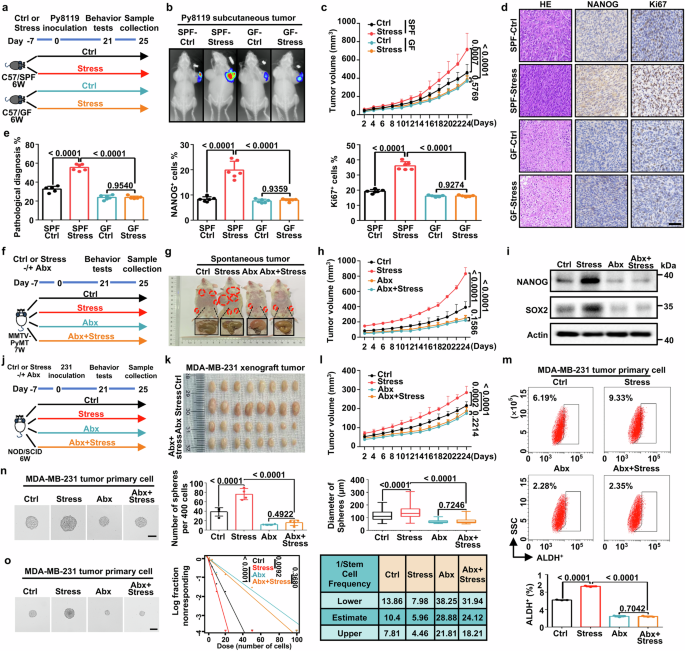
Psychological stress causes gut microbial dysbiosis and cancer progression, yet how gut microbiota determines psychological stress-induced tumor development remains unclear. Here we showed that psychological stress promotes breast tumor growth and cancer stemness, an outcome that depends on gut microbiota in germ-free and antibiotic-treated mice. Metagenomic and metabolomic analyses revealed that psychological stress markedly alters the composition and abundance of gut microbiota, especially Akkermansia muciniphila (A. muciniphila), and decreases short-chain fatty acid butyrate. Supplement of active A. muciniphila, butyrate or a butyrate-producing high fiber diet dramatically reversed the oncogenic property and anxiety-like behavior of psychological stress in a murine spontaneous tumor model or an orthotopic tumor model. Mechanistically, RNA sequencing analysis screened out that butyrate decreases LRP5 expression to block the activation of Wnt/β-catenin signaling pathway, dampening breast cancer stemness. Moreover, butyrate as a HDAC inhibitor elevated histone H3K9 acetylation level to transcriptionally activate ZFP36, which further accelerates LRP5 mRNA decay by binding adenine uridine-rich (AU-rich) elements of LRP5 transcript. Clinically, fecal A. muciniphila and serum butyrate were inversely correlated with tumoral LRP5/β-catenin expression, poor prognosis and negative mood in breast cancer patients. Altogether, our findings uncover a microbiota-dependent mechanism of psychological stress-triggered cancer stemness, and provide both clinical biomarkers and potential therapeutic avenues for cancer patients undergoing psychological stress.
期刊介绍:
Signal Transduction and Targeted Therapy is an open access journal that focuses on timely publication of cutting-edge discoveries and advancements in basic science and clinical research related to signal transduction and targeted therapy.
Scope: The journal covers research on major human diseases, including, but not limited to:
Cancer,Cardiovascular diseases,Autoimmune diseases,Nervous system diseases.



 京公网安备 11010802042870号
京ICP备2023020795号-1
京公网安备 11010802042870号
京ICP备2023020795号-1

 分享
分享
 求助内容:
求助内容: 应助结果提醒方式:
 扫码关注我们
