{"title":"Anode Alchemy on Multiscale: Engineering from Intrinsic Activity to Impedance Optimization for Efficient Water Electrolysis","authors":"Xiaotong Wu, Faiza Meharban, Jingsan Xu, Zian Zhao, Xiangmin Tang, Lei Tan, Yujie Song, Weibo Hu, Qi Xiao, Chao Lin, Xiaopeng Li, Yejian Xue, Wei Luo","doi":"10.1002/smll.202411704","DOIUrl":null,"url":null,"abstract":"<p>The past decade has seen significant progress in proton exchange membrane water electrolyzers (PEMWE), but the growing demand for cost-effective electrolytic hydrogen pushes for higher efficiency at lower costs. As a complex system, the performance of PEMWE is governed by a combination of multiscale factors. This review summarizes the latest progress from quantum to macroscopic scales. At the quantum level, electron spin configurations can be optimized to enhance catalytic activity. At the nano and meso scales, advancements in atomic structure optimization, crystal phase engineering, and heterostructure design improve catalytic performance and mass transport. At the macro scale, innovative techniques in gas bubble management and internal resistance reduction drive further efficiency gains under ampere-level operating conditions. These modifications at the quantum level cascade through meso- and macro-scales, affecting charge transfer, reaction kinetics, and gas evolution management. Unlike conventional approaches that focus solely on one scale—either at the catalyst level (e.g., atomic, or crystal modifications) or at the device level (e.g., porous transport layers design)—combining multiscale optimizations unlocks greater performance improvements. Finally, a perspective on future opportunities for multiscale engineering in PEMWE anode design toward commercial viability is offered.</p>","PeriodicalId":228,"journal":{"name":"Small","volume":"21 14","pages":""},"PeriodicalIF":12.1000,"publicationDate":"2025-03-05","publicationTypes":"Journal Article","fieldsOfStudy":null,"isOpenAccess":false,"openAccessPdf":"","citationCount":"0","resultStr":null,"platform":"Semanticscholar","paperid":null,"PeriodicalName":"Small","FirstCategoryId":"88","ListUrlMain":"https://onlinelibrary.wiley.com/doi/10.1002/smll.202411704","RegionNum":2,"RegionCategory":"材料科学","ArticlePicture":[],"TitleCN":null,"AbstractTextCN":null,"PMCID":null,"EPubDate":"","PubModel":"","JCR":"Q1","JCRName":"CHEMISTRY, MULTIDISCIPLINARY","Score":null,"Total":0}
引用次数: 0
Abstract
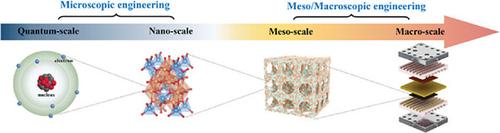
The past decade has seen significant progress in proton exchange membrane water electrolyzers (PEMWE), but the growing demand for cost-effective electrolytic hydrogen pushes for higher efficiency at lower costs. As a complex system, the performance of PEMWE is governed by a combination of multiscale factors. This review summarizes the latest progress from quantum to macroscopic scales. At the quantum level, electron spin configurations can be optimized to enhance catalytic activity. At the nano and meso scales, advancements in atomic structure optimization, crystal phase engineering, and heterostructure design improve catalytic performance and mass transport. At the macro scale, innovative techniques in gas bubble management and internal resistance reduction drive further efficiency gains under ampere-level operating conditions. These modifications at the quantum level cascade through meso- and macro-scales, affecting charge transfer, reaction kinetics, and gas evolution management. Unlike conventional approaches that focus solely on one scale—either at the catalyst level (e.g., atomic, or crystal modifications) or at the device level (e.g., porous transport layers design)—combining multiscale optimizations unlocks greater performance improvements. Finally, a perspective on future opportunities for multiscale engineering in PEMWE anode design toward commercial viability is offered.
期刊介绍:
Small serves as an exceptional platform for both experimental and theoretical studies in fundamental and applied interdisciplinary research at the nano- and microscale. The journal offers a compelling mix of peer-reviewed Research Articles, Reviews, Perspectives, and Comments.
With a remarkable 2022 Journal Impact Factor of 13.3 (Journal Citation Reports from Clarivate Analytics, 2023), Small remains among the top multidisciplinary journals, covering a wide range of topics at the interface of materials science, chemistry, physics, engineering, medicine, and biology.
Small's readership includes biochemists, biologists, biomedical scientists, chemists, engineers, information technologists, materials scientists, physicists, and theoreticians alike.



 京公网安备 11010802042870号
京ICP备2023020795号-1
京公网安备 11010802042870号
京ICP备2023020795号-1

 分享
分享
 求助内容:
求助内容: 应助结果提醒方式:
 扫码关注我们
