Nicolas Richard, Aurélien Amiot, Philippe Seksik, Romain Altwegg, David Laharie, Lucine Vuitton, Maria Nachury, Guillaume Bouguen, Stéphane Nancey, Cyrielle Gilletta, Cléa Rouilon, Benoît Coffin, Matthieu Allez, Anthony Buisson, Catherine Le Berre, Mathieu Uzzan, Ludovic Caillo, Anne-Laure Pelletier, Laurent Peyrin-Biroulet, Mathurin Fumery, GETAID
{"title":"Effectiveness and Safety of Upadacitinib Induction Therapy for 223 Patients With Crohn's Disease: A GETAID Multicentre Cohort Study","authors":"Nicolas Richard, Aurélien Amiot, Philippe Seksik, Romain Altwegg, David Laharie, Lucine Vuitton, Maria Nachury, Guillaume Bouguen, Stéphane Nancey, Cyrielle Gilletta, Cléa Rouilon, Benoît Coffin, Matthieu Allez, Anthony Buisson, Catherine Le Berre, Mathieu Uzzan, Ludovic Caillo, Anne-Laure Pelletier, Laurent Peyrin-Biroulet, Mathurin Fumery, GETAID","doi":"10.1111/apt.70073","DOIUrl":null,"url":null,"abstract":"<div>\n \n \n <section>\n \n <h3> Background</h3>\n \n <p>Real-world effectiveness and safety of upadacitinib in patients with Crohn's disease (CD) remain unclear.</p>\n </section>\n \n <section>\n \n <h3> Aims</h3>\n \n <p>This study aimed to evaluate the effectiveness and safety of upadacitinib in a real-world cohort.</p>\n </section>\n \n <section>\n \n <h3> Methods</h3>\n \n <p>From September 2022 to June 2024, all consecutive patients with refractory luminal CD treated with once daily upadacitinib 45 mg in 29 French GETAID centres were retrospectively included. The primary outcome was steroid-free clinical remission (SFCR) at week 12, defined as a Harvey–Bradshaw Index (HBI) of < 4. Clinical response (decrease of ≥ 3 points in HBI and/or HBI < 4), clinical remission, biomarker remission, endoscopic and/or radiologic response and safety were also assessed.</p>\n </section>\n \n <section>\n \n <h3> Results</h3>\n \n <p>Among the 223 patients included, all were previously exposed to at least one biologic (median 4, IQR [3, 4]) and 119 (53.8%) had prior intestinal resection. At week 12, SFCR was achieved in 107/197 (54%), clinical response in 129/197 (65%) and clinical remission in 111/197 (56%). A total of, 90 out of 173 (52%) achieved biomarker remission. Endoscopic and/or radiologic response was observed in 18/38 (47%) patients. Clinical response of extraintestinal manifestations was observed in 37/47 (79%) patients and clinical remission in 29/47 (62%). A total of, 65 adverse events (AEs) occurred in 58 patients (26%), including 17 serious AEs, 16 disease exacerbation and one case of colonic EBV-associated lymphoproliferative disorder. Acne was reported in 24/223 (11%) patients.</p>\n </section>\n \n <section>\n \n <h3> Conclusion</h3>\n \n <p>In this real-world cohort of highly refractory CD patients, upadacitinib induction resulted in a clinical response in about two-thirds of patients and in SFCR in half of the patients, with an acceptable safety profile.</p>\n </section>\n </div>","PeriodicalId":121,"journal":{"name":"Alimentary Pharmacology & Therapeutics","volume":"61 10","pages":"1662-1670"},"PeriodicalIF":6.7000,"publicationDate":"2025-03-04","publicationTypes":"Journal Article","fieldsOfStudy":null,"isOpenAccess":false,"openAccessPdf":"https://onlinelibrary.wiley.com/doi/epdf/10.1111/apt.70073","citationCount":"0","resultStr":null,"platform":"Semanticscholar","paperid":null,"PeriodicalName":"Alimentary Pharmacology & Therapeutics","FirstCategoryId":"3","ListUrlMain":"https://onlinelibrary.wiley.com/doi/10.1111/apt.70073","RegionNum":1,"RegionCategory":"医学","ArticlePicture":[],"TitleCN":null,"AbstractTextCN":null,"PMCID":null,"EPubDate":"","PubModel":"","JCR":"Q1","JCRName":"GASTROENTEROLOGY & HEPATOLOGY","Score":null,"Total":0}
引用次数: 0
Abstract
Background
Real-world effectiveness and safety of upadacitinib in patients with Crohn's disease (CD) remain unclear.
Aims
This study aimed to evaluate the effectiveness and safety of upadacitinib in a real-world cohort.
Methods
From September 2022 to June 2024, all consecutive patients with refractory luminal CD treated with once daily upadacitinib 45 mg in 29 French GETAID centres were retrospectively included. The primary outcome was steroid-free clinical remission (SFCR) at week 12, defined as a Harvey–Bradshaw Index (HBI) of < 4. Clinical response (decrease of ≥ 3 points in HBI and/or HBI < 4), clinical remission, biomarker remission, endoscopic and/or radiologic response and safety were also assessed.
Results
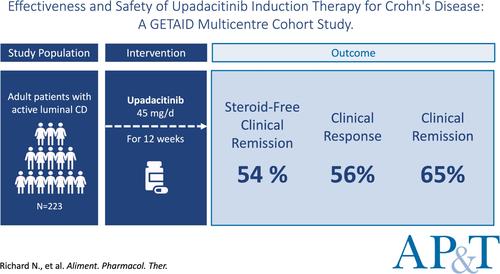
Among the 223 patients included, all were previously exposed to at least one biologic (median 4, IQR [3, 4]) and 119 (53.8%) had prior intestinal resection. At week 12, SFCR was achieved in 107/197 (54%), clinical response in 129/197 (65%) and clinical remission in 111/197 (56%). A total of, 90 out of 173 (52%) achieved biomarker remission. Endoscopic and/or radiologic response was observed in 18/38 (47%) patients. Clinical response of extraintestinal manifestations was observed in 37/47 (79%) patients and clinical remission in 29/47 (62%). A total of, 65 adverse events (AEs) occurred in 58 patients (26%), including 17 serious AEs, 16 disease exacerbation and one case of colonic EBV-associated lymphoproliferative disorder. Acne was reported in 24/223 (11%) patients.
Conclusion
In this real-world cohort of highly refractory CD patients, upadacitinib induction resulted in a clinical response in about two-thirds of patients and in SFCR in half of the patients, with an acceptable safety profile.
期刊介绍:
Alimentary Pharmacology & Therapeutics is a global pharmacology journal focused on the impact of drugs on the human gastrointestinal and hepato-biliary systems. It covers a diverse range of topics, often with immediate clinical relevance to its readership.




 京公网安备 11010802042870号
京ICP备2023020795号-1
京公网安备 11010802042870号
京ICP备2023020795号-1

 分享
分享
 求助内容:
求助内容: 应助结果提醒方式:
 扫码关注我们
