{"title":"Full polarization control of photons with evanescent wave coupling in the ultra subwavelength gap of photonic molecules","authors":"Rui Zhu, Chenjiang Qian, Shan Xiao, Jingnan Yang, Sai Yan, Hanqing Liu, Deyan Dai, Hancong Li, Longlong Yang, Xiqing Chen, Yu Yuan, Danjie Dai, Zhanchun Zuo, Haiqiao Ni, Zhichuan Niu, Can Wang, Kuijuan Jin, Qihuang Gong, Xiulai Xu","doi":"10.1038/s41377-025-01794-1","DOIUrl":null,"url":null,"abstract":"<p>Polarization of photons plays a key role in quantum optics and light-matter interactions, however, it is difficult to control in nanosystems since the eigenstate of a nanophotonic cavity is usually fixed and linearly polarized. Here, we reveal the polarization control of photons using photonic molecules (PMs) that host supermodes of two coupled nanobeam cavities. In contrast to conventional PMs in a 2D photonic crystal slab, for the two 1D photonic crystal nanobeam cavities the shift and gap between them can be tuned continuously. With an ultra subwavelength gap, the coupling between the two cavities is dominated by the evanescent wave coupling in the surrounding environment, rather not the emission wave coupling for conventional PMs. As such, the non-Hermiticity of the system becomes pronounced, and the supermodes consist of a non-trivial phase difference between bare eigenstates that supports elliptical polarization. We observe that both the polarization degree and polarization angle of the antisymmetric mode strongly depend on the shift and gap between the two cavities, exhibiting polarization states from linear to circular. This full polarization control indicates the great potential of PMs in quantum optical devices and spin-resolved cavity quantum electrodynamics.</p>","PeriodicalId":18069,"journal":{"name":"Light-Science & Applications","volume":"210 1","pages":""},"PeriodicalIF":23.4000,"publicationDate":"2025-03-05","publicationTypes":"Journal Article","fieldsOfStudy":null,"isOpenAccess":false,"openAccessPdf":"","citationCount":"0","resultStr":null,"platform":"Semanticscholar","paperid":null,"PeriodicalName":"Light-Science & Applications","FirstCategoryId":"1089","ListUrlMain":"https://doi.org/10.1038/s41377-025-01794-1","RegionNum":0,"RegionCategory":null,"ArticlePicture":[],"TitleCN":null,"AbstractTextCN":null,"PMCID":null,"EPubDate":"","PubModel":"","JCR":"Q1","JCRName":"OPTICS","Score":null,"Total":0}
引用次数: 0
Abstract
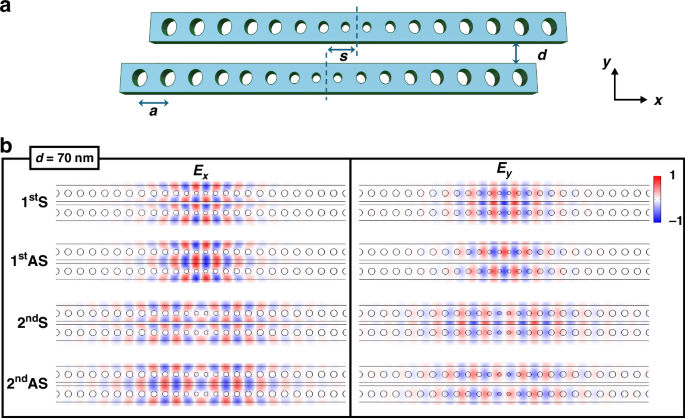
Polarization of photons plays a key role in quantum optics and light-matter interactions, however, it is difficult to control in nanosystems since the eigenstate of a nanophotonic cavity is usually fixed and linearly polarized. Here, we reveal the polarization control of photons using photonic molecules (PMs) that host supermodes of two coupled nanobeam cavities. In contrast to conventional PMs in a 2D photonic crystal slab, for the two 1D photonic crystal nanobeam cavities the shift and gap between them can be tuned continuously. With an ultra subwavelength gap, the coupling between the two cavities is dominated by the evanescent wave coupling in the surrounding environment, rather not the emission wave coupling for conventional PMs. As such, the non-Hermiticity of the system becomes pronounced, and the supermodes consist of a non-trivial phase difference between bare eigenstates that supports elliptical polarization. We observe that both the polarization degree and polarization angle of the antisymmetric mode strongly depend on the shift and gap between the two cavities, exhibiting polarization states from linear to circular. This full polarization control indicates the great potential of PMs in quantum optical devices and spin-resolved cavity quantum electrodynamics.




 京公网安备 11010802042870号
京ICP备2023020795号-1
京公网安备 11010802042870号
京ICP备2023020795号-1

 分享
分享
 求助内容:
求助内容: 应助结果提醒方式:
 扫码关注我们
