{"title":"Negative-Valent Platinum Stabilized by Pt─Ni Electron Bridges on Oxygen-Deficient NiFe-LDH for Enhanced Electrocatalytic Hydrogen Evolution","authors":"Shijie Shen, Qingao Li, Huanhuan Zhang, Dian Yang, Junjie Gong, Lin Gu, Tong Gao, Wenwu Zhong","doi":"10.1002/adma.202500595","DOIUrl":null,"url":null,"abstract":"<p>The unique hydrogen adsorption characteristics of negatively charged platinum play a crucial role in enhancing the electrocatalytic hydrogen evolution reaction. However, atomically dispersed Pt atoms are typically anchored to the support through non-metallic atom bonds, resulting in a high oxidation state. Here, atomically dispersed Pt atoms are anchored in oxygen-deficient NiFe-LDH. Electron transfer between Pt and NiFe-LDH occurs primarily through Pt─Ni bonds rather than the conventional Pt─O bonds. Oxygen vacancies in the NiFe-LDH promote additional electron transfer from Ni to Pt, thereby reducing the valence state of Pt and enhancing hydrogen adsorption. Meanwhile, the elevated valence state of Ni increases the catalyst's hydrophilicity and reduces the energy barrier for hydrolysis dissociation. This catalyst demonstrates remarkably low overpotentials of 4 and 9 mV at 10 mA cm<sup>−2</sup> in 1 <span>m</span> KOH and 1 <span>m</span> KPi, respectively. Additionally, its mass activity is 51.5 and 23.7 times higher that of Pt/C, respectively. This study presents a novel strategy for enhancing electrocatalytic performance through the rational design of coordination environments and electronic structures in supported metal catalysts.</p>","PeriodicalId":114,"journal":{"name":"Advanced Materials","volume":"37 15","pages":""},"PeriodicalIF":26.8000,"publicationDate":"2025-03-04","publicationTypes":"Journal Article","fieldsOfStudy":null,"isOpenAccess":false,"openAccessPdf":"","citationCount":"0","resultStr":null,"platform":"Semanticscholar","paperid":null,"PeriodicalName":"Advanced Materials","FirstCategoryId":"88","ListUrlMain":"https://advanced.onlinelibrary.wiley.com/doi/10.1002/adma.202500595","RegionNum":1,"RegionCategory":"材料科学","ArticlePicture":[],"TitleCN":null,"AbstractTextCN":null,"PMCID":null,"EPubDate":"","PubModel":"","JCR":"Q1","JCRName":"CHEMISTRY, MULTIDISCIPLINARY","Score":null,"Total":0}
引用次数: 0
Abstract
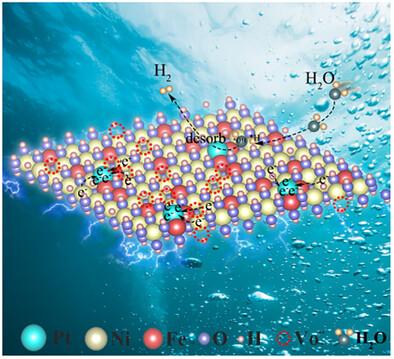
The unique hydrogen adsorption characteristics of negatively charged platinum play a crucial role in enhancing the electrocatalytic hydrogen evolution reaction. However, atomically dispersed Pt atoms are typically anchored to the support through non-metallic atom bonds, resulting in a high oxidation state. Here, atomically dispersed Pt atoms are anchored in oxygen-deficient NiFe-LDH. Electron transfer between Pt and NiFe-LDH occurs primarily through Pt─Ni bonds rather than the conventional Pt─O bonds. Oxygen vacancies in the NiFe-LDH promote additional electron transfer from Ni to Pt, thereby reducing the valence state of Pt and enhancing hydrogen adsorption. Meanwhile, the elevated valence state of Ni increases the catalyst's hydrophilicity and reduces the energy barrier for hydrolysis dissociation. This catalyst demonstrates remarkably low overpotentials of 4 and 9 mV at 10 mA cm−2 in 1 m KOH and 1 m KPi, respectively. Additionally, its mass activity is 51.5 and 23.7 times higher that of Pt/C, respectively. This study presents a novel strategy for enhancing electrocatalytic performance through the rational design of coordination environments and electronic structures in supported metal catalysts.
带负电铂特有的吸氢特性对电催化析氢反应的增强起着至关重要的作用。然而,原子分散的Pt原子通常通过非金属原子键固定在载体上,导致高氧化态。在这里,原子分散的Pt原子被锚定在缺氧的NiFe-LDH中。Pt和NiFe-LDH之间的电子转移主要通过Pt─Ni键而不是传统的Pt─O键进行。NiFe-LDH中的氧空位促进了从Ni到Pt的额外电子转移,从而降低了Pt的价态,增强了氢的吸附。同时,Ni价态的升高提高了催化剂的亲水性,降低了水解解离的能垒。该催化剂在1 m KOH和1 m KPi条件下,在10 mA cm−2下的过电位分别为4 mV和9 mV。其质量活度分别是Pt/C的51.5倍和23.7倍。本研究提出了一种通过合理设计负载型金属催化剂的配位环境和电子结构来提高电催化性能的新策略。
期刊介绍:
Advanced Materials, one of the world's most prestigious journals and the foundation of the Advanced portfolio, is the home of choice for best-in-class materials science for more than 30 years. Following this fast-growing and interdisciplinary field, we are considering and publishing the most important discoveries on any and all materials from materials scientists, chemists, physicists, engineers as well as health and life scientists and bringing you the latest results and trends in modern materials-related research every week.







 京公网安备 11010802042870号
京ICP备2023020795号-1
京公网安备 11010802042870号
京ICP备2023020795号-1

 分享
分享
 求助内容:
求助内容: 应助结果提醒方式:
 扫码关注我们
