{"title":"Structure exploration of gallium based on machine-learning potential","authors":"Yaochen Yu, Jiahui Fan, Yuefeng Lei, Haiyang Niu","doi":"10.1016/j.jmst.2024.12.080","DOIUrl":null,"url":null,"abstract":"Gallium, an elemental metal known for its distinctive thermal and electronic characteristics, holds significant importance across various industrial fields including semiconductors, biomedicine, and aerospace. When subjected to supercooling, gallium exhibits the ability to crystallize into multiple structures that are notably more intricate compared to those found in other metallic elements, emphasizing the complex nature of its configuration space. Despite ongoing research efforts, our comprehensive understanding of the configuration space of gallium remains incomplete. In this study, we utilize an active learning strategy to develop an accurate deep neural network (DNN) model with strong descriptive capabilities for gallium's entire configuration space. By integrating this DNN model with the evolutionary crystal structure prediction algorithm USPEX, we conduct an extensive exploration of gallium configurations within simulation cells containing up to 120 atoms. Through this approach, we successfully identify the experimentally observed phases of <em>α</em>-Ga, <em>β</em>-Ga, <em>γ</em>-Ga, <em>δ</em>-Ga, Ga-II and Ga-III. Additionally, we predict eight thermodynamically metastable structures, labeled as <em>mC</em>20, <em>oC</em>8(no.63), <em>mC</em>4, <em>oP</em>12, <em>tR</em>18, <em>tI</em>20, <em>oC</em>8(no.64), and <em>mC</em>12, with high potential of experimental verification. Of particular interest, we identify the true structure of <em>β</em>-Ga as having orthorhombic symmetry, in contrast to the widely accepted monoclini<em>c</em> structure. These findings offer new insights into gallium's configuration space, demonstrating the effectiveness of the crystal structure prediction method combined with DNN model in guiding the exploration of complex systems.","PeriodicalId":16154,"journal":{"name":"Journal of Materials Science & Technology","volume":"23 1","pages":""},"PeriodicalIF":14.3000,"publicationDate":"2025-03-04","publicationTypes":"Journal Article","fieldsOfStudy":null,"isOpenAccess":false,"openAccessPdf":"","citationCount":"0","resultStr":null,"platform":"Semanticscholar","paperid":null,"PeriodicalName":"Journal of Materials Science & Technology","FirstCategoryId":"88","ListUrlMain":"https://doi.org/10.1016/j.jmst.2024.12.080","RegionNum":1,"RegionCategory":"材料科学","ArticlePicture":[],"TitleCN":null,"AbstractTextCN":null,"PMCID":null,"EPubDate":"","PubModel":"","JCR":"Q1","JCRName":"MATERIALS SCIENCE, MULTIDISCIPLINARY","Score":null,"Total":0}
引用次数: 0
Abstract
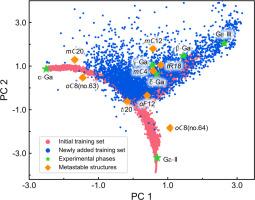
Gallium, an elemental metal known for its distinctive thermal and electronic characteristics, holds significant importance across various industrial fields including semiconductors, biomedicine, and aerospace. When subjected to supercooling, gallium exhibits the ability to crystallize into multiple structures that are notably more intricate compared to those found in other metallic elements, emphasizing the complex nature of its configuration space. Despite ongoing research efforts, our comprehensive understanding of the configuration space of gallium remains incomplete. In this study, we utilize an active learning strategy to develop an accurate deep neural network (DNN) model with strong descriptive capabilities for gallium's entire configuration space. By integrating this DNN model with the evolutionary crystal structure prediction algorithm USPEX, we conduct an extensive exploration of gallium configurations within simulation cells containing up to 120 atoms. Through this approach, we successfully identify the experimentally observed phases of α-Ga, β-Ga, γ-Ga, δ-Ga, Ga-II and Ga-III. Additionally, we predict eight thermodynamically metastable structures, labeled as mC20, oC8(no.63), mC4, oP12, tR18, tI20, oC8(no.64), and mC12, with high potential of experimental verification. Of particular interest, we identify the true structure of β-Ga as having orthorhombic symmetry, in contrast to the widely accepted monoclinic structure. These findings offer new insights into gallium's configuration space, demonstrating the effectiveness of the crystal structure prediction method combined with DNN model in guiding the exploration of complex systems.
期刊介绍:
Journal of Materials Science & Technology strives to promote global collaboration in the field of materials science and technology. It primarily publishes original research papers, invited review articles, letters, research notes, and summaries of scientific achievements. The journal covers a wide range of materials science and technology topics, including metallic materials, inorganic nonmetallic materials, and composite materials.



 京公网安备 11010802042870号
京ICP备2023020795号-1
京公网安备 11010802042870号
京ICP备2023020795号-1

 分享
分享
 求助内容:
求助内容: 应助结果提醒方式:
 扫码关注我们
