Xiaojian Feng , Xinyi Guo , Sen Pang , Mingcheng Guo , Yajie Chen
{"title":"Bioavailability assessment of propiconazole to Limnobium laevigatum and zebrafish (Danio rerio) in aquatic microcosms","authors":"Xiaojian Feng , Xinyi Guo , Sen Pang , Mingcheng Guo , Yajie Chen","doi":"10.1016/j.envpol.2025.126004","DOIUrl":null,"url":null,"abstract":"<div><div>Residues of the triazole fungicide propiconazole (PCZ) in the environment can easily enter aquatic ecosystems through various pathways and accumulate in sediments, thus threatening ecosystem stability. The method of using passive sampling techniques to measure the freely dissolved concentration (<em>C</em><sub>free</sub>) of pollutants in aquatic environments for assessing their bioavailability has been widely utilized in environmental risk assessments. This study employs oleic acid-embedded cellulose acetate membrane (OECAM) as a tool to determine the <em>C</em><sub>free</sub> of PCZ in water. By establishing sediment spiking concentrations of 0.1 and 0.5 mg/kg in an aquatic microcosm, the distribution and bioaccumulation of PCZ in zebrafish (<em>Danio rerio</em>) and the aquatic plant <em>Limnobium laevigatum</em> (<em>L. laevigatum)</em> were examined over a 7-day period. During the experimental period, the concentrations of PCZ in the water for the 0.1 mg/kg and 0.5 mg/kg treatment groups remained approximately 0.9 μg/L and 10.0 μg/L, respectively. After 7 days, the PCZ content in the sediments decreased by 22.74% and 14.94%, respectively. In both zebrafish and <em>L. laevigatum</em>, the concentration of PCZ initially increased and then gradually stabilized, with both species exhibiting moderate accumulation ability for PCZ. The bioconcentration factor (BCF) for zebrafish in the 0.1 mg/kg and 0.5 mg/kg treatment groups ranged from 9.25 to 13.96 and 7.84–16.05, respectively, while those for <em>L. laevigatum</em> ranged from 28.17 to 31.40 and 23.01–36.11, respectively. By the end of the 7-day experiment, the total PCZ content in both treatment groups decreased by an average of 17.51%. Among them, <em>L. laevigatum</em> contributed significantly, highlighting its potential in accelerating the removal of PCZ from aquatic ecosystems.</div></div>","PeriodicalId":311,"journal":{"name":"Environmental Pollution","volume":"372 ","pages":"Article 126004"},"PeriodicalIF":7.3000,"publicationDate":"2025-03-05","publicationTypes":"Journal Article","fieldsOfStudy":null,"isOpenAccess":false,"openAccessPdf":"","citationCount":"0","resultStr":null,"platform":"Semanticscholar","paperid":null,"PeriodicalName":"Environmental Pollution","FirstCategoryId":"93","ListUrlMain":"https://www.sciencedirect.com/science/article/pii/S026974912500377X","RegionNum":2,"RegionCategory":"环境科学与生态学","ArticlePicture":[],"TitleCN":null,"AbstractTextCN":null,"PMCID":null,"EPubDate":"","PubModel":"","JCR":"Q1","JCRName":"ENVIRONMENTAL SCIENCES","Score":null,"Total":0}
引用次数: 0
Abstract
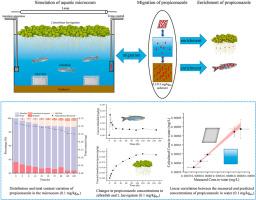
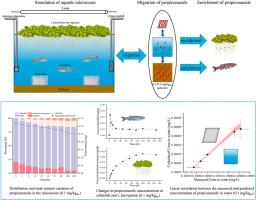
Residues of the triazole fungicide propiconazole (PCZ) in the environment can easily enter aquatic ecosystems through various pathways and accumulate in sediments, thus threatening ecosystem stability. The method of using passive sampling techniques to measure the freely dissolved concentration (Cfree) of pollutants in aquatic environments for assessing their bioavailability has been widely utilized in environmental risk assessments. This study employs oleic acid-embedded cellulose acetate membrane (OECAM) as a tool to determine the Cfree of PCZ in water. By establishing sediment spiking concentrations of 0.1 and 0.5 mg/kg in an aquatic microcosm, the distribution and bioaccumulation of PCZ in zebrafish (Danio rerio) and the aquatic plant Limnobium laevigatum (L. laevigatum) were examined over a 7-day period. During the experimental period, the concentrations of PCZ in the water for the 0.1 mg/kg and 0.5 mg/kg treatment groups remained approximately 0.9 μg/L and 10.0 μg/L, respectively. After 7 days, the PCZ content in the sediments decreased by 22.74% and 14.94%, respectively. In both zebrafish and L. laevigatum, the concentration of PCZ initially increased and then gradually stabilized, with both species exhibiting moderate accumulation ability for PCZ. The bioconcentration factor (BCF) for zebrafish in the 0.1 mg/kg and 0.5 mg/kg treatment groups ranged from 9.25 to 13.96 and 7.84–16.05, respectively, while those for L. laevigatum ranged from 28.17 to 31.40 and 23.01–36.11, respectively. By the end of the 7-day experiment, the total PCZ content in both treatment groups decreased by an average of 17.51%. Among them, L. laevigatum contributed significantly, highlighting its potential in accelerating the removal of PCZ from aquatic ecosystems.
期刊介绍:
Environmental Pollution is an international peer-reviewed journal that publishes high-quality research papers and review articles covering all aspects of environmental pollution and its impacts on ecosystems and human health.
Subject areas include, but are not limited to:
• Sources and occurrences of pollutants that are clearly defined and measured in environmental compartments, food and food-related items, and human bodies;
• Interlinks between contaminant exposure and biological, ecological, and human health effects, including those of climate change;
• Contaminants of emerging concerns (including but not limited to antibiotic resistant microorganisms or genes, microplastics/nanoplastics, electronic wastes, light, and noise) and/or their biological, ecological, or human health effects;
• Laboratory and field studies on the remediation/mitigation of environmental pollution via new techniques and with clear links to biological, ecological, or human health effects;
• Modeling of pollution processes, patterns, or trends that is of clear environmental and/or human health interest;
• New techniques that measure and examine environmental occurrences, transport, behavior, and effects of pollutants within the environment or the laboratory, provided that they can be clearly used to address problems within regional or global environmental compartments.



 京公网安备 11010802042870号
京ICP备2023020795号-1
京公网安备 11010802042870号
京ICP备2023020795号-1

 分享
分享
 求助内容:
求助内容: 应助结果提醒方式:
 扫码关注我们
