Zhuang Cui , Yukai Xiong , Yang Liu , Ying Zeng , Manping Liu , Xiaochun Liu , Zhuoran Zeng , Xu Zhang , Shiwei Xu
{"title":"Lowering creep rate in Mg-Zn-Ca magnesium alloy with hierarchical distribution of phases","authors":"Zhuang Cui , Yukai Xiong , Yang Liu , Ying Zeng , Manping Liu , Xiaochun Liu , Zhuoran Zeng , Xu Zhang , Shiwei Xu","doi":"10.1016/j.ijplas.2025.104295","DOIUrl":null,"url":null,"abstract":"<div><div>The improvement of creep resistance remains an important challenge for engineering applications of magnesium (Mg) alloys at elevated temperatures. Based on the experimental investigations and crystal plastic finite element method (CPFEM), the creep deformation mechanisms of the AC3 (Mg-5Al-3Ca) and ZC1 (Mg-5Zn-1Ca) alloys (both in wt.%) were proposed separately in this study. The results indicate that the ZC1 alloy with lower content of Ca and hierarchical distribution of strengthening phases exhibits superior creep resistance compared to the AC3 alloy. This superiority of ZC1 alloy is attributed to the low mechanical incompatibility between the skeleton Ca<sub>2</sub>Mg<sub>6</sub>Zn<sub>3</sub> phases and the α-Mg matrix, as well as the presence of small dispersed particles in the grain interior surrounded by stable skeleton phases. The interconnectedness of the skeleton intermetallic phase affects the creep resistance of Mg alloys. During the creep process of the AC3 alloy, local stress concentration led to the cracking of the hard skeleton Al<sub>2</sub>Ca phase, grain boundaries (GBs) sliding, and grain coarsening/rotating, resulting in large creep rate. In the ZC1 alloy, the skeleton Ca<sub>2</sub>Mg<sub>6</sub>Zn<sub>3</sub> phases distributed along the GBs act as barriers to GB sliding. In addition, the particle precipitates inside the grains which have an orientation relationship with the α-Mg matrix can additionally strengthen the matrix, effectively preventing the motion of basal 〈a〉 dislocations. The findings of this study provide a strategy to design high creep-resistant Mg alloys by synergistic effect of the stable skeleton phase and dispersed particle phase.</div></div>","PeriodicalId":340,"journal":{"name":"International Journal of Plasticity","volume":"188 ","pages":"Article 104295"},"PeriodicalIF":12.8000,"publicationDate":"2025-05-01","publicationTypes":"Journal Article","fieldsOfStudy":null,"isOpenAccess":false,"openAccessPdf":"","citationCount":"0","resultStr":null,"platform":"Semanticscholar","paperid":null,"PeriodicalName":"International Journal of Plasticity","FirstCategoryId":"88","ListUrlMain":"https://www.sciencedirect.com/science/article/pii/S0749641925000543","RegionNum":1,"RegionCategory":"材料科学","ArticlePicture":[],"TitleCN":null,"AbstractTextCN":null,"PMCID":null,"EPubDate":"2025/3/5 0:00:00","PubModel":"Epub","JCR":"Q1","JCRName":"ENGINEERING, MECHANICAL","Score":null,"Total":0}
引用次数: 0
Abstract
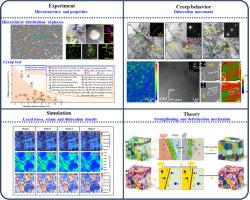
The improvement of creep resistance remains an important challenge for engineering applications of magnesium (Mg) alloys at elevated temperatures. Based on the experimental investigations and crystal plastic finite element method (CPFEM), the creep deformation mechanisms of the AC3 (Mg-5Al-3Ca) and ZC1 (Mg-5Zn-1Ca) alloys (both in wt.%) were proposed separately in this study. The results indicate that the ZC1 alloy with lower content of Ca and hierarchical distribution of strengthening phases exhibits superior creep resistance compared to the AC3 alloy. This superiority of ZC1 alloy is attributed to the low mechanical incompatibility between the skeleton Ca2Mg6Zn3 phases and the α-Mg matrix, as well as the presence of small dispersed particles in the grain interior surrounded by stable skeleton phases. The interconnectedness of the skeleton intermetallic phase affects the creep resistance of Mg alloys. During the creep process of the AC3 alloy, local stress concentration led to the cracking of the hard skeleton Al2Ca phase, grain boundaries (GBs) sliding, and grain coarsening/rotating, resulting in large creep rate. In the ZC1 alloy, the skeleton Ca2Mg6Zn3 phases distributed along the GBs act as barriers to GB sliding. In addition, the particle precipitates inside the grains which have an orientation relationship with the α-Mg matrix can additionally strengthen the matrix, effectively preventing the motion of basal 〈a〉 dislocations. The findings of this study provide a strategy to design high creep-resistant Mg alloys by synergistic effect of the stable skeleton phase and dispersed particle phase.
期刊介绍:
International Journal of Plasticity aims to present original research encompassing all facets of plastic deformation, damage, and fracture behavior in both isotropic and anisotropic solids. This includes exploring the thermodynamics of plasticity and fracture, continuum theory, and macroscopic as well as microscopic phenomena.
Topics of interest span the plastic behavior of single crystals and polycrystalline metals, ceramics, rocks, soils, composites, nanocrystalline and microelectronics materials, shape memory alloys, ferroelectric ceramics, thin films, and polymers. Additionally, the journal covers plasticity aspects of failure and fracture mechanics. Contributions involving significant experimental, numerical, or theoretical advancements that enhance the understanding of the plastic behavior of solids are particularly valued. Papers addressing the modeling of finite nonlinear elastic deformation, bearing similarities to the modeling of plastic deformation, are also welcomed.





 京公网安备 11010802042870号
京ICP备2023020795号-1
京公网安备 11010802042870号
京ICP备2023020795号-1

 分享
分享
 求助内容:
求助内容: 应助结果提醒方式:
 扫码关注我们
