{"title":"High-Adhesive Hydrogel-Based Strain Sensor in the Clinical Diagnosis of Anterior Talofibular Ligament Sprain","authors":"Wenjun Wang, , , Guanbo Min, , , Xufeng Jiao, , , Wang Tingyu, , , Chengyu Li, , , Kun Xu, , , Xuanli Dong, , , Jiaxuan Wu, , , Feng Qu, , , Weiguo Wang, , , YuSheng Li, , , Cheng Huang*, , , Wei Tang*, , and , Bo Meng*, ","doi":"10.1021/acssensors.4c03472","DOIUrl":null,"url":null,"abstract":"<p >Anterior talofibular ligament (ATFL) sprain is one of the most prevalent sports-related injuries, so proper evaluation of ligament sprains is critical for treatment options. However, existing tests suffer from a lack of standardized quantitative evaluation criteria, interindividual variability, incompatible materials, or risks of infection. Although advanced medical diagnostic methods already have been using noninvasive, portable, and wearable diagnostic electronics, these devices have insufficient adhesion to accurately respond to internal body injuries. Therefore, we propose a high-adhesive hydrogel-based strain sensor made from gelatin, cellulose nanofiber (CNF), and cross-linked poly(acrylic acid) grafted with <i>N</i>-hydrosuccinimide ester. The adhesive strain sensor, with excellent conformability and stretchability, firmly adheres to the skin, making it suitable for accurately evaluating the severity of anterior talofibular ligament sprain. Its strong adhesive (up to 192 kPa) can adapt to the surface characterization of ankles. The high-adhesive hydrogel-based strain sensor has a high tensile strength (680%) and achieves a high gauge factor (GF) of 8.29. Simultaneously, it also presents a 40 μm ultralow detection limit. Additionally, after a deep learning model was integrated to improve sensing accuracy, the system achieved a diagnostic accuracy of 95%, significantly surpassing the magnetic resonance imaging (MRI) gold standard of 81.1%.</p>","PeriodicalId":24,"journal":{"name":"ACS Sensors","volume":"10 9","pages":"6415–6425"},"PeriodicalIF":9.1000,"publicationDate":"2025-03-05","publicationTypes":"Journal Article","fieldsOfStudy":null,"isOpenAccess":false,"openAccessPdf":"","citationCount":"0","resultStr":null,"platform":"Semanticscholar","paperid":null,"PeriodicalName":"ACS Sensors","FirstCategoryId":"92","ListUrlMain":"https://pubs.acs.org/doi/10.1021/acssensors.4c03472","RegionNum":1,"RegionCategory":"化学","ArticlePicture":[],"TitleCN":null,"AbstractTextCN":null,"PMCID":null,"EPubDate":"","PubModel":"","JCR":"Q1","JCRName":"CHEMISTRY, ANALYTICAL","Score":null,"Total":0}
引用次数: 0
Abstract
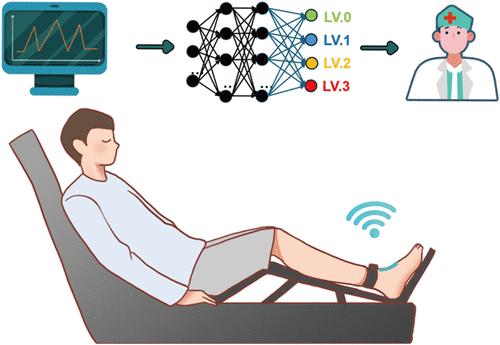
Anterior talofibular ligament (ATFL) sprain is one of the most prevalent sports-related injuries, so proper evaluation of ligament sprains is critical for treatment options. However, existing tests suffer from a lack of standardized quantitative evaluation criteria, interindividual variability, incompatible materials, or risks of infection. Although advanced medical diagnostic methods already have been using noninvasive, portable, and wearable diagnostic electronics, these devices have insufficient adhesion to accurately respond to internal body injuries. Therefore, we propose a high-adhesive hydrogel-based strain sensor made from gelatin, cellulose nanofiber (CNF), and cross-linked poly(acrylic acid) grafted with N-hydrosuccinimide ester. The adhesive strain sensor, with excellent conformability and stretchability, firmly adheres to the skin, making it suitable for accurately evaluating the severity of anterior talofibular ligament sprain. Its strong adhesive (up to 192 kPa) can adapt to the surface characterization of ankles. The high-adhesive hydrogel-based strain sensor has a high tensile strength (680%) and achieves a high gauge factor (GF) of 8.29. Simultaneously, it also presents a 40 μm ultralow detection limit. Additionally, after a deep learning model was integrated to improve sensing accuracy, the system achieved a diagnostic accuracy of 95%, significantly surpassing the magnetic resonance imaging (MRI) gold standard of 81.1%.
期刊介绍:
ACS Sensors is a peer-reviewed research journal that focuses on the dissemination of new and original knowledge in the field of sensor science, particularly those that selectively sense chemical or biological species or processes. The journal covers a broad range of topics, including but not limited to biosensors, chemical sensors, gas sensors, intracellular sensors, single molecule sensors, cell chips, and microfluidic devices. It aims to publish articles that address conceptual advances in sensing technology applicable to various types of analytes or application papers that report on the use of existing sensing concepts in new ways or for new analytes.




 京公网安备 11010802042870号
京ICP备2023020795号-1
京公网安备 11010802042870号
京ICP备2023020795号-1

 分享
分享
 求助内容:
求助内容: 应助结果提醒方式:
 扫码关注我们
