{"title":"Confining asymmetric water hydrogen-bond network to boost photoreduction of CO2 to formaldehyde","authors":"Minzhi Ma, Shuaikang Zhang, Mengge Jia, Tongqing Li, Jinshuo Chen, Shichu Zhao, Suxiang Ge, Zhi Zheng, Sixin Wu, Wenjun Fa","doi":"10.1016/j.cej.2025.161232","DOIUrl":null,"url":null,"abstract":"Overall photocatalytic CO<sub>2</sub> reduction with H<sub>2</sub>O to value-added HCHO is a promising route to achieve the carbon neutrality goal. However, the efficiency of the CO<sub>2</sub> reduction half-reaction is constrained by the structural configuration of the hydrogen bond network of water on the catalyst surface, because it controls the H<sub>2</sub>O dissociation half-reaction that was deemed as the rate-determining step in the overall CO<sub>2</sub> reduction reaction. Herein, we propose a novel concept of confining an asymmetric water hydrogen-bond network to enhance H<sub>2</sub>O dissociation, thereby providing protons for CO<sub>2</sub> reduction and significantly increasing the rate of HCHO formation. As a demonstration of feasibility, sulfur-doped graphite carbon nitride (g-C<sub>3</sub>N<sub>4</sub>-S) was successfully prepared as the desired prototype photocatalyst. We unravel that −SO<sub>x</sub> species on g-C<sub>3</sub>N<sub>4</sub>-S photocatalyst enhance the adsorption concentration of CO<sub>2</sub> and *CO intermediate by promoting the adsorption of H<sub>2</sub>O. More importantly, −SO<sub>x</sub> species boosts the dissociative adsorption of H<sub>2</sub>O due to altering the symmetric water hydrogen bonding network on the interface into a confining asymmetric one, thereby accelerating the activation and conversion of CO<sub>2</sub> adsorbed on the catalyst surface. As a result, the production of HCHO over the g-C<sub>3</sub>N<sub>4</sub>-S (180.9 μmol) has increased 2.5 times compared to the pristine g-C<sub>3</sub>N<sub>4</sub> (72.9 μmol). The novel approach of enhancing CO<sub>2</sub> photoreduction efficiency by regulating the water hydrogen-bond network structure at the interface offers a promising avenue for advancing CO<sub>2</sub> conversion efficiency.","PeriodicalId":270,"journal":{"name":"Chemical Engineering Journal","volume":"53 1","pages":""},"PeriodicalIF":12.5000,"publicationDate":"2025-03-04","publicationTypes":"Journal Article","fieldsOfStudy":null,"isOpenAccess":false,"openAccessPdf":"","citationCount":"0","resultStr":null,"platform":"Semanticscholar","paperid":null,"PeriodicalName":"Chemical Engineering Journal","FirstCategoryId":"5","ListUrlMain":"https://doi.org/10.1016/j.cej.2025.161232","RegionNum":1,"RegionCategory":"工程技术","ArticlePicture":[],"TitleCN":null,"AbstractTextCN":null,"PMCID":null,"EPubDate":"","PubModel":"","JCR":"Q1","JCRName":"ENGINEERING, CHEMICAL","Score":null,"Total":0}
引用次数: 0
Abstract
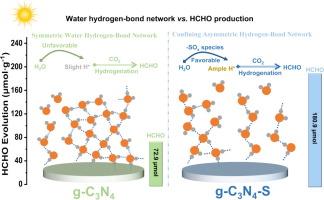
Overall photocatalytic CO2 reduction with H2O to value-added HCHO is a promising route to achieve the carbon neutrality goal. However, the efficiency of the CO2 reduction half-reaction is constrained by the structural configuration of the hydrogen bond network of water on the catalyst surface, because it controls the H2O dissociation half-reaction that was deemed as the rate-determining step in the overall CO2 reduction reaction. Herein, we propose a novel concept of confining an asymmetric water hydrogen-bond network to enhance H2O dissociation, thereby providing protons for CO2 reduction and significantly increasing the rate of HCHO formation. As a demonstration of feasibility, sulfur-doped graphite carbon nitride (g-C3N4-S) was successfully prepared as the desired prototype photocatalyst. We unravel that −SOx species on g-C3N4-S photocatalyst enhance the adsorption concentration of CO2 and *CO intermediate by promoting the adsorption of H2O. More importantly, −SOx species boosts the dissociative adsorption of H2O due to altering the symmetric water hydrogen bonding network on the interface into a confining asymmetric one, thereby accelerating the activation and conversion of CO2 adsorbed on the catalyst surface. As a result, the production of HCHO over the g-C3N4-S (180.9 μmol) has increased 2.5 times compared to the pristine g-C3N4 (72.9 μmol). The novel approach of enhancing CO2 photoreduction efficiency by regulating the water hydrogen-bond network structure at the interface offers a promising avenue for advancing CO2 conversion efficiency.
期刊介绍:
The Chemical Engineering Journal is an international research journal that invites contributions of original and novel fundamental research. It aims to provide an international platform for presenting original fundamental research, interpretative reviews, and discussions on new developments in chemical engineering. The journal welcomes papers that describe novel theory and its practical application, as well as those that demonstrate the transfer of techniques from other disciplines. It also welcomes reports on carefully conducted experimental work that is soundly interpreted. The main focus of the journal is on original and rigorous research results that have broad significance. The Catalysis section within the Chemical Engineering Journal focuses specifically on Experimental and Theoretical studies in the fields of heterogeneous catalysis, molecular catalysis, and biocatalysis. These studies have industrial impact on various sectors such as chemicals, energy, materials, foods, healthcare, and environmental protection.




 京公网安备 11010802042870号
京ICP备2023020795号-1
京公网安备 11010802042870号
京ICP备2023020795号-1

 分享
分享
 求助内容:
求助内容: 应助结果提醒方式:
 扫码关注我们
