{"title":"Multifactorial interaction and influence of culture conditions on yellow fluorescent protein production in Phaeodactylum tricornutum","authors":"Arun Augustine , Anis Messaabi , Elisa Fantino , Natacha Merindol , Fatma Meddeb-Mouelhi , Isabel Desgagné-Penix","doi":"10.1016/j.biortech.2025.132336","DOIUrl":null,"url":null,"abstract":"<div><div><em>Phaeodactylum tricornutum</em> is a promising host for light-driven synthesis of heterologous proteins. However, the marine cold-water environment and alkaline-acidic pH shifts in the culture, necessitated by the diatom’s growth requirements. In this study, we analyzed the influence of growth condition on maturation and dynamics of the yellow fluorescent protein (YFP) in episomal-transformant <em>P. tricornutum</em>. A mathematical model was developed to detect the parameters that affect biomass and YFP production. Optimized conditions increased YFP mean fluorescence intensity (MFI) per cell by 4.2-fold (3.6 ± 0.6 to 15.4 ± 1.1) and total protein levels in the culture by 1.8-fold (123 ± 4 to 219 ± 9 µg L<sup>−1</sup>), without affecting biomass. YFP stability studies in P. tricornutum showed that the ubiquitin–proteasome system contributes the degradation of the recombinant protein, whereas newly synthesized YFP remains stable for up to 12 h. This optimization provides insights into the fluorescent protein-based heterologous production in diatoms.</div></div>","PeriodicalId":258,"journal":{"name":"Bioresource Technology","volume":"425 ","pages":"Article 132336"},"PeriodicalIF":9.0000,"publicationDate":"2025-06-01","publicationTypes":"Journal Article","fieldsOfStudy":null,"isOpenAccess":false,"openAccessPdf":"","citationCount":"0","resultStr":null,"platform":"Semanticscholar","paperid":null,"PeriodicalName":"Bioresource Technology","FirstCategoryId":"5","ListUrlMain":"https://www.sciencedirect.com/science/article/pii/S0960852425003025","RegionNum":1,"RegionCategory":"环境科学与生态学","ArticlePicture":[],"TitleCN":null,"AbstractTextCN":null,"PMCID":null,"EPubDate":"2025/3/3 0:00:00","PubModel":"Epub","JCR":"Q1","JCRName":"AGRICULTURAL ENGINEERING","Score":null,"Total":0}
引用次数: 0
Abstract
Phaeodactylum tricornutum is a promising host for light-driven synthesis of heterologous proteins. However, the marine cold-water environment and alkaline-acidic pH shifts in the culture, necessitated by the diatom’s growth requirements. In this study, we analyzed the influence of growth condition on maturation and dynamics of the yellow fluorescent protein (YFP) in episomal-transformant P. tricornutum. A mathematical model was developed to detect the parameters that affect biomass and YFP production. Optimized conditions increased YFP mean fluorescence intensity (MFI) per cell by 4.2-fold (3.6 ± 0.6 to 15.4 ± 1.1) and total protein levels in the culture by 1.8-fold (123 ± 4 to 219 ± 9 µg L−1), without affecting biomass. YFP stability studies in P. tricornutum showed that the ubiquitin–proteasome system contributes the degradation of the recombinant protein, whereas newly synthesized YFP remains stable for up to 12 h. This optimization provides insights into the fluorescent protein-based heterologous production in diatoms.
三角褐指藻是一种很有前途的光驱动合成异源蛋白的宿主。然而,由于硅藻的生长需要,海水冷水环境和酸碱pH值在培养过程中发生了变化。在本研究中,我们分析了生长条件对episomal- transformation P. tricornutum黄色荧光蛋白(YFP)成熟和动态的影响。建立了一个数学模型来检测影响生物量和YFP产量的参数。优化后的条件使每个细胞的YFP平均荧光强度(MFI)提高4.2倍(3.6±0.6至15.4±1.1),培养物中总蛋白水平提高1.8倍(123±4至219±9µg L−1),而生物量不受影响。三角藻中YFP的稳定性研究表明,泛素-蛋白酶体系统有助于重组蛋白的降解,而新合成的YFP在12小时内保持稳定。这一优化为硅藻中基于异源生产荧光蛋白提供了新的见解。
期刊介绍:
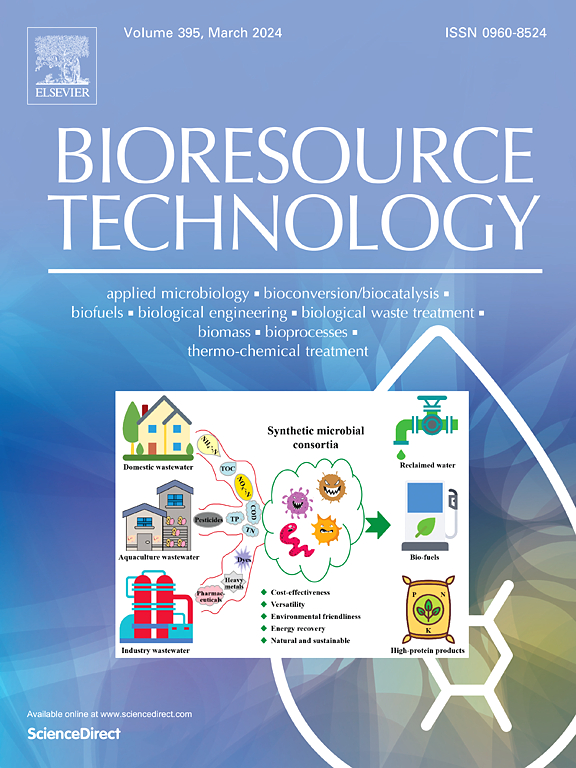
Bioresource Technology publishes original articles, review articles, case studies, and short communications covering the fundamentals, applications, and management of bioresource technology. The journal seeks to advance and disseminate knowledge across various areas related to biomass, biological waste treatment, bioenergy, biotransformations, bioresource systems analysis, and associated conversion or production technologies.
Topics include:
• Biofuels: liquid and gaseous biofuels production, modeling and economics
• Bioprocesses and bioproducts: biocatalysis and fermentations
• Biomass and feedstocks utilization: bioconversion of agro-industrial residues
• Environmental protection: biological waste treatment
• Thermochemical conversion of biomass: combustion, pyrolysis, gasification, catalysis.




 京公网安备 11010802042870号
京ICP备2023020795号-1
京公网安备 11010802042870号
京ICP备2023020795号-1

 分享
分享
 求助内容:
求助内容: 应助结果提醒方式:
 扫码关注我们
