Chen Qu , Zhuoran Zhang , Ning Liu , Zixuan Zhao , Zhongbao Guo , Jinhua Liu , Jiemin Liu , Chuandong Wu
{"title":"Adhesive-emitted odorants detection using an electronic nose: Unraveling algorithm applicability with controlled dataset characteristics","authors":"Chen Qu , Zhuoran Zhang , Ning Liu , Zixuan Zhao , Zhongbao Guo , Jinhua Liu , Jiemin Liu , Chuandong Wu","doi":"10.1016/j.microc.2025.113220","DOIUrl":null,"url":null,"abstract":"<div><div>Electronic nose technology is becoming increasingly important in pollution monitoring; however, the inappropriate selection of pattern recognition algorithms may lead to performance decreases. In this study, an electronic nose was developed for the qualitative classification of adhesives and quantitative detection of adhesive-emitted odorant concentrations. Meanwhile, the applicability of commonly used pattern recognition algorithms (support vector regression, partial least squares regression, artificial neural network (ANN), random forest regression (RFR), ridge regression, and Lasso regression) to datasets with controlled volumes and interference intensities was investigated by comparing their quantitative performance. In qualitative analysis, the support vector machine with polynomial nonlinear kernel and random forest achieved 100% accurate classification of 11 adhesive samples. In quantitative analysis, RFR demonstrated good generalization ability and interference insensitivity, with a mean absolute percentage error (MAPE) below 3% in the large-volume strongly interfering dataset and less than 25% in the small-volume strongly interfering dataset. While ANN showed certain data volume dependence and interference sensitivity. For dataset with small volume and weak interference, algorithms with simple structures could achieve accurate quantification (MAPE of 10%). Moreover, the algorithm applicability was validated on homologous datasets and the effectiveness of cluster analysis to remove outliers was discussed.</div></div>","PeriodicalId":391,"journal":{"name":"Microchemical Journal","volume":"212 ","pages":"Article 113220"},"PeriodicalIF":4.9000,"publicationDate":"2025-05-01","publicationTypes":"Journal Article","fieldsOfStudy":null,"isOpenAccess":false,"openAccessPdf":"","citationCount":"0","resultStr":null,"platform":"Semanticscholar","paperid":null,"PeriodicalName":"Microchemical Journal","FirstCategoryId":"92","ListUrlMain":"https://www.sciencedirect.com/science/article/pii/S0026265X25005740","RegionNum":2,"RegionCategory":"化学","ArticlePicture":[],"TitleCN":null,"AbstractTextCN":null,"PMCID":null,"EPubDate":"2025/3/2 0:00:00","PubModel":"Epub","JCR":"Q1","JCRName":"CHEMISTRY, ANALYTICAL","Score":null,"Total":0}
引用次数: 0
Abstract
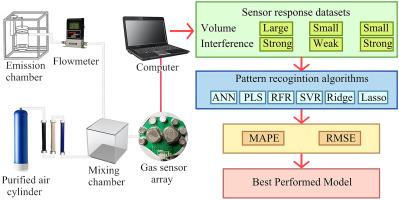
Electronic nose technology is becoming increasingly important in pollution monitoring; however, the inappropriate selection of pattern recognition algorithms may lead to performance decreases. In this study, an electronic nose was developed for the qualitative classification of adhesives and quantitative detection of adhesive-emitted odorant concentrations. Meanwhile, the applicability of commonly used pattern recognition algorithms (support vector regression, partial least squares regression, artificial neural network (ANN), random forest regression (RFR), ridge regression, and Lasso regression) to datasets with controlled volumes and interference intensities was investigated by comparing their quantitative performance. In qualitative analysis, the support vector machine with polynomial nonlinear kernel and random forest achieved 100% accurate classification of 11 adhesive samples. In quantitative analysis, RFR demonstrated good generalization ability and interference insensitivity, with a mean absolute percentage error (MAPE) below 3% in the large-volume strongly interfering dataset and less than 25% in the small-volume strongly interfering dataset. While ANN showed certain data volume dependence and interference sensitivity. For dataset with small volume and weak interference, algorithms with simple structures could achieve accurate quantification (MAPE of 10%). Moreover, the algorithm applicability was validated on homologous datasets and the effectiveness of cluster analysis to remove outliers was discussed.
期刊介绍:
The Microchemical Journal is a peer reviewed journal devoted to all aspects and phases of analytical chemistry and chemical analysis. The Microchemical Journal publishes articles which are at the forefront of modern analytical chemistry and cover innovations in the techniques to the finest possible limits. This includes fundamental aspects, instrumentation, new developments, innovative and novel methods and applications including environmental and clinical field.
Traditional classical analytical methods such as spectrophotometry and titrimetry as well as established instrumentation methods such as flame and graphite furnace atomic absorption spectrometry, gas chromatography, and modified glassy or carbon electrode electrochemical methods will be considered, provided they show significant improvements and novelty compared to the established methods.




 京公网安备 11010802042870号
京ICP备2023020795号-1
京公网安备 11010802042870号
京ICP备2023020795号-1

 分享
分享
 求助内容:
求助内容: 应助结果提醒方式:
 扫码关注我们
