Timon Meier , Vasileios Korakis , Brian W. Blankenship , Haotian Lu , Eudokia Kyriakou , Savvas Papamakarios , Zacharias Vangelatos , M. Erden Yildizdag , Gordon Zyla , Xiaoxing Xia , Xiaoyu Zheng , Yoonsoo Rho , Maria Farsari , Costas P. Grigoropoulos
{"title":"Scalable phononic metamaterials: Tunable bandgap design and multi-scale experimental validation","authors":"Timon Meier , Vasileios Korakis , Brian W. Blankenship , Haotian Lu , Eudokia Kyriakou , Savvas Papamakarios , Zacharias Vangelatos , M. Erden Yildizdag , Gordon Zyla , Xiaoxing Xia , Xiaoyu Zheng , Yoonsoo Rho , Maria Farsari , Costas P. Grigoropoulos","doi":"10.1016/j.matdes.2025.113778","DOIUrl":null,"url":null,"abstract":"<div><div>Phononic metamaterials offer unprecedented control over wave propagation, making them essential for applications such as vibration isolation, waveguiding, and acoustic filtering. However, achieving scalable and precisely tunable bandgap properties across different length scales remains challenging. This study presents a user-friendly design framework for phononic metamaterials, enabling ultra-wide bandgap tunability (<em>B/</em><span><math><msub><mi>ω</mi><mi>c</mi></msub></math></span> ratios up to 172 %) across multiple frequency ranges and scales. Using finite element simulations of a Yablonovite-inspired unit cell, we establish a comprehensive parametric design space that illustrates how geometric parameters, such as sphere size and beam diameter, controls bandgap width and frequency. The scalability and robustness of the framework are validated through experimental testing on additively manufactured structures at both macro (10 mm) and micro (80 µm) scales, fabricated using Stereolithography and Two-Photon Polymerization. Transmission loss measurements, conducted with piezoelectric transducers and laser vibrometry, closely match simulations in the kHz and MHz frequency ranges, confirming the reliability and consistency of the bandgap behavior across scales. This work bridges theory and experiments at multiple scales, offering a practical methodology for the rapid design of phononic metamaterials and expanding their potential for diverse applications across a broad range of frequencies.</div></div>","PeriodicalId":383,"journal":{"name":"Materials & Design","volume":"252 ","pages":"Article 113778"},"PeriodicalIF":7.9000,"publicationDate":"2025-03-02","publicationTypes":"Journal Article","fieldsOfStudy":null,"isOpenAccess":false,"openAccessPdf":"","citationCount":"0","resultStr":null,"platform":"Semanticscholar","paperid":null,"PeriodicalName":"Materials & Design","FirstCategoryId":"88","ListUrlMain":"https://www.sciencedirect.com/science/article/pii/S0264127525001984","RegionNum":2,"RegionCategory":"材料科学","ArticlePicture":[],"TitleCN":null,"AbstractTextCN":null,"PMCID":null,"EPubDate":"","PubModel":"","JCR":"Q1","JCRName":"MATERIALS SCIENCE, MULTIDISCIPLINARY","Score":null,"Total":0}
引用次数: 0
Abstract
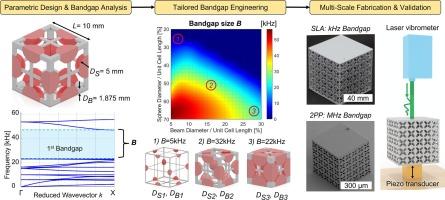
Phononic metamaterials offer unprecedented control over wave propagation, making them essential for applications such as vibration isolation, waveguiding, and acoustic filtering. However, achieving scalable and precisely tunable bandgap properties across different length scales remains challenging. This study presents a user-friendly design framework for phononic metamaterials, enabling ultra-wide bandgap tunability (B/ ratios up to 172 %) across multiple frequency ranges and scales. Using finite element simulations of a Yablonovite-inspired unit cell, we establish a comprehensive parametric design space that illustrates how geometric parameters, such as sphere size and beam diameter, controls bandgap width and frequency. The scalability and robustness of the framework are validated through experimental testing on additively manufactured structures at both macro (10 mm) and micro (80 µm) scales, fabricated using Stereolithography and Two-Photon Polymerization. Transmission loss measurements, conducted with piezoelectric transducers and laser vibrometry, closely match simulations in the kHz and MHz frequency ranges, confirming the reliability and consistency of the bandgap behavior across scales. This work bridges theory and experiments at multiple scales, offering a practical methodology for the rapid design of phononic metamaterials and expanding their potential for diverse applications across a broad range of frequencies.
期刊介绍:
Materials and Design is a multi-disciplinary journal that publishes original research reports, review articles, and express communications. The journal focuses on studying the structure and properties of inorganic and organic materials, advancements in synthesis, processing, characterization, and testing, the design of materials and engineering systems, and their applications in technology. It aims to bring together various aspects of materials science, engineering, physics, and chemistry.
The journal explores themes ranging from materials to design and aims to reveal the connections between natural and artificial materials, as well as experiment and modeling. Manuscripts submitted to Materials and Design should contain elements of discovery and surprise, as they often contribute new insights into the architecture and function of matter.



 京公网安备 11010802042870号
京ICP备2023020795号-1
京公网安备 11010802042870号
京ICP备2023020795号-1

 分享
分享
 求助内容:
求助内容: 应助结果提醒方式:
 扫码关注我们
