Wengang Bu , Pengfei He , Jiamao Hao , Rong Wang , Zhenfeng Hu , Jinyong Mo , Xiubing Liang
{"title":"Achieving superior mechanical properties by regulating nano-phases in cast Al-Li alloys: Experimental and simulation","authors":"Wengang Bu , Pengfei He , Jiamao Hao , Rong Wang , Zhenfeng Hu , Jinyong Mo , Xiubing Liang","doi":"10.1016/j.matdes.2025.113782","DOIUrl":null,"url":null,"abstract":"<div><div>Due to the outstanding advantages such as low density, high modulus, and high damage tolerance, cast Al-Li alloys are highly promising metallic materials for load-bearing applications in the coming decades. However, compared to their wrought counterparts, the mechanical properties of these alloys, particularly the ductility, are still unsatisfactory, which severely limits their further applications. Here, we report that the mechanical properties of cast Al-Li alloys can be significantly improved by regulating various nano-phases during aging. Results show that the introduction of 0.2 wt% Zr in the Al-2Li-2Cu-0.5 Mg alloy contributes to grain refinement by providing a large number of primary Al<sub>3</sub>Zr particles acting as ideal heterogeneous nucleation sites for the α-Al matrix. During subsequent aging, Al<sub>3</sub>Li tends to nucleate and grow on the Al<sub>3</sub>Zr surface to reduce the interfacial energy and form a nano-complex with a core–shell structure in 0.2Zr alloy. Then, the Al<sub>3</sub>Li shell can serve as an effective nucleation site for the T<sub>1</sub> and θʹ phases. Density functional theory (DFT) calculations indicate that nucleation of T<sub>1</sub> and θʹ on the Al<sub>3</sub>Li shell reduces the interfacial energy, which promotes their uniform precipitation. In this case, unique Al<sub>3</sub>(Zr, Li) particles and higher density of finer T<sub>1</sub> and θʹ phases provide a substantial Orowan strengthening effect, alleviating the stress concentration. In addition, grain refinement improves the coordination of plastic deformation in 0.2Zr alloys. As a result, the ductility of 0.2Zr alloy increases from 3.6 % to 7.1 % compared to the Base alloy, accompanied by a 66 MPa increase in ultimate tensile strength. This work is expected to offer a new engineering approach to designing high-performance cast Al-Li alloy components with broad application prospects.</div></div>","PeriodicalId":383,"journal":{"name":"Materials & Design","volume":"252 ","pages":"Article 113782"},"PeriodicalIF":7.9000,"publicationDate":"2025-04-01","publicationTypes":"Journal Article","fieldsOfStudy":null,"isOpenAccess":false,"openAccessPdf":"","citationCount":"0","resultStr":null,"platform":"Semanticscholar","paperid":null,"PeriodicalName":"Materials & Design","FirstCategoryId":"88","ListUrlMain":"https://www.sciencedirect.com/science/article/pii/S0264127525002023","RegionNum":2,"RegionCategory":"材料科学","ArticlePicture":[],"TitleCN":null,"AbstractTextCN":null,"PMCID":null,"EPubDate":"2025/3/2 0:00:00","PubModel":"Epub","JCR":"Q1","JCRName":"MATERIALS SCIENCE, MULTIDISCIPLINARY","Score":null,"Total":0}
引用次数: 0
Abstract
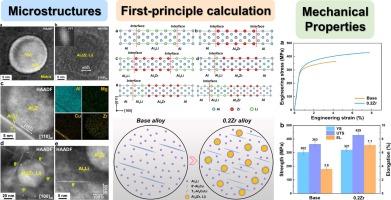
Due to the outstanding advantages such as low density, high modulus, and high damage tolerance, cast Al-Li alloys are highly promising metallic materials for load-bearing applications in the coming decades. However, compared to their wrought counterparts, the mechanical properties of these alloys, particularly the ductility, are still unsatisfactory, which severely limits their further applications. Here, we report that the mechanical properties of cast Al-Li alloys can be significantly improved by regulating various nano-phases during aging. Results show that the introduction of 0.2 wt% Zr in the Al-2Li-2Cu-0.5 Mg alloy contributes to grain refinement by providing a large number of primary Al3Zr particles acting as ideal heterogeneous nucleation sites for the α-Al matrix. During subsequent aging, Al3Li tends to nucleate and grow on the Al3Zr surface to reduce the interfacial energy and form a nano-complex with a core–shell structure in 0.2Zr alloy. Then, the Al3Li shell can serve as an effective nucleation site for the T1 and θʹ phases. Density functional theory (DFT) calculations indicate that nucleation of T1 and θʹ on the Al3Li shell reduces the interfacial energy, which promotes their uniform precipitation. In this case, unique Al3(Zr, Li) particles and higher density of finer T1 and θʹ phases provide a substantial Orowan strengthening effect, alleviating the stress concentration. In addition, grain refinement improves the coordination of plastic deformation in 0.2Zr alloys. As a result, the ductility of 0.2Zr alloy increases from 3.6 % to 7.1 % compared to the Base alloy, accompanied by a 66 MPa increase in ultimate tensile strength. This work is expected to offer a new engineering approach to designing high-performance cast Al-Li alloy components with broad application prospects.
期刊介绍:
Materials and Design is a multi-disciplinary journal that publishes original research reports, review articles, and express communications. The journal focuses on studying the structure and properties of inorganic and organic materials, advancements in synthesis, processing, characterization, and testing, the design of materials and engineering systems, and their applications in technology. It aims to bring together various aspects of materials science, engineering, physics, and chemistry.
The journal explores themes ranging from materials to design and aims to reveal the connections between natural and artificial materials, as well as experiment and modeling. Manuscripts submitted to Materials and Design should contain elements of discovery and surprise, as they often contribute new insights into the architecture and function of matter.




 京公网安备 11010802042870号
京ICP备2023020795号-1
京公网安备 11010802042870号
京ICP备2023020795号-1

 分享
分享
 求助内容:
求助内容: 应助结果提醒方式:
 扫码关注我们
