S. Sudheer Khan , J.P. Steffy , M. Swedha , Asad Syed , Abdallah M. Elgorban , Islem Abid , Ling Shing Wong
{"title":"Topotactic synthesis of shape-tuned MoS2 nanorods as self-template interfacial ensemble-induced catalysis towards degradation of organic pollutants","authors":"S. Sudheer Khan , J.P. Steffy , M. Swedha , Asad Syed , Abdallah M. Elgorban , Islem Abid , Ling Shing Wong","doi":"10.1016/j.matchemphys.2025.130556","DOIUrl":null,"url":null,"abstract":"<div><div>The extensive use of synthetic dyes in the textile industry has resulted in significant water contamination, prompting the need for effective remediation strategies. Rhodamine B (Rh B), a persistent dye known for its stability and toxicity, poses environmental and human health risks. In response, this study investigates catalytic degradation as a promising solution, with MoS<sub>2</sub> nanoparticles demonstrating exceptional performance. Synthesized MoS<sub>2</sub> nanorods with a porous structure were analyzed using scanning electron microscopy and high-resolution transmission electron microscopy, and its enhanced catalytic activity for the degradation of Rh B. X-ray diffraction confirms the hexagonal crystalline structure of MoS<sub>2</sub>, while X-ray photoelectron spectroscopy (XPS) reveals its Mo<sup>4+</sup> oxidation state, contributing to its catalytic activity. Catalytic degradation experiments reveal MoS<sub>2</sub>'s superior catalytic efficiency and it was determined to be 96.8 % in 45 min. Recyclability studies affirm MoS<sub>2</sub>'s stability over six cycles, indicating its practical applicability for wastewater treatment. The intermediates formed were identified with the help of GC/MS analysis and elucidates the Rh B degradation pathway. ECOSAR analysis further supports the environmental benefits of catalytic degradation, showing the conversion of Rh B into less harmful compounds. The intermediates formed were non-toxic to algae, daphnia and fish. The novelty lies on the remarkable catalytic efficiency of porous MoS<sub>2</sub> nanorods in degrading persistent synthetic dyes like Rh B, offering a sustainable solution for textile wastewater treatment. Their excellent recyclability and minimal environmental impact make them a promising candidate for addressing water contamination challenges. By converting harmful dyes into non-toxic compounds, MoS<sub>2</sub> paves the way for more eco-friendly and efficient remediation strategies in industries relying on synthetic dyes.</div></div>","PeriodicalId":18227,"journal":{"name":"Materials Chemistry and Physics","volume":"337 ","pages":"Article 130556"},"PeriodicalIF":4.7000,"publicationDate":"2025-03-04","publicationTypes":"Journal Article","fieldsOfStudy":null,"isOpenAccess":false,"openAccessPdf":"","citationCount":"0","resultStr":null,"platform":"Semanticscholar","paperid":null,"PeriodicalName":"Materials Chemistry and Physics","FirstCategoryId":"88","ListUrlMain":"https://www.sciencedirect.com/science/article/pii/S0254058425002020","RegionNum":3,"RegionCategory":"材料科学","ArticlePicture":[],"TitleCN":null,"AbstractTextCN":null,"PMCID":null,"EPubDate":"","PubModel":"","JCR":"Q2","JCRName":"MATERIALS SCIENCE, MULTIDISCIPLINARY","Score":null,"Total":0}
引用次数: 0
Abstract
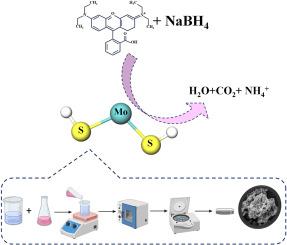
The extensive use of synthetic dyes in the textile industry has resulted in significant water contamination, prompting the need for effective remediation strategies. Rhodamine B (Rh B), a persistent dye known for its stability and toxicity, poses environmental and human health risks. In response, this study investigates catalytic degradation as a promising solution, with MoS2 nanoparticles demonstrating exceptional performance. Synthesized MoS2 nanorods with a porous structure were analyzed using scanning electron microscopy and high-resolution transmission electron microscopy, and its enhanced catalytic activity for the degradation of Rh B. X-ray diffraction confirms the hexagonal crystalline structure of MoS2, while X-ray photoelectron spectroscopy (XPS) reveals its Mo4+ oxidation state, contributing to its catalytic activity. Catalytic degradation experiments reveal MoS2's superior catalytic efficiency and it was determined to be 96.8 % in 45 min. Recyclability studies affirm MoS2's stability over six cycles, indicating its practical applicability for wastewater treatment. The intermediates formed were identified with the help of GC/MS analysis and elucidates the Rh B degradation pathway. ECOSAR analysis further supports the environmental benefits of catalytic degradation, showing the conversion of Rh B into less harmful compounds. The intermediates formed were non-toxic to algae, daphnia and fish. The novelty lies on the remarkable catalytic efficiency of porous MoS2 nanorods in degrading persistent synthetic dyes like Rh B, offering a sustainable solution for textile wastewater treatment. Their excellent recyclability and minimal environmental impact make them a promising candidate for addressing water contamination challenges. By converting harmful dyes into non-toxic compounds, MoS2 paves the way for more eco-friendly and efficient remediation strategies in industries relying on synthetic dyes.
期刊介绍:
Materials Chemistry and Physics is devoted to short communications, full-length research papers and feature articles on interrelationships among structure, properties, processing and performance of materials. The Editors welcome manuscripts on thin films, surface and interface science, materials degradation and reliability, metallurgy, semiconductors and optoelectronic materials, fine ceramics, magnetics, superconductors, specialty polymers, nano-materials and composite materials.



 京公网安备 11010802042870号
京ICP备2023020795号-1
京公网安备 11010802042870号
京ICP备2023020795号-1

 分享
分享
 求助内容:
求助内容: 应助结果提醒方式:
 扫码关注我们
