Laura Arroyo-Esquivel , Víctor M. Jiménez , Fabián Vásquez , Patricia Esquivel
{"title":"Plasticizers improved flexibility, homogeneity, and color stability in pitahaya (Hylocereus sp.) peel-based biopolymer films aimed at food packaging","authors":"Laura Arroyo-Esquivel , Víctor M. Jiménez , Fabián Vásquez , Patricia Esquivel","doi":"10.1016/j.indcrop.2025.120757","DOIUrl":null,"url":null,"abstract":"<div><div>The growing demand for sustainable food packaging materials has driven the exploration of novel biopolymer sources. This study aimed to develop biopolymer films (Bfs) from pitahaya (<em>Hylocereus</em> sp.) peels using three plasticizers (glycerol, sorbitol, and ethylene glycol) at three concentrations (0.05, 0.06, and 0.07 mol/L) via the casting method. The Bfs were characterized for their performance, stability, and potential applications at two time points (day 1 and day 30). The films were homogeneous, fracture-free, and exhibited a color range from brown to light brown, with thickness between 0.087 and 0.175 mm. Solubility tests showed the highest water solubility in sorbitol (59 %) and glycerol (56 %) Bfs, compared with the control (43 %) and ethylene glycol (37 %). Films with ethylene glycol exhibited the lowest solubility in both acidic (36 %) and basic (19 %) conditions. Moisture content was about 22 % across all treatments. Bfs containing plasticizers exhibited elongation between 11.9 % and 14.2 %, whereas control Bfs showed an elongation of 5.1 %. The lowest water vapor permeability was observed in the control Bfs (2.431 µg s<sup>−1</sup> m<sup>−2</sup> Pa<sup>−1</sup>), while glycerol-supplemented Bfs had the highest (3.938 µg s<sup>−1</sup> m<sup>−2</sup> Pa<sup>−1</sup>). Thermal analysis indicated a constant glass transition temperature of 62.4°C, a melting temperature of 131°C, and a melting enthalpy of 241.6 J g<sup>−1</sup>, with no differences between treatments. X-ray diffraction identified peaks at 2θ = 14° and 32° (pectin) and 2θ = 22° (lignocellulose). These results highlight the potential of pitahaya peel-based Bfs as sustainable materials for food packaging applications.</div></div>","PeriodicalId":13581,"journal":{"name":"Industrial Crops and Products","volume":"227 ","pages":"Article 120757"},"PeriodicalIF":6.2000,"publicationDate":"2025-03-05","publicationTypes":"Journal Article","fieldsOfStudy":null,"isOpenAccess":false,"openAccessPdf":"","citationCount":"0","resultStr":null,"platform":"Semanticscholar","paperid":null,"PeriodicalName":"Industrial Crops and Products","FirstCategoryId":"97","ListUrlMain":"https://www.sciencedirect.com/science/article/pii/S0926669025003036","RegionNum":1,"RegionCategory":"农林科学","ArticlePicture":[],"TitleCN":null,"AbstractTextCN":null,"PMCID":null,"EPubDate":"","PubModel":"","JCR":"Q1","JCRName":"AGRICULTURAL ENGINEERING","Score":null,"Total":0}
引用次数: 0
Abstract
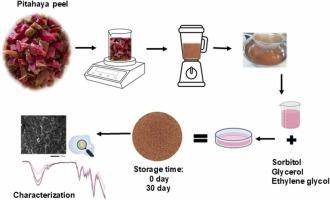
The growing demand for sustainable food packaging materials has driven the exploration of novel biopolymer sources. This study aimed to develop biopolymer films (Bfs) from pitahaya (Hylocereus sp.) peels using three plasticizers (glycerol, sorbitol, and ethylene glycol) at three concentrations (0.05, 0.06, and 0.07 mol/L) via the casting method. The Bfs were characterized for their performance, stability, and potential applications at two time points (day 1 and day 30). The films were homogeneous, fracture-free, and exhibited a color range from brown to light brown, with thickness between 0.087 and 0.175 mm. Solubility tests showed the highest water solubility in sorbitol (59 %) and glycerol (56 %) Bfs, compared with the control (43 %) and ethylene glycol (37 %). Films with ethylene glycol exhibited the lowest solubility in both acidic (36 %) and basic (19 %) conditions. Moisture content was about 22 % across all treatments. Bfs containing plasticizers exhibited elongation between 11.9 % and 14.2 %, whereas control Bfs showed an elongation of 5.1 %. The lowest water vapor permeability was observed in the control Bfs (2.431 µg s−1 m−2 Pa−1), while glycerol-supplemented Bfs had the highest (3.938 µg s−1 m−2 Pa−1). Thermal analysis indicated a constant glass transition temperature of 62.4°C, a melting temperature of 131°C, and a melting enthalpy of 241.6 J g−1, with no differences between treatments. X-ray diffraction identified peaks at 2θ = 14° and 32° (pectin) and 2θ = 22° (lignocellulose). These results highlight the potential of pitahaya peel-based Bfs as sustainable materials for food packaging applications.
期刊介绍:
Industrial Crops and Products is an International Journal publishing academic and industrial research on industrial (defined as non-food/non-feed) crops and products. Papers concern both crop-oriented and bio-based materials from crops-oriented research, and should be of interest to an international audience, hypothesis driven, and where comparisons are made statistics performed.



 京公网安备 11010802042870号
京ICP备2023020795号-1
京公网安备 11010802042870号
京ICP备2023020795号-1

 分享
分享
 求助内容:
求助内容: 应助结果提醒方式:
 扫码关注我们
