Enhancing biofuel production with Co-pyrolysis of distiller's grains and waste polypropylene: synergistic effects and activation energy optimization with hybrid FLO-ENN approach
{"title":"Enhancing biofuel production with Co-pyrolysis of distiller's grains and waste polypropylene: synergistic effects and activation energy optimization with hybrid FLO-ENN approach","authors":"Nivedita Patel","doi":"10.1016/j.cep.2025.110194","DOIUrl":null,"url":null,"abstract":"<div><div>Biofuel production from renewable feedstocks is gaining significant attention due to the growing demand for sustainable energy solutions. This study proposes enhancing biofuel production through the co-pyrolysis of distiller's grains (DG) and waste polypropylene plastic (PP) using a hybrid FLO-ENN approach. The proposed approach is the joint execution of both the Frilled lizard Optimization (FLO) and Epistemic Neural Network (ENN). The main goal of this research is to improve the quality of biofuel production. The FLO algorithm is used to optimize the operational parameters to enhance the co-pyrolysis of DG and waste PP, while the ENN is employed to predict the quality of the biofuel. The proposed method is simulated using MATLAB to evaluate its performances and is compared with existing methods. The FLO-ENN approach achieves lower error as well as higher efficiency compared to existing techniques such as Particle Swarm Optimization (PSO), Progressive Depth Swarm-Evolution (PDSE) and Artificial Neural Network-Genetic Algorithm (ANN-GA). Also, the co-pyrolisis of DG and PP yields low activation energy of 44.82 kJ mol-1. This improvement demonstrates that the proposed framework has significant potential to optimize the pyrolysis of polymeric wastes and biomass feedstocks more effectively, providing more accurate results than previous optimization techniques.</div></div>","PeriodicalId":9929,"journal":{"name":"Chemical Engineering and Processing - Process Intensification","volume":"212 ","pages":"Article 110194"},"PeriodicalIF":3.9000,"publicationDate":"2025-01-30","publicationTypes":"Journal Article","fieldsOfStudy":null,"isOpenAccess":false,"openAccessPdf":"","citationCount":"0","resultStr":null,"platform":"Semanticscholar","paperid":null,"PeriodicalName":"Chemical Engineering and Processing - Process Intensification","FirstCategoryId":"5","ListUrlMain":"https://www.sciencedirect.com/science/article/pii/S0255270125000443","RegionNum":3,"RegionCategory":"工程技术","ArticlePicture":[],"TitleCN":null,"AbstractTextCN":null,"PMCID":null,"EPubDate":"","PubModel":"","JCR":"Q3","JCRName":"ENERGY & FUELS","Score":null,"Total":0}
引用次数: 0
Abstract
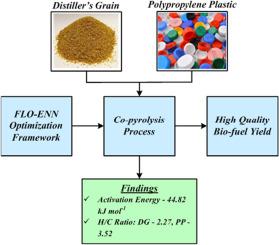
Biofuel production from renewable feedstocks is gaining significant attention due to the growing demand for sustainable energy solutions. This study proposes enhancing biofuel production through the co-pyrolysis of distiller's grains (DG) and waste polypropylene plastic (PP) using a hybrid FLO-ENN approach. The proposed approach is the joint execution of both the Frilled lizard Optimization (FLO) and Epistemic Neural Network (ENN). The main goal of this research is to improve the quality of biofuel production. The FLO algorithm is used to optimize the operational parameters to enhance the co-pyrolysis of DG and waste PP, while the ENN is employed to predict the quality of the biofuel. The proposed method is simulated using MATLAB to evaluate its performances and is compared with existing methods. The FLO-ENN approach achieves lower error as well as higher efficiency compared to existing techniques such as Particle Swarm Optimization (PSO), Progressive Depth Swarm-Evolution (PDSE) and Artificial Neural Network-Genetic Algorithm (ANN-GA). Also, the co-pyrolisis of DG and PP yields low activation energy of 44.82 kJ mol-1. This improvement demonstrates that the proposed framework has significant potential to optimize the pyrolysis of polymeric wastes and biomass feedstocks more effectively, providing more accurate results than previous optimization techniques.
期刊介绍:
Chemical Engineering and Processing: Process Intensification is intended for practicing researchers in industry and academia, working in the field of Process Engineering and related to the subject of Process Intensification.Articles published in the Journal demonstrate how novel discoveries, developments and theories in the field of Process Engineering and in particular Process Intensification may be used for analysis and design of innovative equipment and processing methods with substantially improved sustainability, efficiency and environmental performance.



 京公网安备 11010802042870号
京ICP备2023020795号-1
京公网安备 11010802042870号
京ICP备2023020795号-1

 分享
分享
 求助内容:
求助内容: 应助结果提醒方式:
 扫码关注我们
