J.L. Clabel H., K.T. Paula, Filipe A. Couto, G. Lozano C., M.P. da Silva, E. Marega Jr., Valmor R. Mastelaro, Cleber R. Mendonça
{"title":"Optical waveguides and work function modification in perovskite particles embedded tellurium-zinc glass for photonic applications","authors":"J.L. Clabel H., K.T. Paula, Filipe A. Couto, G. Lozano C., M.P. da Silva, E. Marega Jr., Valmor R. Mastelaro, Cleber R. Mendonça","doi":"10.1016/j.optlastec.2025.112680","DOIUrl":null,"url":null,"abstract":"<div><div>In recent years, tellurium-zinc glass and perovskite structures have gained significant attention in advancing the field of integrated optics. This research explores the integration of tellurium-zinc glass (TZ) and perovskite BaTiO3 tri-doped Er/Yb/Zn embedded in tellurium-zinc glass (TZ-NP), aiming to enhance the functionality of nonlinear optical (NLO) materials for applications involving integrated optical systems. Pure TZ and TZ-NP were fabricated to address these issues, improving their chemical and thermal stability. Chemical surface and internal structure analyses were conducted using X-ray Photoelectron Spectroscopy (XPS) and High-resolution Transmission Electron Microscopy (HR-TEM). The study also focuses on optimizing femtosecond laser (fs-laser) direct writing for creating microstructured waveguides in TZ-NP glass with low propagation loss. An end-face coupling experimental setup measured the waveguide near-field mode intensity. Kelvin Probe Force Microscopy (KPFM) was also used to assess the electrical properties crucial for photovoltaic devices. The possibility of a 14-fold increase in surface potential providing a highly homogeneous response using the KPFM compared to the pure TZ glass has been shown. The propagation loss was reduced to 1.35 dB/cm in optical waveguides of TZ-NP without introducing additional scattering. It has been demonstrated that embedding perovskite particles in glass significantly improves the response of optical and electric properties through enhanced light-matter interactions, potentially leading to the development of optical waveguide components and photovoltaic devices for photonics.</div></div>","PeriodicalId":19511,"journal":{"name":"Optics and Laser Technology","volume":"186 ","pages":"Article 112680"},"PeriodicalIF":5.0000,"publicationDate":"2025-03-04","publicationTypes":"Journal Article","fieldsOfStudy":null,"isOpenAccess":false,"openAccessPdf":"","citationCount":"0","resultStr":null,"platform":"Semanticscholar","paperid":null,"PeriodicalName":"Optics and Laser Technology","FirstCategoryId":"101","ListUrlMain":"https://www.sciencedirect.com/science/article/pii/S0030399225002683","RegionNum":2,"RegionCategory":"物理与天体物理","ArticlePicture":[],"TitleCN":null,"AbstractTextCN":null,"PMCID":null,"EPubDate":"","PubModel":"","JCR":"Q1","JCRName":"OPTICS","Score":null,"Total":0}
引用次数: 0
Abstract
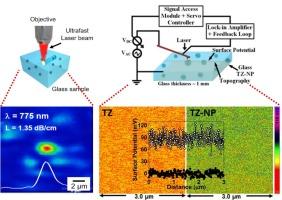
In recent years, tellurium-zinc glass and perovskite structures have gained significant attention in advancing the field of integrated optics. This research explores the integration of tellurium-zinc glass (TZ) and perovskite BaTiO3 tri-doped Er/Yb/Zn embedded in tellurium-zinc glass (TZ-NP), aiming to enhance the functionality of nonlinear optical (NLO) materials for applications involving integrated optical systems. Pure TZ and TZ-NP were fabricated to address these issues, improving their chemical and thermal stability. Chemical surface and internal structure analyses were conducted using X-ray Photoelectron Spectroscopy (XPS) and High-resolution Transmission Electron Microscopy (HR-TEM). The study also focuses on optimizing femtosecond laser (fs-laser) direct writing for creating microstructured waveguides in TZ-NP glass with low propagation loss. An end-face coupling experimental setup measured the waveguide near-field mode intensity. Kelvin Probe Force Microscopy (KPFM) was also used to assess the electrical properties crucial for photovoltaic devices. The possibility of a 14-fold increase in surface potential providing a highly homogeneous response using the KPFM compared to the pure TZ glass has been shown. The propagation loss was reduced to 1.35 dB/cm in optical waveguides of TZ-NP without introducing additional scattering. It has been demonstrated that embedding perovskite particles in glass significantly improves the response of optical and electric properties through enhanced light-matter interactions, potentially leading to the development of optical waveguide components and photovoltaic devices for photonics.
期刊介绍:
Optics & Laser Technology aims to provide a vehicle for the publication of a broad range of high quality research and review papers in those fields of scientific and engineering research appertaining to the development and application of the technology of optics and lasers. Papers describing original work in these areas are submitted to rigorous refereeing prior to acceptance for publication.
The scope of Optics & Laser Technology encompasses, but is not restricted to, the following areas:
•development in all types of lasers
•developments in optoelectronic devices and photonics
•developments in new photonics and optical concepts
•developments in conventional optics, optical instruments and components
•techniques of optical metrology, including interferometry and optical fibre sensors
•LIDAR and other non-contact optical measurement techniques, including optical methods in heat and fluid flow
•applications of lasers to materials processing, optical NDT display (including holography) and optical communication
•research and development in the field of laser safety including studies of hazards resulting from the applications of lasers (laser safety, hazards of laser fume)
•developments in optical computing and optical information processing
•developments in new optical materials
•developments in new optical characterization methods and techniques
•developments in quantum optics
•developments in light assisted micro and nanofabrication methods and techniques
•developments in nanophotonics and biophotonics
•developments in imaging processing and systems



 京公网安备 11010802042870号
京ICP备2023020795号-1
京公网安备 11010802042870号
京ICP备2023020795号-1

 分享
分享
 求助内容:
求助内容: 应助结果提醒方式:
 扫码关注我们
